

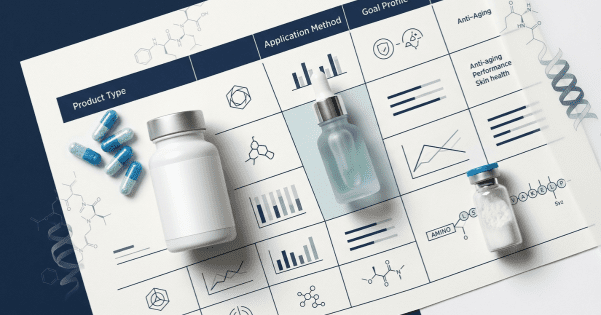
Here’s the cheat sheet, organized the way you’d actually use it. Pick your goal, read across, and you’ll see what’s been studied for it, how it’s sold, and whether you can buy it at all. Route and legal status are the two columns that decide everything, so they sit next to every peptide name instead of getting buried in a footnote.
Most peptide cheat sheets on the internet are dosing charts. They assume you’ve already decided to inject something. This one starts a step earlier, at the point where you’re still choosing.
Key Takeaways

The Short Version
Peptides sort into seven goal buckets, and inside each one the deciding question is the format: capsule, topical, prescription, or research vial.
A capsule label prints milligrams per serving, while a lyophilized vial prints the total powder in the vial, so the same number means two different things.
Short peptides of two or three amino acids are the ones that survive digestion well enough to work in capsule form, which is why the oral peptide market clusters around them.
Judge any peptide product by four things: the named form, the printed amount per serving, an independent purity result, and storage instructions that match the format.

Peptides by Goal: The Cheat Sheet
Each table below covers one goal, with the route you’ll actually find that compound in and its status in the United States. Nothing here is a dosing protocol, and the research-use-only compounds deliberately carry no amounts at all.
Reading the status column takes two seconds and saves a lot of wasted shopping. “Supplement” means you can buy it and take it. “Prescription” means a clinician decides. “Research use only” means it goes to laboratories, is not intended for human use, and is not something BioLongevity Supplements carries.
FREE PDF
Download the Free Peptide Cheat Sheet PDF
Save the printable guide to compare peptides by goal, check their forms, and make sense of the labels.
Gut health and gut barrier
The gut is the one goal where oral delivery is the stronger route rather than the compromise, because the target tissue is the digestive tract itself.
| Peptide | Studied for | Route you’ll find | Status | Evidence so far |
|---|---|---|---|---|
| BPC-157 | Gut lining integrity, soft tissue signaling | Oral capsule, research vial | Capsule sold as a supplement; vials are research use only | Extensive animal work, no completed Phase II trial |
| KPV | Calming intestinal inflammatory signaling | Oral capsule | Supplement | Animal colitis models |
| Larazotide (and N-acetyl larazotide) | Tight junction regulation | Oral | Investigational drug; the N-acetyl form appears in supplements | Animal and human celiac trials |
| Zinc L-carnosine | Gastric and intestinal mucosal support | Oral capsule | Supplement | Small human crossover trial |
| Tributyrin | Delivering butyrate to colon cells | Oral capsule | Supplement | Animal and human microbiome research |
BPC-157 is the unusual one. A 2026 biopharmaceutical review notes it shows unusual stability in gastric juice and activity through oral, injected and topical routes, while also stating plainly that no approved formulation or validated dosing regimen exists. That combination is why you see it in capsules and in research vials at the same time.
KPV is three amino acids long, and in two mouse models of colitis it reduced inflammatory infiltrates and helped animals regain weight. Zinc L-carnosine has the tidier human data: in a small randomized crossover trial, it prevented the roughly threefold rise in gut permeability that five days of indomethacin otherwise caused. Larazotide works on the tight junctions themselves, and in injured intestinal tissue it improved barrier recovery and the positioning of the sealing protein claudin-4.
Skin, hair, and visible aging
Skin is the goal where topical delivery competes on equal terms, since the peptide can reach its target without crossing the gut at all.
| Peptide | Studied for | Route you’ll find | Status | Evidence so far |
|---|---|---|---|---|
| GHK-Cu | Collagen and elastin synthesis, dermal fibroblast function | Topical cream or serum, oral capsule, research vial | Topical and oral forms sold as supplements; vials are research use only | Cell, animal, and gene expression data |
| Collagen peptides | Dermis density, hydration, elasticity | Oral powder or capsule | Supplement | Human randomized trials |
| Cosmetic signal peptides (AK series, palmitoyl peptides) | Skin tone, texture, barrier support | Topical | Cosmetic ingredient | Manufacturer-run human panels |
GHK is a copper-binding tripeptide your own plasma already contains, and a gene expression review credits it with stimulating collagen, elastin and glycosaminoglycan synthesis and supporting dermal fibroblast function. Collagen peptides sit at a higher evidence tier for the specific claim people buy them for: in a double-blind placebo-controlled trial, 5 grams a day improved dermis density and skin moisture at 84 days.
Topical is where the cosmetic peptide complexes live. BioRegenix Recovery Cream is built on that approach, using the AK peptide series with panthenol and bisabolol rather than GHK-Cu or BPC-157.
Recovery, joints, and soft tissue
Recovery is the goal with the widest gap between what’s popular and what’s purchasable, because most of the well-known repair peptides exist only as research vials.
| Peptide | Studied for | Route you’ll find | Status | Evidence so far |
|---|---|---|---|---|
| BPC-157 | Tendon, muscle and connective tissue signaling | Oral capsule, research vial | Capsule sold as a supplement; vials are research use only | Preclinical, with very limited human case data |
| TB-500 (thymosin beta-4 fragment) | Angiogenesis, tissue repair | Injectable research vial only | Research use only, and prohibited in competitive sport | Preclinical only |
| GHK-Cu | Wound and connective tissue repair | Topical, oral capsule, research vial | Topical and oral sold as supplements; vials research use only | Cell and animal |
| CJC-1295 with ipamorelin | Growth hormone release | Injectable | Compounded prescription or research vial depending on source | Animal models |
| PEA (palmitoylethanolamide) | Discomfort and inflammatory balance | Oral capsule | Supplement | Human meta-analysis |
A 2026 review in a sports medicine journal walked through exactly this list for orthopaedic physicians and reached a blunt conclusion. The indications, dosing, frequency and duration for these injectable peptides remain unknown, and thymosin beta-4 derivatives are banned substances in sport. That is the honest state of the injectable recovery category, and it is why the route column matters more here than anywhere else on this page.
PEA is the outlier with real human numbers. A meta-analysis of nine trials covering 742 patients found a clinically meaningful drop in pain scores over 60 days of oral micronized PEA. It’s worth knowing that PEA is a fatty acid amide rather than a true peptide, even though it’s filed under peptides almost everywhere.
Metabolic support and body composition
This bucket is dominated by prescription drugs, and the cheat sheet’s job here is mostly to keep you from confusing them with supplements.
| Compound | Studied for | Route you’ll find | Status | Evidence so far |
|---|---|---|---|---|
| Semaglutide, tirzepatide | Blood glucose, body weight | Injection or tablet | Prescription only | Large human trials |
| Tesamorelin | Visceral fat in HIV-associated lipodystrophy | Injection | Prescription only | Human randomized trials |
| MOTS-c | Mitochondrial metabolic signaling | Research vial | Research use only | Animal and cell |
| AOD-9604 | Fat metabolism signaling | Research vial | Research use only | Animal, with mixed human results |
Tesamorelin is the one with a clean approved indication. In a randomized analysis of adults living with HIV, it increased trunk muscle area and density alongside its known effect on visceral fat. It’s a prescription growth hormone releasing hormone analogue, not something you order online.
Brain, focus, and mood
Cognitive peptides split cleanly into oral capsule formats you can buy and intranasal research preparations you can’t.
| Peptide | Studied for | Route you’ll find | Status | Evidence so far |
|---|---|---|---|---|
| Cerluten (A-5 nervous system complex) | Nervous system tissue support | Oral capsule, 40 mg | Supplement | Ultrashort peptide research literature |
| Semax | Attention and neuroprotective signaling | Intranasal research preparation | Research use only in the US | Animal, plus non-US clinical literature |
| Selank | Anxiety-related signaling | Intranasal research preparation | Research use only in the US | Animal |
| Noopept | Cognitive performance | Oral capsule | Sold as a supplement in the US | Animal, with limited human data |
| Dihexa | Synaptic signaling | Research compound | Research use only | Animal and cell |
Organ systems and healthy aging
This is the bioregulator bucket, and it’s the one goal where the oral capsule is the original research format rather than a consumer adaptation.
| Peptide | Studied for | Route you’ll find | Status | Evidence so far |
|---|---|---|---|---|
| Khavinson bioregulators, A-1 through A-21 | Tissue-specific cellular signaling | Oral capsule, 40 mg | Supplement | Ultrashort peptide gene and protein research |
| Epitalon | Pineal and telomere-related signaling | Research vial | Research use only in the US | Animal, plus non-US clinical literature |
| GPL geroprotector complexes | Multi-tissue healthy aging support | Oral capsule, 65 mg | Supplement | Bioregulator research literature |
Researchers describe these ultrashort peptides as small enough to enter cells and interact directly with histone proteins and DNA regulatory elements, which is the proposed mechanism behind tissue-specific signaling effects. The full set runs to more than twenty tissue complexes, each sold as its own capsule product.
Hormone, libido, and immune
Two of the compounds people search for in this bucket are approved drugs, which changes the answer entirely.
| Peptide | Studied for | Route you’ll find | Status | Evidence so far |
|---|---|---|---|---|
| Bremelanotide (PT-141) | Sexual desire in premenopausal women with HSDD | Subcutaneous auto-injector | FDA-approved prescription drug | Two Phase 3 randomized trials |
| Kisspeptin | Reproductive hormone signaling | Research preparation | Research use only | Early human mechanistic work |
| Thymosin alpha-1 | Immune modulation | Injection | Prescription in some countries, research use only in the US | Human trials in specific conditions |
| Testoluten (A-13), Vladonix (A-6) | Reproductive and thymus tissue support | Oral capsule, 40 mg | Supplement | Bioregulator research literature |
Bremelanotide has the strongest data of anything in this table. Across two Phase 3 trials enrolling 1,267 premenopausal women, it produced statistically significant increases in sexual desire and reductions in related distress, with nausea, flushing and headache as the common side effects.
Things that get called peptides but aren’t
Half the confusion in this category comes from compounds filed under “peptides” that are nothing of the kind. Worth knowing before you compare labels.
| Compound | What it actually is | Why it gets grouped with peptides |
|---|---|---|
| MK-677 (ibutamoren) | Non-peptide growth hormone secretagogue | Sold alongside GH peptides |
| 5-Amino-1MQ | Small molecule NNMT inhibitor | Sold in the same catalogs |
| SLU-PP-332 | Small molecule ERR agonist | Marketed as an exercise mimetic |
| PEA | Fatty acid amide | Filed under peptide supplements |
| C60, urolithin A | Small molecules | Both sit in longevity stacks |
Route and Status Decide What You Can Even Buy
Before comparing two peptides, check whether they share a route, because an oral capsule and a lyophilized vial are not two versions of the same product.
Chain length is what sets the route. Peptides two to three amino acids long have a transporter in the gut wall built to carry them through. Longer chains depend on their specific sequence, and anything past about thirty amino acids needs an engineered delivery system or an injection. We’ve covered which peptides survive digestion and how the two routes actually compare in full, so this sheet just carries the verdict.
Four status labels cover almost everything you’ll meet.
| Status label | What it means for you |
|---|---|
| Supplement | Sold for human use under supplement labeling rules. No prescription needed. |
| Prescription drug | Approved for a specific indication. A clinician decides the dose, a pharmacy dispenses it. |
| Compounded | Made up by a compounding pharmacy for one patient. Still needs a prescription. |
| Research use only | Sold to labs for in vitro work. Not intended for human use, no matter how consumer-friendly the website looks. |
If you’re pricing options across those four categories, what peptides actually cost breaks the numbers down by format.
What the mg Number Actually Tells You
The number on a peptide label means something different depending on the format, and that single fact causes more bad comparisons than anything else in this category.
Here’s the translation table:
| What you see | What it means | The trap |
|---|---|---|
| “1,000 mcg per serving” on a capsule bottle | 1 mg of that peptide in one full serving | A serving may be two or three capsules, so check the serving size |
| “40 mg per capsule” on a bioregulator | The full peptide complex weight in each capsule | Bioregulator complexes are dosed by complex weight, not by single peptide |
| “70 mg” on a lyophilized vial | The total powder in the vial | This is inventory, not a dose, and it says nothing about how it would be used |
| “≥99% HPLC” | Purity of the material, verified by chromatography | Purity is separate from amount, and a pure product can still be underdosed |
| “Proprietary blend, 500 mg” | Combined weight of undisclosed ingredients | You cannot verify any single amount, which is why serious formulas skip this |
Blends make the vial number stranger still. A research blend labeled 70 mg is usually three peptides sharing that total. Fifty milligrams of one plus 10 mg each of two others adds up to the number on the front, and no single component is anywhere near 70 mg. Add a fourth peptide at 10 mg and the vial now reads 80 mg without any of the original three changing. That is the whole arithmetic behind the GLOW and KLOW research blends. Both are research preparations from the sister research brand, not supplements.
One more unit note, since it trips people constantly. 1,000 mcg equals 1 mg. A capsule listing 1,000 mcg of BPC-157 and a vial listing 1 mg contain the same amount of peptide in completely different formats and legal categories.
Reading a Peptide Label Without Getting Fooled
A good peptide label tells you the form, the amount, and who verified it, in that order.
| Green flag | Red flag |
|---|---|
| The specific form is named, such as BPC-157 arginine salt | Just the peptide name with no form |
| Every active has a printed amount per serving | A proprietary blend total |
| Serving size stated in capsules | Amounts printed “per scoop” with no scoop weight |
| Batch-specific Certificate of Analysis available to view | “Third-party tested” with no document behind it |
| Purity method named, such as HPLC or LC-MS | A purity percentage with no method |
| Storage instructions that match the format | No storage guidance at all |
| Delivery support explained, such as a pH buffer or delayed release | An oral version of a large peptide with no delivery strategy |
That last row is the one people skip. A large peptide sold as a plain capsule with nothing done to protect it is a chain-length problem no amount of marketing fixes.
You can read our batch documents on the Certificates of Analysis page before ordering anything, which is the standard worth holding every brand to.
Storage, in Four Lines
Format determines storage, and getting it wrong quietly costs you the product.
- Capsules and tablets want cool, dry, dark and tightly sealed. Room temperature is fine, a bathroom cabinet is not, since humidity and heat both cycle in there.
- Lyophilized powder in a sealed vial keeps longest cold and dark. Oxidation and deamidation are the main chemical degradation routes for peptides, and temperature swings drive aggregation and cut shelf life.
- Anything already in solution is far less stable than powder. Refrigerate it, keep it out of light, and respect the supplier’s stated window.
- Creams and serums need a tight cap, no windowsill, and no hot car.
Where BioLongevity Fits on This Sheet
Look down the route column and the pattern is obvious: the goals BioLongevity covers are the ones where oral delivery is the right call rather than a workaround.
Gut is the clearest case. BioGutPro puts every entry in the gut table into one capsule, plus GHK-Cu from the skin row. BPC-157 sits at 1,000 mcg, KPV at 500 mcg, GHK-Cu at 2 mg, N-acetyl larazotide at 500 mcg, tributyrin at 400 mg and zinc L-carnosine at 100 mg. A sodium bicarbonate buffer goes in alongside them, so the peptides meet a gentler pH on the way through. Every amount is printed. Nothing is hidden in a blend.
For recovery, BioRestore takes the same approach with a BPC-157 arginine salt, PEA and hyaluronic acid, which is the oral answer to the recovery table’s mostly research-only lineup. The wider peptide capsule range covers the brain, metabolic and energy goals in the same format.
Download the Cheat Sheet as a PDF
The full cheat sheet is available as a free PDF, with no email required and no signup form in the way.
Download the peptide cheat sheet PDF
It’s a four-page printable version of everything above. You get the goal tables, the route and status key, the label translation table, and the storage rules. Print it, save it to your phone, or keep it open in a tab while you compare products.
If you want the companion reference instead, our A to Z list of peptides and what they do is the alphabetical lookup for when you’ve hit an unfamiliar name and just want to know what it is.
Frequently Asked Questions
These are the questions that come up once someone has the table in front of them and starts narrowing down.
What is the best peptide to start with?
Start from the goal, not the compound. If it’s gut or recovery, an oral capsule formula with printed amounts is the sensible entry point, because those goals have real oral options. If your goal sits in the metabolic or hormone rows, start with a clinician instead. The compounds with strong data there are prescription drugs.
Can you take peptides orally?
Some, and it depends almost entirely on chain length. Peptides of two to three amino acids have a dedicated gut transporter, a few longer sequences are unusually stable, and large peptides need either an engineered delivery system or an injection.
What does research use only mean on a peptide?
It means the product is sold to laboratories for in vitro work and is not intended for human use. It isn’t a technicality or a legal formality, and it’s the reason this cheat sheet lists no amounts for those compounds.
Why do peptide vials list milligrams that seem so high?
Because a vial label states the total powder inside it rather than a dose. In a multi-peptide blend, that total is split across several components, so no single peptide is anywhere near the number printed on the front.
How should I store peptide capsules?
Cool, dry, dark and sealed. Keep the bottle out of the bathroom, since heat and humidity both cycle there, and don’t decant capsules into a pill organizer that sits in sunlight.
Are peptide bioregulators the same as the injectable peptides on this list?
No. Bioregulators are short peptide complexes formulated as oral capsules and studied in that format, while most of the well-known injectables are single synthetic peptides sold as research material.
If the gut row is the one you keep coming back to, BioGutPro is the formula built directly against it. Six studied gut compounds in one capsule, every amount printed on the label, a pH buffer designed into the delivery, and a batch Certificate of Analysis you can read before you order.
Ask a qualified clinician before starting any supplement if you are pregnant, nursing, taking medication, or managing a medical condition.
These statements have not been evaluated by the Food and Drug Administration. This product is not intended to diagnose, treat, cure, or prevent any disease.
References
- Mateescu DM, Gavrilescu DM, Constantinescu FE, et al. BPC-157 as an investigational peptide therapeutic: biopharmaceutical challenges, formulation strategies, and translational development barriers. Pharmaceutics. 2026;18(5):625. DOI
- Kannengiesser K, Maaser C, Heidemann J, et al. Melanocortin-derived tripeptide KPV has anti-inflammatory potential in murine models of inflammatory bowel disease. Inflammatory Bowel Diseases. 2008;14(3):324-331. DOI
- Mahmood A, FitzGerald AJ, Marchbank T, et al. Zinc carnosine, a health food supplement that stabilises small bowel integrity and stimulates gut repair processes. Gut. 2007;56(2):168-175. DOI
- Slifer ZM, Hernandez L, Pridgen TA, et al. Larazotide acetate induces recovery of ischemia-injured porcine jejunum via repair of tight junctions. PLoS One. 2021;16(4):e0250165. DOI
- Pickart L, Margolina A. Regenerative and protective actions of the GHK-Cu peptide in the light of the new gene data. International Journal of Molecular Sciences. 2018;19(7):1987. DOI
- Vleminckx S, Virgilio N, Asserin J, Prawitt J, Silva CIF. Influence of collagen peptide supplementation on visible signs of skin and nail health and aging in an East Asian population: a double blind, randomized, placebo-controlled trial. Journal of Cosmetic Dermatology. 2024;23(11):3645-3653. DOI
- Schweiger V, Schievano C, Martini A, et al. Extended treatment with micron-size oral palmitoylethanolamide (PEA) in chronic pain: a systematic review and meta-analysis. Nutrients. 2024;16(11):1653. DOI
- Mayfield CK, Bolia IK, Feingold CL, et al. Injectable peptide therapy: a primer for orthopaedic and sports medicine physicians. The American Journal of Sports Medicine. 2026;54(1):223-229. DOI
- Adrian S, Scherzinger A, Sanyal A, et al. The growth hormone releasing hormone analogue, tesamorelin, decreases muscle fat and increases muscle area in adults with HIV. The Journal of Frailty & Aging. 2019;8(3):154-159. DOI
- Kingsberg SA, Clayton AH, Portman D, et al. Bremelanotide for the treatment of hypoactive sexual desire disorder: two randomized phase 3 trials. Obstetrics and Gynecology. 2019;134(5):899-908. DOI
- Ilina A, Khavinson V, Linkova N, Petukhov M. Neuroepigenetic mechanisms of action of ultrashort peptides in Alzheimer’s disease. International Journal of Molecular Sciences. 2022;23(8):4259. DOI
- Cherif Chefchaouni A, Bennani I, El Baraka S, et al. Stability challenges of oncological medicines: the overlooked role of industrial pharmacy. Journal of Oncology Pharmacy Practice. 2026. DOI