

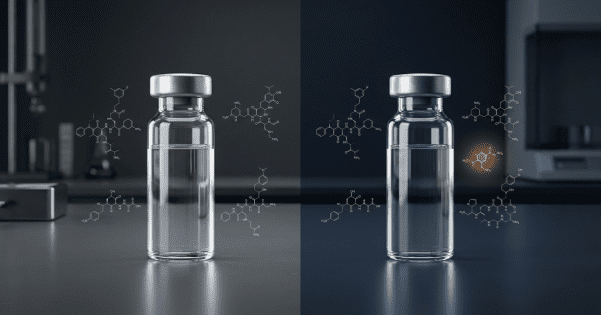
KLOW is GLOW with one more peptide in it. Both blends carry GHK-Cu, BPC-157 and TB-500 in identical amounts, and KLOW adds 10 mg of KPV on top, which makes the choice between them a question about that single ingredient and nothing else.
If the interest is tissue repair and skin remodeling, GLOW covers it. If inflammatory signaling is part of the picture, KPV is the reason KLOW exists.
Both blends are lyophilized research preparations sold by the sister research brand BioLongevity Labs, labeled for research use only. They aren’t dietary supplements, they aren’t sold on this site, and what follows is educational rather than a use guide.
Key Takeaways

The Short Version
KLOW contains the same three peptides as GLOW plus 10 mg of KPV, so KPV is the only difference between the two blends.
KPV is a three amino acid fragment of alpha-MSH studied for quieting NF-kB and MAP kinase inflammatory signaling rather than for building tissue.
Adding KPV shifts the blend from a repair-weighted profile toward inflammatory balance alongside repair.
Both blends are research-use-only injectable preparations, while BioGutPro delivers three of the same four peptides orally at capsule doses.

What Is in GLOW and What Is in KLOW
GLOW carries three peptides in a 70 mg vial and KLOW carries those same three plus KPV in an 80 mg vial. The shared three appear at exactly the same amounts in both.
| Component | GLOW | KLOW |
|---|---|---|
| GHK-Cu | 50 mg | 50 mg |
| BPC-157 | 10 mg | 10 mg |
| TB-500 | 10 mg | 10 mg |
| KPV | Not included | 10 mg |
| Regulatory status | Research use only | Research use only |

KLOW isn’t a reformulation of GLOW. Nothing was swapped, reduced, or rebalanced, and one component was added to an otherwise unchanged base.
That matters for how you read every comparison you’ll find online. Any difference in how the two blends behave traces back to KPV, because there is no other variable to attribute it to.
The Three Peptides Both Blends Share
GHK-Cu, BPC-157 and TB-500 form the repair-side core of both vials, and they cover different parts of the same job. GHK-Cu is a copper-binding tripeptide studied for collagen and elastin synthesis, fibroblast activity and tissue remodeling. BPC-157 is a fifteen amino acid gastric peptide with a broad animal literature in gut and soft tissue repair, and it reached phase II clinical testing for inflammatory bowel disease under the designation PL 14736. TB-500 is the synthetic form of thymosin beta-4, an actin-binding peptide researched for angiogenesis, cell migration and regeneration.
Our full breakdown of the GLOW peptide blend walks through the evidence on each of those three in depth. The rest of this article stays on the fourth.
What KPV Brings to the Fourth Slot
KPV does a different job from the other three, which is why adding it changes the blend’s character rather than just its potency. It’s the last three amino acids of alpha-melanocyte-stimulating hormone, a signaling hormone the body already makes, and researchers isolated the fragment because it keeps the anti-inflammatory activity while dropping the pigmentation effects of the full molecule, according to an overview of alpha-MSH peptides in Endocrine Reviews.
The mechanism sits upstream of inflammation rather than downstream of injury. In cell-based research published in Gastroenterology using human intestinal epithelial and T cells, nanomolar concentrations of KPV inhibited activation of NF-kB and MAP kinase, two pathways that switch on inflammatory gene expression, and reduced pro-inflammatory cytokine secretion.
Two details make that finding more interesting than a generic anti-inflammatory label.
- The effect doesn’t run through the pigmentation receptor. In mice engineered with a nonfunctional melanocortin-1 receptor, KPV still reduced colitis severity, which points to a route separate from classic melanocortin signaling.
- It may work by interfering with IL-1beta. In a peritonitis model comparing KPV with core melanocortin peptides, KPV reduced inflammatory cell accumulation without raising cAMP the way the core peptides did, and researchers pointed to IL-1beta interference as the likelier explanation.
KPV’s research also reaches past the gut. A 2025 review of tripeptides in wound repair covers KPV alongside GHK-based formulations as complementary tools in the same healing sequence, and in one animal model, KPV loaded into a wound dressing lowered inflammation while collagen deposition and angiogenesis proceeded. If you want the deeper version, our guide to KPV peptide benefits covers the gut, skin and antimicrobial research in full.
Why 10 mg of a Tripeptide Is Not a Rounding Error
KPV is the smallest component in KLOW by mass, at 12.5% of the vial, and mass share is a misleading way to judge it. Two things explain why.
The first is potency. The signaling effects in that same cell work appeared at nanomolar concentrations, which is a very small quantity of peptide producing a measurable change in gene expression.
The second is targeting, and this is the part most comparisons skip. KPV enters cells through PepT1, a transporter built to absorb di- and tripeptides from digested protein. PepT1 normally sits in the small intestine, but it gets upregulated in the colon during intestinal inflammation, where it’s otherwise barely expressed.
So the tissue doing the inflaming expresses more of the door that KPV walks through. Researchers confirmed how load-bearing that route is by removing it: in mice lacking PepT1, KPV’s protective effect in a colitis-associated model disappeared entirely.
None of the other three peptides in either blend has a comparable targeting route. Our comparison of KPV and BPC-157 covers how that targeting mechanism differs from BPC-157’s stability in gastric juice.
Repair Alone, or Repair Plus Inflammatory Balance
The honest framing is that GLOW is repair-weighted and KLOW is repair plus inflammatory balance, and neither one is an upgrade on the other in every case. Here’s how the research interests map.
| If the focus is | The blend that matches |
|---|---|
| Skin remodeling, collagen and elastin signaling | GLOW |
| Soft tissue and connective tissue repair | Either, since those three peptides are identical |
| Gut lining and intestinal inflammatory signaling | KLOW |
| Inflammatory balance running alongside tissue repair | KLOW |
| Keeping the number of variables low | GLOW |
That last row is worth sitting with. In a research context, a fourth peptide is also a fourth variable, and the simpler blend is sometimes the more useful one for that reason alone.
The two vials sit close together on price, so cost rarely decides this one. The real question is whether inflammatory signaling belongs in the picture at all, and when it does, KLOW is the blend built for it.
How to Get Three of the Four Orally
BioGutPro contains BPC-157, KPV and GHK-Cu in capsule form, which covers three of KLOW’s four peptides through a route you can actually buy. Being precise about what that is matters here.
BioGutPro is a dietary supplement taken orally at capsule doses of 1,000 mcg BPC-157, 500 mcg KPV and 2 mg GHK-Cu per serving. A research vial is a different product at different amounts through a different route, and there’s no TB-500 in the capsule formula. Treat it as an oral gut-lining formula built around three of the same peptides, not as a version of an injectable blend.
The oral route makes mechanistic sense for two of the three. KPV rides PepT1 into intestinal cells, which is the reason oral dosing has been studied for gut-focused endpoints at all, and BPC-157 has been described as stable in human gastric juice, unusual for a peptide of that size.
The capsule surrounds those three with four ingredients chosen for the same barrier job: N-acetyl larazotide at 500 mcg for tight junction support, CoreBiome tributyrin at 400 mg as a butyrate source, zinc L-carnosine at 100 mg for gastric lining support, and a sodium bicarbonate buffer to soften the acid load peptides face on the way down. If connective tissue recovery is the goal rather than digestion, BioRestore uses BPC-157 arginine salt with PEA and hyaluronic acid instead.
Frequently Asked Questions
Is KLOW just GLOW with KPV added?
Yes. GLOW contains GHK-Cu 50 mg, BPC-157 10 mg and TB-500 10 mg for a 70 mg vial, and KLOW contains those same three at the same amounts plus KPV 10 mg for an 80 mg vial. Nothing else changes between the two.
Is KLOW better than GLOW?
Neither is better in general terms, since they answer different questions. KLOW adds an inflammatory-signaling component to the same repair base, which is an advantage when inflammation is part of what’s being studied and a needless extra variable when it isn’t.
Can I buy GLOW or KLOW as a supplement?
No. Both are lyophilized preparations labeled for research use only and sold through BioLongevity Labs, the sister research brand, not as consumer supplements. BioLongevity Supplements sells oral capsule formulas, including BioGutPro, which contains three of KLOW’s four peptides.
Why is KPV only 10 mg when GHK-Cu is 50 mg?
Different peptides work at different concentrations. KPV produced measurable anti-inflammatory signaling changes at nanomolar concentrations in cell research, so its contribution to a blend doesn’t track its share of the total milligrams.
What does KPV do that GHK-Cu doesn’t?
GHK-Cu has been studied mainly for tissue remodeling, collagen and elastin synthesis, and fibroblast activity. KPV has been studied for turning down inflammatory transcription through NF-kB and MAP kinase, which is a signaling job rather than a building job. Both have anti-inflammatory activity in the literature, but only KPV is transported selectively into inflamed intestinal tissue.
Is the research on these peptides done in humans?
Most of it is animal and cell research, with BPC-157’s phase II work for inflammatory bowel disease as the notable exception. That’s normal for a young ingredient category and it’s why formula transparency and third-party verification carry more weight here than in a mature supplement category.
Read More From the BioLongevity Blog
- Peptide Supplements for Inflammation: What the Research Supports
- The Science of Peptides: How Peptide Signaling Works
- Can Peptides Be Taken Orally?
If the reason you searched this comparison was gut and inflammatory support, BioGutPro is the formula built around that goal, with BPC-157, KPV and GHK-Cu dosed alongside larazotide, tributyrin and zinc carnosine, and every amount printed on the label. Every batch is third-party tested with a Certificate of Analysis you can read before you buy, and you can compare the rest of the range in the peptide capsule collection.
Ask a qualified clinician before starting any supplement if you are pregnant, nursing, taking medication, or managing a medical condition.
These statements have not been evaluated by the Food and Drug Administration. This product is not intended to diagnose, treat, cure, or prevent any disease.
References
- Pickart L. The human tri-peptide GHK and tissue remodeling. Journal of Biomaterials Science, Polymer Edition. 2008;19(8):969-988. DOI
- Sikiric P, Seiwerth S, Rucman R, et al. Focus on ulcerative colitis: stable gastric pentadecapeptide BPC 157. Current Medicinal Chemistry. 2012;19(1):126-132. DOI
- Bollini S, Riley PR, Smart N. Thymosin beta-4: multiple functions in protection, repair and regeneration of the mammalian heart. Expert Opinion on Biological Therapy. 2015;15(Suppl 1):S163-S174. DOI
- Brzoska T, Luger TA, Maaser C, Abels C, Bohm M. Alpha-melanocyte-stimulating hormone and related tripeptides: biochemistry, antiinflammatory and protective effects in vitro and in vivo, and future perspectives for the treatment of immune-mediated inflammatory diseases. Endocrine Reviews. 2008;29(5):581-602. DOI
- Dalmasso G, Charrier-Hisamuddin L, Nguyen HT, Yan Y, Sitaraman S, Merlin D. PepT1-mediated tripeptide KPV uptake reduces intestinal inflammation. Gastroenterology. 2008;134(1):166-178. DOI
- Kannengiesser K, Maaser C, Heidemann J, et al. Melanocortin-derived tripeptide KPV has anti-inflammatory potential in murine models of inflammatory bowel disease. Inflammatory Bowel Diseases. 2008;14(3):324-331. DOI
- Getting SJ, Schioth HB, Perretti M. Dissection of the anti-inflammatory effect of the core and C-terminal (KPV) alpha-melanocyte-stimulating hormone peptides. Journal of Pharmacology and Experimental Therapeutics. 2003;306(2):631-637. DOI
- Adnan SB, Maarof M, Fauzi MB, Fadilah NIM. Exploring the role of tripeptides in wound healing and skin regeneration: a comprehensive review. International Journal of Medical Sciences. 2025;22(16):4175-4200. DOI
- Zhao Y, Huang L, Lin G, et al. Skin-adaptive film dressing with smart-release of growth factors accelerated diabetic wound healing. International Journal of Biological Macromolecules. 2022;222(Pt B):2729-2743. DOI
- Ingersoll SA, Ayyadurai S, Charania MA, Laroui H, Yan Y, Merlin D. The role and pathophysiological relevance of membrane transporter PepT1 in intestinal inflammation and inflammatory bowel disease. American Journal of Physiology. Gastrointestinal and Liver Physiology. 2012;302(5):G484-G492. DOI
- Viennois E, Ingersoll SA, Ayyadurai S, et al. Critical role of PepT1 in promoting colitis-associated cancer and therapeutic benefits of the anti-inflammatory PepT1-mediated tripeptide KPV in a murine model. Cellular and Molecular Gastroenterology and Hepatology. 2016;2(3):340-357. DOI