

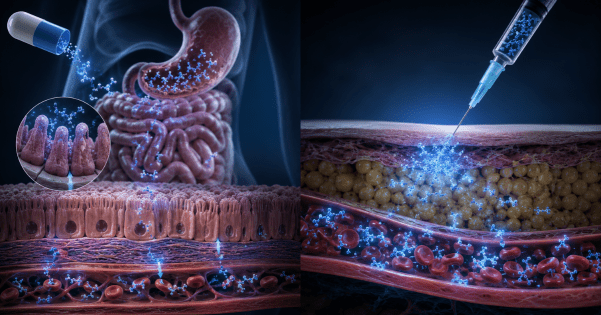
Injectable peptides deliver far more of a dose into circulation than oral ones do, often by a factor of a hundred or more. That gap sounds like it settles the argument, and it doesn’t, because the route that works best depends on where the peptide needs to end up and whether you’ll still be taking it a year from now.
Most comparisons stop at the absorption percentage. The more useful question is what that percentage costs you, and whether the peptide you care about even needs to reach the bloodstream to do its job.
Key Takeaways

The Short Version
Injectable peptides reach circulation almost intact, while oral peptide drugs typically deliver 1% or less of the dose without formulation help.
A low absorption percentage is usually solved by raising the dose, which is why an approved oral peptide can use roughly 200 times the injected amount and still hit its clinical endpoints.
Oral is the stronger route whenever the target tissue is the gut itself, whenever the peptide is short enough to be absorbed without engineering, or whenever the routine has to last for years.
Judge an oral peptide product by its peptide form, buffering strategy, printed dose per capsule, and third-party testing rather than by the route on the label.

Bioavailability Is a Dosing Problem, Not a Verdict
A low oral absorption figure tells you how much of a dose to give. It doesn’t tell you whether the route works.
Oral octreotide makes the point better than any other example. A technological evaluation of the permeation enhancer system behind it reported a relative oral bioavailability of roughly 0.7%, and noted that the oral dose needed to hit its Phase III endpoints was more than 200 times the immediate-release subcutaneous dose. Both routes reached the goal. One just needed a much bigger tablet.
The same logic runs through the whole field. Unmodified insulin sits below 1% oral bioavailability because of enzymatic breakdown, mucus, epithelial impermeability, and first-pass metabolism working together.
So the practical question isn’t “how much gets in.” It’s three other things:
- Can the dose be raised far enough to compensate without cost or tolerability becoming the limit?
- Is the absorption reliable enough to be worth dosing against?
- Does the peptide need to be in the blood at all?
That last one is where most route comparisons go quiet, and it’s the one that changes the answer most often.
What an Injection Actually Delivers

Injection puts a peptide into circulation largely intact, which buys you two things worth paying for: predictable blood levels and a small, precise dose.
Skipping the stomach and small intestine removes the acid, the pepsin, and the pancreatic proteases in one move. For a large peptide with a receptor somewhere far from the digestive tract, that’s the difference between a measurable effect and none at all.
Predictability matters just as much as magnitude. When a clinician needs a known blood concentration at a known time, subcutaneous delivery gives a tighter target than any oral formulation currently on the market.
The tradeoffs are practical rather than pharmacological. Injectable peptides generally require a prescription, sterile technique, and clinical oversight, and the schedule has to fit a real life. Those constraints are exactly what the next two sections are about.
Where the Oral Route Wins Outright
Oral wins outright whenever the target tissue is the digestive tract itself, because in that case absorption is a liability rather than a goal.
Linaclotide is the cleanest illustration. Research on its metabolism and disposition found that systemic exposure is low in both rats and humans and that the peptide is minimally absorbed after oral dosing. It works by binding a receptor on the intestinal lining, so staying in the lumen is the whole point. Injecting it would defeat the design.
That principle generalizes. Match the route to where the peptide has to act, not to which route sounds more serious.
| If the target is | The route that fits | Why |
|---|---|---|
| The gut lining or gut immune tissue | Oral | The peptide reaches the target before absorption is even relevant |
| A short peptide with its own transport route | Oral | Small chains have carriers built for them and don’t need engineering |
| A large peptide with a distant receptor | Injectable | Digestion removes it before it can reach circulation |
| A daily habit you intend to keep for years | Oral | Consistency compounds and needles get skipped |
Short peptides are the other clear oral case. Chain length is the deciding variable there, and we’ve covered which peptides survive digestion in the first place in its own guide, including the size threshold that separates the three groups. If you want the underlying biochemistry, the science of peptides explains what these molecules are before the delivery question comes up.

The Head-to-Head Data Nobody Quotes Properly
One peptide has been compared across both routes in real patients, and the result is more interesting than the usual summary suggests.
A 2025 systematic review and meta-analysis of oral versus subcutaneous semaglutide pooled four studies and 559 patients. The injectable form produced a modestly greater reduction in HbA1c. The difference in body weight reduction favored injection too, but was not statistically significant.
Then the twist. Patients on the oral form had a significantly higher risk of stopping treatment because of side effects, with a relative risk of 1.79.
Two lessons sit inside that. First, the absorption gap translated into a small efficacy gap, not a chasm. Second, route changes the side-effect experience, not just the dose, so “oral is gentler” isn’t a safe assumption either.
The mechanism behind oral semaglutide explains the first part. Clinical and preclinical work published in Science Translational Medicine showed that absorption happens in the stomach rather than the intestine, in a small zone right at the tablet surface, and only when the peptide is co-formulated with the permeation enhancer SNAC. Delivery that specific is an engineering achievement, and it’s why formulation detail deserves more attention than route labels do.
The Adherence Multiplier Most Comparisons Skip
A route that gets skipped delivers zero percent of its dose, which makes willingness the most underrated variable in this entire comparison.
The numbers here are striking. In an international survey of 2,098 adults, 63.2% reported experiencing needle phobia, and among those, roughly a third said it led them to avoid vaccinations.
Preference research points the same direction. In a study of 1,689 adults already taking injections for chronic conditions, the large majority said they’d switch to an oral alternative, and 91% of participants in the accompanying clinical arm preferred the oral route to their current injections. People injecting monthly still preferred a once-daily capsule.
Willingness also shifts what people expect in return. In a conjoint analysis of 185 postmenopausal women weighing a daily injectable osteoporosis therapy, most demanded a benefit larger than the one the drug had actually demonstrated before they’d accept the needle.
For a supplement routine meant to run for years rather than weeks, this is the deciding factor more often than absorption is.
Four Questions That Settle the Route
Run these in order. The first one that gives a clear answer usually ends the discussion.
| Question | If yes | If no |
|---|---|---|
| Does the peptide act on the gut itself? | Oral, and absorption is beside the point | Continue |
| Is it short enough to cross the intestinal wall without help? | Oral is plausible and often how it was studied | Continue |
| Is the oral form built with a real delivery strategy, such as a buffer, a salt form, or a permeation enhancer? | Oral is worth trying at the labeled dose | Treat oral claims skeptically |
| Will you keep the routine going for a year or more? | Favor oral, since consistency beats peak exposure | Injectable under clinical supervision may fit better |
Notice what isn’t on that list. The bioavailability percentage never appears on its own, because it only means something once you know the target, the dose, and the formulation.
What Good Oral Peptide Design Looks Like
Serious oral peptide products treat the digestive tract as an engineering problem and show their work on the label.
Three design decisions separate a considered formula from a hopeful one:
- A buffering agent such as sodium bicarbonate, which raises the pH the capsule contents meet and protects acid-sensitive peptides during the harshest part of the trip.
- A stabilized peptide form. Arginine salts and similar modifications improve handling and stability compared with the free peptide.
- A printed dose for every active, in micrograms or milligrams per serving, with the serving size stated in capsules and no proprietary blends hiding the numbers.
The pharmaceutical version of this work is still moving. A 2026 clinical and preclinical study of caprate-based tablets with a pH modifier found the approach improved gastric peptide absorption in animals, though the advantage over an existing enhancer narrowed in humans. Delivery science is being refined in public, and the formulas that respect it are the ones worth buying.
BioRestore is built on exactly those three decisions. It pairs a BPC-157 arginine salt at 1,000 mcg with palmitoylethanolamide, hyaluronic acid, and 400 mg of sodium bicarbonate specifically to stabilize the gastric environment the peptide has to pass through. For the compound-level version of this question, our guide to whether BPC-157 capsules work goes deeper on that peptide’s oral evidence.
Peptide bioregulators come at the oral route from the other direction. They’re short peptide complexes that sit in the size range associated with absorption, and they’ve been sold and studied in capsule form for decades. The bioregulator collection covers the tissue-specific complexes, and the broader peptide capsule range covers the formulated blends.
One safety note worth stating once. Peptides that influence inflammatory signaling or gut motility can interact with NSAIDs, immunosuppressants, and medications for gastrointestinal conditions, so check with your clinician before adding one alongside a prescription.
Frequently Asked Questions
These are the questions that come up most often once the absorption numbers stop doing the deciding.
Are oral peptides less effective than injectable peptides?
Not automatically. For peptides that act in the gut or are short enough to be absorbed, oral delivery matches how the research was often conducted. For large peptides with distant targets, injection delivers substantially more of the dose into circulation.
Why do oral peptide doses look so much higher than injected ones?
Because the dose is raised to compensate for what digestion removes. Approved oral octreotide uses roughly 200 times the immediate-release subcutaneous dose and still met its trial endpoints, which is the normal pattern rather than a red flag.
Do oral peptides have fewer side effects than injections?
Not necessarily. In the pooled comparison of oral and subcutaneous semaglutide, patients on the oral form were significantly more likely to stop treatment because of side effects, so route changes the experience in both directions.
Can any peptide be made into a capsule?
No. Chain length and sequence stability set the limit, and large peptides need a permeation enhancer or a specialized delivery system before an oral version is viable at all.
Does an oral peptide need to reach the bloodstream to work?
Sometimes the opposite is true. Linaclotide is minimally absorbed by design because its receptor sits on the intestinal lining, and several oral peptides work the same way.
How should I choose between an oral peptide supplement and a prescription injectable?
Start with what you’re trying to support and talk it through with a qualified clinician. Prescription injectables are a medical decision, while oral peptide supplements are a daily routine decision where consistency and formulation quality carry most of the weight.
Read More From the BioLongevity Blog
- Best Oral Peptides for Muscle Growth: What Survives Digestion?
- KPV vs BPC-157: Calming Inflammation or Rebuilding Tissue
- Peptide Bioregulators Explained: What They Are and How They Fit Into Wellness
If you want an oral peptide formula that treats delivery as part of the design rather than an afterthought, BioRestore pairs a stabilized peptide salt with a gastric buffer and prints every amount on the label. Every batch is third-party tested, and you can read the analytical results yourself on our Certificates of Analysis page before you order.
Ask a qualified clinician before starting any supplement if you are pregnant, nursing, taking medication, or managing a medical condition.
These statements have not been evaluated by the Food and Drug Administration. This product is not intended to diagnose, treat, cure, or prevent any disease.
References
- Brayden DJ, Maher S. Transient Permeation Enhancer (TPE) technology for oral delivery of octreotide: a technological evaluation. Expert Opinion on Drug Delivery. 2021;18(10):1501-1512. DOI
- Zheng Y, Fang X, Gao J. Re-engineering insulin for oral delivery: structural modifications, advanced formulation strategies, and future directions. Drug Delivery. 2026;33(1):2624192. DOI
- Busby RW, Kessler MM, Bartolini WP, et al. Pharmacologic properties, metabolism, and disposition of linaclotide, a novel therapeutic peptide approved for the treatment of irritable bowel syndrome with constipation and chronic idiopathic constipation. Journal of Pharmacology and Experimental Therapeutics. 2013;344(1):196-206. DOI
- Karedath J, Nall S, Kaur M, et al. Comparative effectiveness and safety of oral versus subcutaneous semaglutide in type 2 diabetes mellitus: a systematic review and meta-analysis. Cureus. 2025;17(4):e82497. DOI
- Buckley ST, Bækdal TA, Vegge A, et al. Transcellular stomach absorption of a derivatized glucagon-like peptide-1 receptor agonist. Science Translational Medicine. 2018;10(467):eaar7047. DOI