

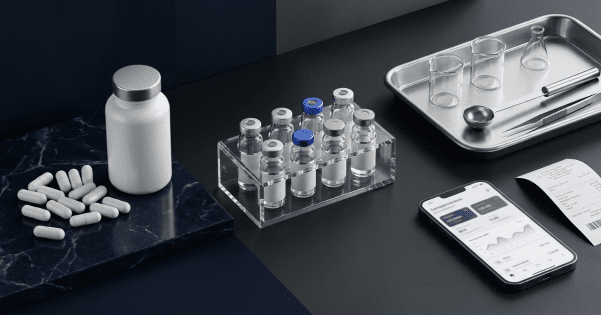
Peptide capsules run about $95 to $450 a bottle at regular price, and a bottle typically covers one to two months. A clinic or compounding pharmacy protocol usually lands between $250 and $600 a month once the consult, labs and supplies are counted. The spread is that wide because “peptides” is not one product, and the route you buy through changes the bill more than the molecule does.
Most pricing articles quote a sticker price for one vial and stop there. That number is close to useless, because nobody buys one vial and then stops. What you actually want to know is what a month of use costs, and what the second month costs after the setup fees are behind you.
Key Takeaways

The Short Version
A bottle of oral peptide capsules typically costs $95 to $450 at regular retail and covers one to two months, depending on whether you buy a single bioregulator or a multi-peptide formula.
A clinic or compounding pharmacy route typically costs $250 to $600 a month, and the first month runs higher because of the consult and baseline labs.
Research-use-only vials carry low per-milligram prices because they are laboratory materials sold outside the consumer supply chain, not a discount version of a supplement.
Over a full year, the capsule route usually totals $1,100 to $5,400 while a single-compound clinic protocol totals roughly $3,500 to $8,800.

Three Ways People Buy Peptides, Three Very Different Bills
There are only three real routes to a peptide, and each one prices a different bundle of things. Once you know which bundle you’re buying, the numbers stop looking random.
Part of the confusion is that the word covers an enormous range of molecules. More than 60 peptide drugs are approved in the United States and other major markets, with over 150 more in active clinical development, according to a review of therapeutic peptide development in Bioorganic & Medicinal Chemistry, and that’s before you count the peptide ingredients sold as dietary supplements.

| Route | What the price covers | Typical cost |
|---|---|---|
| Oral peptide capsules | A finished, labeled supplement you can buy directly | $95 to $450 a bottle |
| Clinic or compounding pharmacy | Prescription, provider oversight, labs, the compound itself | $250 to $600 a month |
| Research-use-only vials | Raw laboratory material, sold not for human use | Not a consumer route |
The capsule route is the only one of the three where the price on the page is the price you pay. The other two add line items that most pricing guides leave out entirely.
What a Month of Peptide Capsules Costs
Peptide capsules are the cheapest route with a predictable monthly number. There’s one line item: you buy a bottle, and the bottle lasts a known number of days.
Single-tissue peptide bioregulators sit at the bottom of the range. Across the market, a 60-count bottle generally runs about $95 to $135 at regular price and covers roughly one to two months depending on the label serving. The pineal complex and the combination geroprotector formulas run higher, from around $210 to over $440 a bottle.
Multi-peptide capsule formulas cost more because there are several actives in each capsule. BioLongevity’s multi-peptide formulas span roughly $170 to $450 a bottle at regular price. BioGutPro sits in the middle of that band and carries BPC-157, KPV and GHK-Cu together with a tributyrin postbiotic and a sodium bicarbonate buffer, which is a different value proposition than a single-ingredient bottle.
Use regular prices when you plan, since promotional pricing moves. At the time of writing BioLongevity is running a sitewide sale, so checkout prices are lower than the figures above.
The bioregulator category is also not a budget copy of the injectable market. It grew out of a separate research program at the St. Petersburg Institute of Bioregulation and Gerontology, where thymic and pineal peptide preparations were followed in 266 older adults across six to eight years of clinical observation.
What a Clinic or Compounding Pharmacy Adds to the Bill
A prescription route costs more than the compound because you’re also buying a prescriber, a pharmacy and a monitoring schedule. The compound itself is often the smaller half of the bill in month one.
Here’s what the individual line items run across current market pricing:
| Line item | Typical cost | How often |
|---|---|---|
| Initial consultation | $150 to $400 | Once |
| Baseline lab panel | $100 to $400 | Every 3 to 6 months |
| Compounded peptide | $150 to $500 | Monthly, per compound |
| Follow-up visit | $75 to $200 | Quarterly |
| Injection supplies | $10 to $30 | Monthly |
Add those up and a typical single-compound or two-compound protocol lands between $250 and $600 a month. More complex protocols push past $800.
The first month is the expensive one. A four-week starting course, counting the consult and baseline labs, commonly totals $350 to $900. After that, the recurring cost drops to the medication plus supplies until the next lab draw.
Buying direct from a compounding pharmacy with an existing prescription trims the overhead but not the prescription. Vial prices there run roughly $50 to $120 for BPC-157 and $60 to $150 for TB-500, which is why the “peptides are cheap” claim usually comes from someone quoting a pharmacy vial and ignoring everything attached to it.
Research Vials Sit Outside the Consumer Comparison
Research-use-only vials show the lowest per-milligram numbers anywhere in the peptide market, and they are not a consumer purchasing route. They are laboratory materials sold for in vitro and preclinical work, labeled not for human consumption, and they carry no FDA approval for human use.
The market context is worth knowing anyway, because those numbers are what fuel most of the confusion about peptide pricing. A BPC-157 research vial commonly lists between $25 and $140 depending on vial size, and lyophilized multi-peptide research blends run from roughly $225 to over $1,000 per vial. Our sister brand BioLongevity Labs supplies this market with third-party verified material for laboratory buyers.
Those prices look low for a reason that has nothing to do with value. A research vial is dry powder in a glass container. It has no prescription behind it, no finished dosage form, no consumer labeling, no serving size and no clinical oversight, and every one of those things is a real cost the other two routes actually pay for.
That makes the vial price a poor benchmark for anything a consumer would buy. One side of that comparison is a laboratory input and the other is a finished product with a prescription or a label behind it. Putting them side by side on price compares two things that were never the same purchase.
Why the Same Peptide Costs More Depending on the Route
Route changes the price by changing how much material has to survive the trip, and how much engineering gets built into the product to make that happen. Chain length decides most of it.
Very short peptides get a free ride. The intestinal wall has a dedicated transporter, PepT1, that carries di- and tripeptides across into circulation as part of normal protein digestion. A peptide small enough to use that carrier doesn’t need a delivery system built around it, which is exactly why bioregulator capsules can be sold at under $150 a bottle.
Whether a given peptide survives depends on its structure, not just its size. Research comparing transport against breakdown found the outcome is strongly structure-dependent, with hydrolysis-resistant peptides showing high intact appearance in circulation while others are broken down before they cross.
Longer peptides are where the cost enters. Oral delivery of larger peptides and proteins requires absorption enhancers, enzyme inhibitors, carrier systems or stabilization chemistry to get past gastrointestinal breakdown, and researchers are still building nanoparticle carriers specifically to solve the same barrier. Every one of those strategies is formulation work that ends up in the price.
Injection skips the problem entirely, which is why per-milligram numbers there look small. The cost simply relocates to the prescription, the pharmacy and the clinic visits. If you want the full picture on how route changes what reaches your bloodstream, our guide to oral peptides versus injectable covers the absorption side in detail.
A Year of Peptides, Priced Three Ways
Annual totals are where the routes separate most clearly. Setup fees stop mattering at that scale, and the recurring costs compound.
| Route | Year one, low | Year one, high |
|---|---|---|
| One bioregulator bottle a month | About $1,140 | About $1,620 |
| One multi-peptide capsule formula a month | About $2,040 | About $5,400 |
| Clinic protocol, one compound | About $3,500 | About $8,800 |
The clinic figure includes a consult, two lab panels, two follow-up visits and twelve months of compound. Drop any of those and the number falls, which is why quoted clinic prices vary so much between sources.
Inside any single route, three things move the price. Purity verification and third-party testing cost money and show up on the label. Bottle count changes the per-day cost more than the headline price suggests. And subscription or bundle pricing usually beats one-off ordering over a year.
If you’re still working out which peptides matter for your goal before you price anything, our peptide cheat sheet organizes them by what you’re trying to support, and the full list of peptides and what they do works as an A to Z lookup when you hit an unfamiliar name.
Frequently Asked Questions
These are the cost questions that come up most often once the headline numbers are on the table.
What is the cheapest way to take peptides?
Oral peptide capsules are the lowest-cost route with a predictable monthly number. A single bioregulator bottle generally runs $95 to $135 at regular price and covers roughly one to two months, with no consult fee, no lab work and no supplies attached.
Why are research peptide vials so much cheaper per milligram?
They’re a different product entirely. Research vials are raw laboratory material sold not for human consumption, with no prescription, no finished dosage form and no clinical oversight built into the price. The low per-milligram figure reflects what’s missing, not a better deal.
Does insurance cover peptide therapy?
Most peptide protocols prescribed for wellness or healthy aging are paid out of pocket, which is why the monthly numbers above assume cash pricing. Coverage varies by plan and by the specific compound, so ask your provider before assuming either way.
How much do peptide bioregulators cost per month?
Across the market, a 60-count bioregulator bottle runs about $95 to $135 at regular price and covers roughly one to two months at the label serving. Pineal and combination geroprotector complexes cost more, from around $210 to over $440 a bottle.
Is a more expensive peptide supplement worth it?
Not automatically, but the things that raise a legitimate formula’s price are usually visible. More actives per capsule, verified purity, third-party testing and transparent per-ingredient dosing all cost money to deliver, and all of them show up on the label or the Certificate of Analysis.
Why do peptide prices vary so much between sellers?
Vial or bottle size, purity verification, whether the seller pays for independent testing, and how much of the supply chain they own all move the number. A price well under the market range usually means one of those costs was skipped.
Read More From the BioLongevity Blog
- Peptide Bioregulators Explained: What They Are and How They Fit Into Wellness
- Best Longevity Supplements in 2026 Ranked by Evidence
- Do BPC-157 Capsules Work? What the Oral Evidence Shows
If you want the lowest-cost entry into peptides with a number you can plan around, a single bioregulator is where most people start. BioThymus (A-6 Vladonix) delivers 40 mg of thymus peptide complex per capsule in a 60-count bottle, is designed to support normal immune function and healthy aging, and prints its amount on the label rather than hiding it in a blend. Every batch is third-party tested, and you can read the analytical results yourself on our Certificates of Analysis page before you order.
Ask a qualified clinician before starting any supplement if you are pregnant, nursing, taking medication, or managing a medical condition.
These statements have not been evaluated by the Food and Drug Administration. This product is not intended to diagnose, treat, cure, or prevent any disease.
References
- Lau JL, Dunn MK. Therapeutic peptides: historical perspectives, current development trends, and future directions. Bioorganic & Medicinal Chemistry. 2018;26(10):2700-2707. DOI
- Khavinson VKh, Morozov VG. Peptides of pineal gland and thymus prolong human life. Neuro Endocrinology Letters. 2003;24(3-4):233-240. PubMed
- Brodin B, Nielsen CU, Steffansen B, Frøkjaer S. Transport of peptidomimetic drugs by the intestinal di/tri-peptide transporter, PepT1. Pharmacology & Toxicology. 2002;90(6):285-296. DOI
- Rohm F, Daniel H, Spanier B. Transport versus hydrolysis: reassessing intestinal assimilation of di- and tripeptides by LC-MS/MS analysis. Molecular Nutrition & Food Research. 2019;63(21):e1900263. DOI
- Parida P, Prusty AK, Patro SK, Jena BR. Current advancements on oral protein and peptide drug delivery approaches to bioavailability: extensive review on patents. Recent Advances in Drug Delivery and Formulation. 2024;18(4):227-246. DOI
- Deng B, Liu S, Wang Y, et al. Oral nanomedicine: challenges and opportunities. Advanced Materials. 2024;36(6):e2306081. DOI