

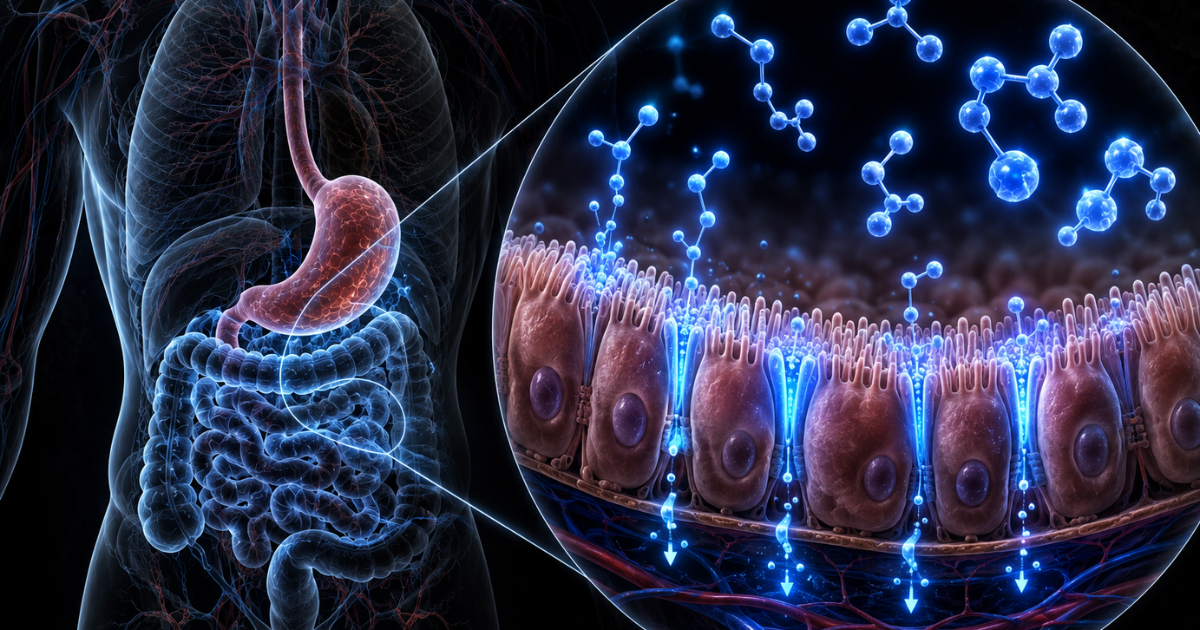
Some peptides work perfectly well in a capsule and most do not, and the difference comes down to how many amino acids long the chain is. Very short peptides have a dedicated transport system in your gut wall built to carry them through, while large ones are broken apart before they get anywhere near it.
That size threshold is the part almost no consumer guide explains. Once you know where it sits, the entire oral peptide market sorts itself into three obvious groups, and you can tell in seconds which one a product belongs to.
Key Takeaways

The Short Version
Peptides two to three amino acids long are carried through the intestinal wall by PepT1, a transporter your body already uses to absorb digested protein.
Larger peptides such as insulin and GLP-1 drugs need permeation enhancers or injection, and even the best oral formulations achieve only single-digit bioavailability.
Peptide bioregulators sit in the small-peptide range that has been studied for oral use for decades, which is why they are sold as capsules rather than injections.
Judge an oral peptide product by chain length, peptide form, exact dose, and third-party testing.
What Happens to a Peptide When You Swallow It
A swallowed peptide faces three obstacles in sequence, and each one removes a different set of candidates. Understanding the order makes the rest of this straightforward.
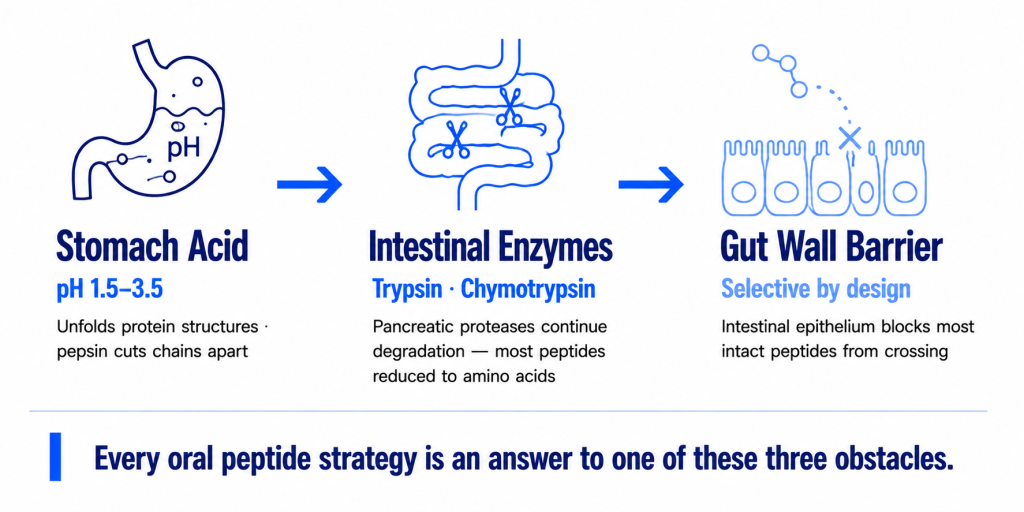
- First, stomach acid: Gastric pH sits between 1.5 and 3.5, low enough to unfold most protein structures. Pepsin is waiting there too, cutting chains apart at specific points.
- Second, intestinal enzymes: Pancreatic proteases including trypsin and chymotrypsin continue the demolition in the small intestine. Between these two stages, most therapeutic peptides are reduced to free amino acids before absorption is even on the table.
- Third, the gut wall itself: Even an intact peptide has to cross the intestinal epithelium, and that barrier is selective by design. A review of oral protein and peptide delivery describes this combination of rapid degradation and low intestinal uptake as the central problem the field has been trying to solve for decades.
Every strategy in oral peptide science is an answer to one of those three obstacles. So is every honest product label.
The Size Rule: Three Tiers of Oral Peptides
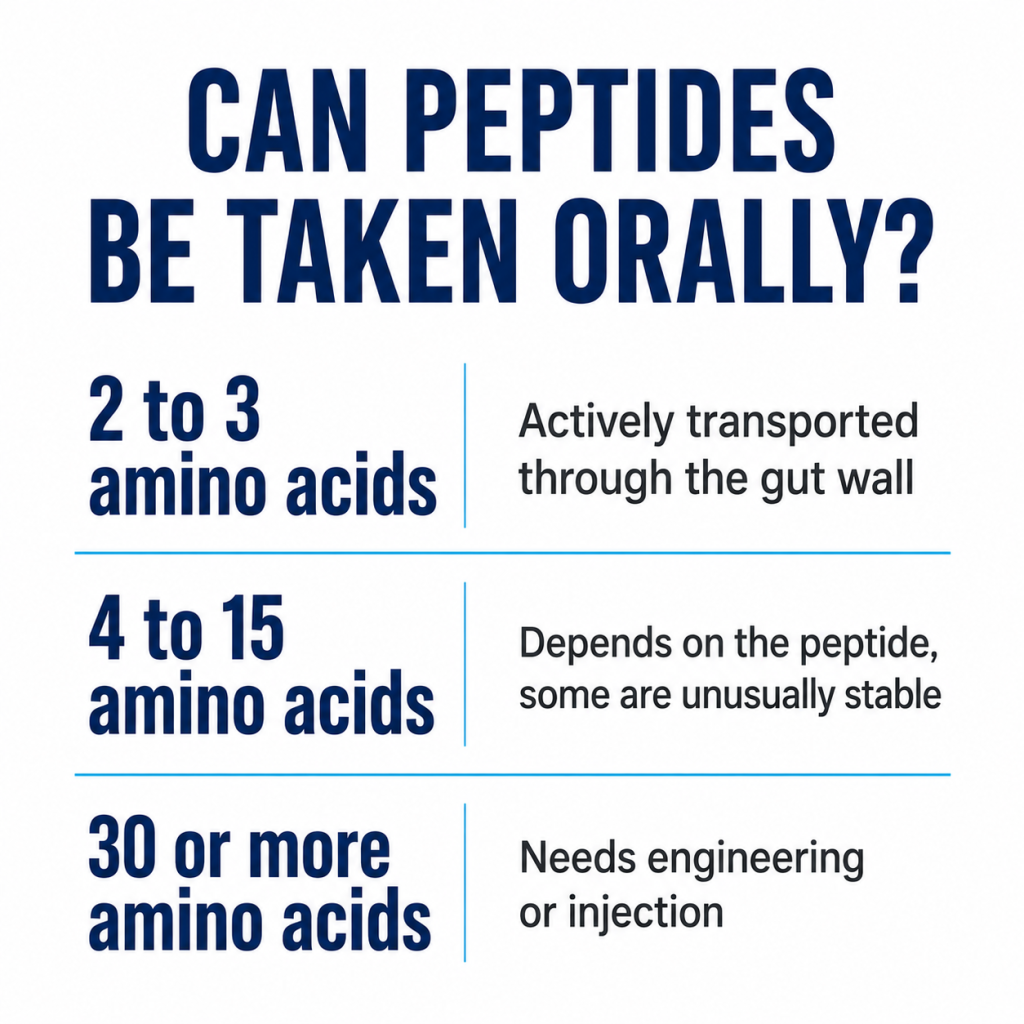
Chain length predicts which obstacles a peptide clears. Here is the framework, and the sections below unpack each tier.
| Tier | Chain length | What happens orally | Examples |
|---|---|---|---|
| Actively transported | 2 to 3 amino acids | Carried through the gut wall by the PepT1 transporter | KPV, carnosine, di- and tripeptide fragments |
| Conditionally absorbed | 4 to 15 amino acids | Depends heavily on the specific sequence and its stability | Peptide bioregulators, BPC-157 |
| Requires engineering | 30 or more amino acids | Degraded without permeation enhancers or special delivery systems | Insulin, semaglutide, most peptide drugs |
Tier one, the peptides your gut is built to absorb
Your body has a transporter called PepT1 whose entire job is absorbing di- and tripeptides left over from protein digestion. It does not care whether those fragments came from a steak or a supplement.
KPV is the clearest example. It is three amino acids long, and research published in Gastroenterology showed it is taken into intestinal and immune cells through PepT1, with oral administration reducing markers of intestinal inflammation in animal models. Our guide to KPV covers that research in detail.
Tier two, where the sequence matters more than the size
Between four and roughly fifteen amino acids, outcomes depend on the specific molecule. Some sequences are unusually resistant to digestion. BPC-157 is the standout case, a fifteen amino acid peptide originally isolated from gastric juice. A 2026 review in Pharmaceutics documents its activity through oral, injected, and topical routes, and our article on whether BPC-157 capsules work covers what that means in practice.
Short peptides in this range have another property worth knowing. A systematic review of peptide regulation of gene expression reports that peptides of two to seven amino acid residues can penetrate cell nuclei and interact directly with DNA and histone proteins, which is the proposed mechanism behind their signaling effects.
Tier three, the peptides that need help
Insulin is 51 amino acids. Semaglutide is 31. These molecules have no realistic chance of surviving digestion intact, which is why the oral versions rely on permeation enhancers such as salcaprozate sodium, better known as SNAC.
The honest numbers here are useful context. A comparison of the two most advanced permeation enhancers found that tablets containing them produced single-digit and highly variable increases in oral bioavailability in human trials, which can still be adequate when the payload is potent enough. That is the state of the art for large peptides, and it explains why nobody sells oral insulin at your pharmacy.
Which Oral Peptides Have the Longest Track Record
Peptide bioregulators have the deepest history of oral use in the consumer space, and the reason is structural. They are short peptide complexes, which puts them in the size range that can be absorbed without engineering, and they have been formulated as capsules since long before the current peptide boom.
The research base describes short peptides acting as signaling molecules rather than building blocks. Reviews of peptide regulation describe short peptides as influencing gene expression and DNA methylation status and as playing a role in cell differentiation across a range of tissue types.
BioPineal is the flagship example in this category, an A-8 pineal peptide complex dosed at 40 mg per capsule and sold in the format the research used. If bioregulators are new to you, start with what peptide bioregulators are and then the background on Khavinson peptide research, which is where most of this literature originates.
The broader bioregulator collection covers the tissue-specific complexes, all in the same oral capsule format.
How Formulators Improve the Odds
Good oral peptide formulas do not just hope for the best. Four techniques do most of the work, and you can spot all of them on a label.
- pH buffering. Sodium bicarbonate raises the gastric pH the capsule opens into, giving acid-sensitive peptides a gentler start.
- Salt forms. Arginine salts and similar modifications improve stability and handling compared to the free peptide.
- Delayed-release capsules. Moving the release point past the stomach removes the harshest obstacle entirely.
- Carrier systems. Nanoparticle and polymer carriers protect the peptide in transit and can concentrate it at a target tissue.
That last one is where the science is moving fastest. Animal work using KPV carried in hyaluronic acid nanoparticles showed improved delivery to inflamed colon tissue, and a January 2026 study in Science Advances went further, building a peptide conjugate that stays intact through the gastrointestinal tract and releases its payload only where reactive oxygen species signal inflammation. In colitis mice, the KPV version reached 3.8 times the colonic accumulation of free KPV and worked at a twenty-fold lower dose.
None of that is on shelves yet. It does tell you the direction of travel, and it explains why the peptides already suited to oral delivery are the ones getting attention now.
How to Judge an Oral Peptide Product Before You Buy
Five checks separate a serious oral peptide product from an expensive guess. Run them in this order.
| Check | What good looks like |
|---|---|
| Chain length | The peptide is short enough that oral delivery is plausible, or has documented oral research behind it |
| Peptide form | The label names the specific form, such as an arginine salt, rather than just the peptide name |
| Exact dose per serving | Microgram or milligram amounts printed for every active, with the serving size stated in capsules |
| Delivery support | A buffer, delayed-release capsule, or carrier system, and a reason it is there |
| Third-party testing | Independent identity and purity verification with a Certificate of Analysis available |
A product that fails the first check cannot be rescued by the other four. If a brand is selling an oral version of a large peptide with no delivery technology attached, the chain length alone tells you what to expect.
Our beginner’s guide walks through how to start with peptide supplements if this is your first purchase in the category.
Frequently Asked Questions
Are oral peptides as effective as injections?
It depends entirely on the peptide. For very short peptides with a transport route, oral delivery is a reasonable match for the research, since much of that research used oral administration. For large peptide drugs, injection remains substantially more efficient.
Do peptides get destroyed by stomach acid?
Most do. Acid and pepsin unfold and cut protein chains, and pancreatic enzymes finish the job in the small intestine. Short peptides and a few unusually stable sequences are the exceptions, which is why they dominate the oral market.
What is the largest peptide that can be absorbed orally?
There is no single cutoff, because stability varies by sequence. As a practical guide, peptides of two to three amino acids have a dedicated transporter, peptides up to about fifteen depend on their specific structure, and anything past thirty needs a delivery system.
Are peptide bioregulator capsules absorbed?
Bioregulators are short peptide complexes in the size range associated with absorption, and researchers describe short peptides of two to seven residues as able to enter cells and reach the nucleus. They have been sold and studied in oral capsule form for decades.
Does taking peptides with food help or hurt?
There is no established consumer rule, and it varies by product. Follow the label, and prioritize taking it at the same time each day, since consistency matters more than timing for signaling peptides.
Can I open a peptide capsule and take the powder?
Not advisable. If the capsule is designed for delayed release or the formula includes a buffer that works alongside the capsule shell, opening it removes the protection the formulator built in.
Read More From the BioLongevity Blog
- KPV vs BPC-157: Calm the Inflammation or Rebuild the Tissue
- Endoluten Peptide Benefits and the Pineal Bioregulator Research
If you want to start with the oral peptide category that has the longest track record, BioPineal is the A-8 pineal complex most people begin with, and every amount is printed on the label. For gut-focused support instead, BioGutPro combines short peptides with butyrate and zinc carnosine in the same capsule format.
Ask a qualified clinician before starting any supplement if you are pregnant, nursing, taking medication, or managing a medical condition.
These statements have not been evaluated by the Food and Drug Administration. This product is not intended to diagnose, treat, cure, or prevent any disease.
References
- Hashim LE, Sabri AH, Mohamad MA, Anjani QK, Mustaffa MF, Abdul Hamid K. Circumventing the gastrointestinal barrier for oral delivery of therapeutic proteins and peptides: current trends and future trajectories. Current Drug Delivery. 2024;21(2):211-235. DOI
- Dalmasso G, Charrier-Hisamuddin L, Nguyen HT, et al. PepT1-mediated tripeptide KPV uptake reduces intestinal inflammation. Gastroenterology. 2008;134(1):166-178. DOI
- Khavinson VK, Popovich IG, Linkova NS, Mironova ES, Ilina AR. Peptide regulation of gene expression: a systematic review. Molecules. 2021;26(22):7053. DOI
- Khavinson V, Linkova N, Diatlova A, Trofimova S. Peptide regulation of cell differentiation. Stem Cell Reviews and Reports. 2020;16(1):118-125. DOI
- Twarog C, Fattah S, Heade J, Maher S, Fattal E, Brayden DJ. Intestinal permeation enhancers for oral delivery of macromolecules: a comparison between salcaprozate sodium (SNAC) and sodium caprate (C10). Pharmaceutics. 2019;11(2):78. DOI
- Mateescu DM, Gavrilescu DM, Constantinescu FE, et al. BPC-157 as an investigational peptide therapeutic: biopharmaceutical challenges, formulation strategies, and translational development barriers. Pharmaceutics. 2026;18(5):625. DOI
- Cheng J, Wu P, Li C, et al. Inflammation-triggered self-immolative conjugates enable oral peptide delivery by overcoming gastrointestinal barriers. Science Advances. 2026;12(3):eaea2989. DOI
- Xiao B, Xu Z, Viennois E, et al. Orally targeted delivery of tripeptide KPV via hyaluronic acid-functionalized nanoparticles efficiently alleviates ulcerative colitis. Molecular Therapy. 2017;25(7):1628-1640. DOI