

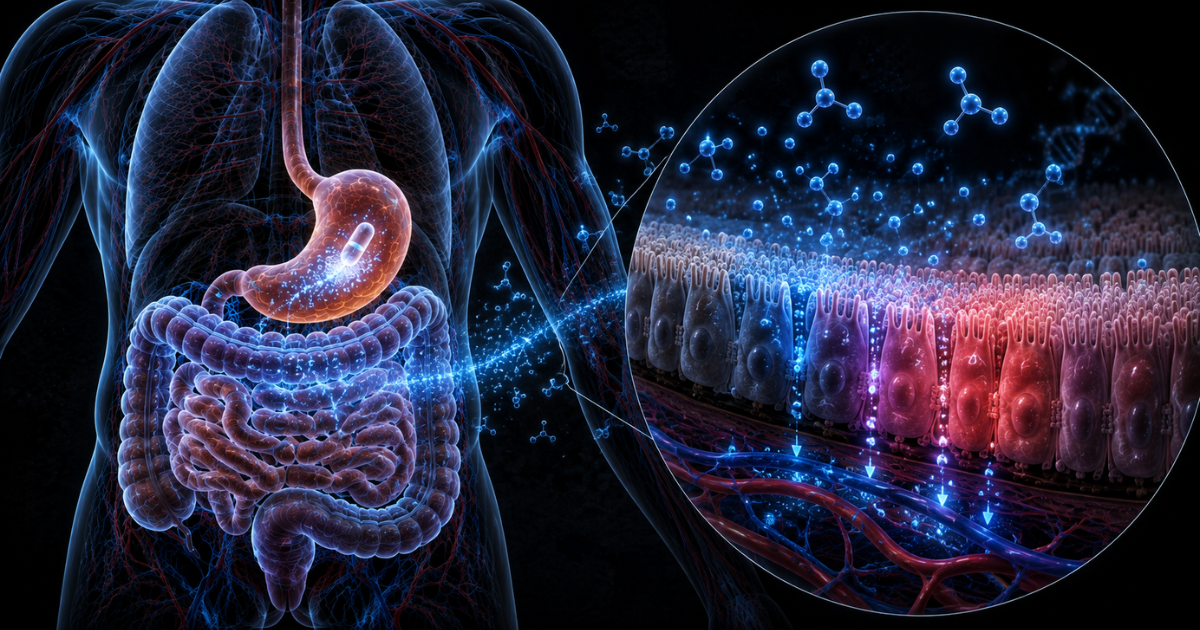
An oral KPV peptide capsule works because KPV is only three amino acids long and the intestine has a transporter, PepT1, built to carry molecules exactly that size. The more useful detail is that PepT1 levels climb in inflamed tissue, so a swallowed dose ends up concentrating where the inflammation is rather than spreading evenly through the body.
That self-targeting behavior is the entire argument for buying KPV as a capsule instead of a vial. It’s also the part most product pages skip.
Key Takeaways

The Short Version
KPV is carried across the gut wall by PepT1, a transporter that handles di- and tripeptides from normal protein digestion.
PepT1 expression increases in inflamed intestinal tissue, so an oral dose concentrates in the areas that need it most.
Every published KPV study is in animals or cells, and the oral route is the one those gut studies used, which is unusual for a peptide.
A serious oral KPV formula pairs the peptide with a gastric buffer and barrier-support compounds, because KPV alone signals inflammation down without rebuilding the lining.
The Transporter That Makes an Oral KPV Capsule Plausible
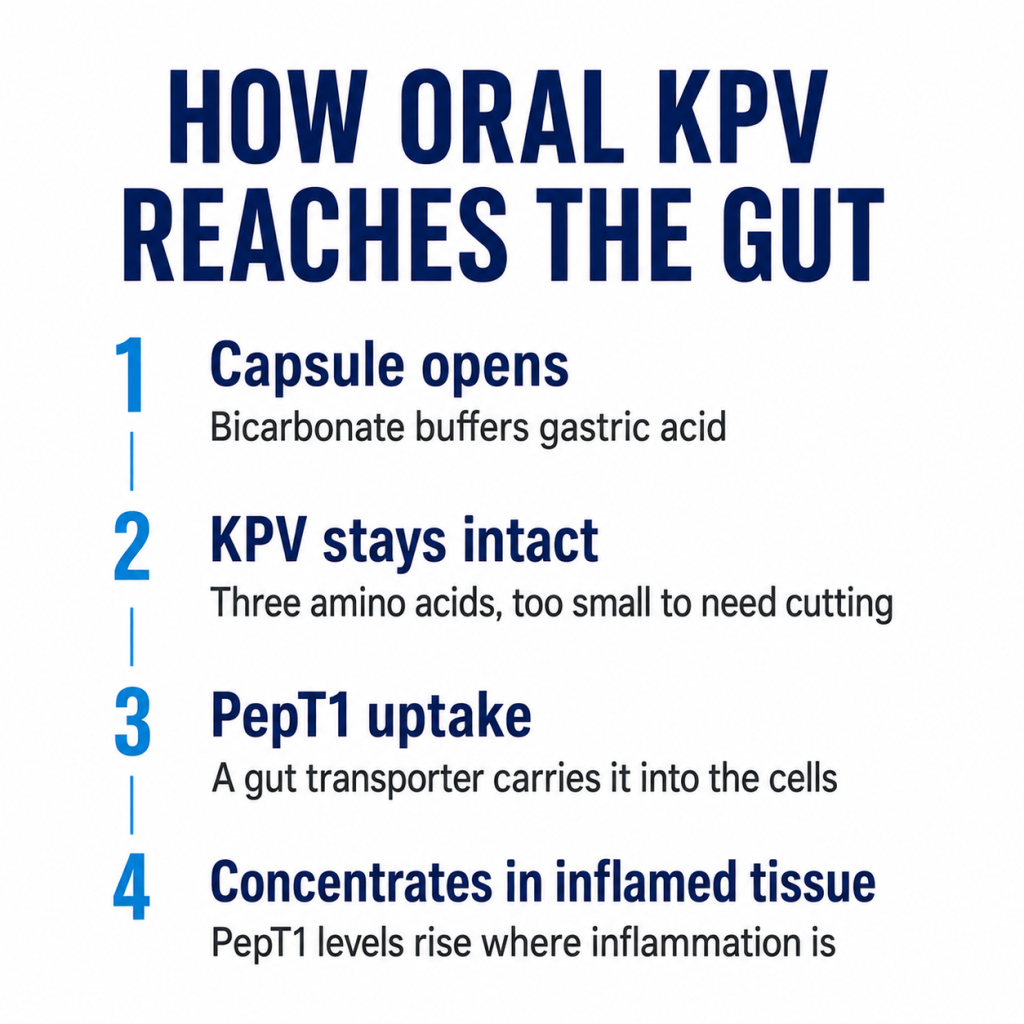
PepT1 is a di- and tripeptide transporter sitting in the intestinal lining, and its normal job is absorbing the small fragments left over after you digest protein. It doesn’t distinguish between a fragment from a steak and a tripeptide from a capsule.
KPV rides that system directly. Researchers confirmed the route using radiolabeled KPV and competition experiments in human intestinal epithelial and immune cells, showing that uptake happens through PepT1 rather than passive diffusion.
Here’s the part worth paying for. PepT1 is expressed at low levels in a healthy colon and is upregulated during intestinal inflammation, which means the transporter that carries KPV is most abundant exactly where inflammation is active. An oral dose doesn’t spread itself evenly. It aims.
The proof came from removing the transporter. In mice lacking PepT1, oral KPV lost the protective effect it produced in normal mice, confirming that the transporter is the delivery route and not an incidental detail.
If you want the full mechanism, including how KPV quiets NF-kB signaling once it’s inside a cell, our guide to KPV peptide benefits covers it in depth.
What Oral Dosing Produced in the Studies
Most peptide research uses injection because the researchers have no other option. KPV is one of the rare cases where the headline studies dosed by mouth, which makes the evidence directly relevant to anyone holding a capsule.
| Study | Model | How it was given | What happened |
|---|---|---|---|
| Dalmasso 2008 | Two mouse colitis models | KPV in drinking water | Lower incidence of intestinal inflammation and reduced pro-inflammatory cytokine expression |
| Kannengiesser 2008 | Two mouse colitis models | KPV treatment | Earlier recovery, greater body weight regain, fewer inflammatory infiltrates in colon tissue |
| Viennois 2016 | Mouse colitis-associated tumor model | Oral KPV | Reduced tumor development in normal mice, no effect once PepT1 was deleted |
| Xiao 2017 | Mouse ulcerative colitis model | Oral, in hyaluronic acid nanoparticles | Improved mucosal healing and lower TNF-alpha than free KPV |
| Cheng 2026 | Mouse colitis and acute lung injury | Oral, as a ROS-triggered conjugate | 3.8 times the colonic accumulation of free KPV, effective at a 20-fold lower dose |
Two things stand out across that list.
The first is consistency. Different labs, different colitis models, and the same direction of effect every time, with the transporter knockout experiment confirming the mechanism rather than just correlating with it.
The second is the trajectory. That 2026 work in Science Advances built a conjugate that stays intact through the digestive tract and releases KPV only where reactive oxygen species signal inflammation, and the same platform carried the peptide to inflamed lung tissue after oral dosing. Delivery science is moving toward KPV, not away from it.
All of this is animal and cell research. That’s the honest tier, and it’s a promising one for a compound whose entire research base was built on the route people are buying.
The Delivery Problem a Good Formula Solves
Putting KPV powder in a capsule and formulating an oral KPV product are two different jobs. Gastric acid sits between pH 1.5 and 3.5, and a review of oral peptide delivery describes that environment plus low intestinal uptake as the core obstacle the field works around.
KPV clears the size problem on its own. Three amino acids is small enough that PepT1 handles it without help, which is why KPV doesn’t need the permeation enhancers that oral insulin and GLP-1 drugs depend on. Our guide to whether peptides can be taken orally lays out where those size thresholds fall.
What KPV does benefit from is a gentler start. A gastric buffer raises the pH the capsule opens into, which protects acid-sensitive compounds in the same formula and improves how the whole capsule is tolerated. That’s why BioGutPro includes 150 mg of sodium bicarbonate alongside its 500 mcg of KPV rather than leaving the peptide to fend for itself.
What Else Belongs in an Oral KPV Formula
KPV turns inflammatory signaling down. It doesn’t tighten a leaky junction, feed a colonocyte, or rebuild mucus, so a formula built only around KPV leaves most of the gut lining unaddressed.
BioGutPro pairs it with six other compounds, each assigned a specific part of the job.
| Compound | Amount | Job in the formula |
|---|---|---|
| KPV | 500 mcg | Supports a balanced inflammatory response at the mucosal level |
| BPC-157 | 1,000 mcg | Supports mucosal integrity and normal tissue repair processes |
| N-Acetyl Larazotide | 500 mcg | Supports healthy tight junction function in the intestinal lining |
| GHK-Cu | 2 mg | Supports tissue remodeling and antioxidant defense in gut tissue |
| CoreBiome Tributyrin | 400 mg | Delivers butyrate to the colon as a protected precursor |
| Zinc L-Carnosine | 100 mg | Supports gastric mucosal integrity |
| Sodium Bicarbonate | 150 mg | Buffers gastric acid so acid-sensitive compounds arrive intact |
The tight junction piece is worth a note because it’s the one part of this stack with human trial history. Larazotide acetate, a tight-junction regulator peptide, has been tested in randomized double-blind trials in celiac patients, where lower doses limited the worsening of gastrointestinal symptom severity during a gluten challenge. That research was on the acetate form as an investigational drug rather than on this formula, so read it as background on the compound class.
For more on the butyrate side, our breakdown of tributyrin supplement benefits explains why the protected form gets further down the tract, and our guide to leaky gut supplements ranks the wider category by evidence.
How People Run an Oral KPV Course
Oral KPV is a consistency compound rather than a fast-acting one, so the protocol matters more than the single dose.
The standard approach with BioGutPro is one capsule in the morning to start, moving to one morning and one evening, taken with water and preferably on an empty stomach so the peptides aren’t competing with a meal for transporter capacity. Sustained gut-lining support is generally judged over 60 days or more, with a two-weeks-on, one-week-off pattern available for long-term maintenance.
One safety note, stated once. KPV and BPC-157 are bioactive peptides that may interact with medications affecting gut motility, pain signaling, or immune function, so anyone taking prescription medication or managing a diagnosed gastrointestinal condition should clear the formula with a clinician before starting.
Browse the gut health and digestion collection if you want to see how an oral KPV formula sits alongside the rest of the catalog.
Frequently Asked Questions
How much KPV is in an oral capsule?
It varies by product and the label should say. BioGutPro discloses 500 mcg of KPV per serving alongside six other named compounds, with no proprietary blend obscuring the amounts.
Should oral KPV be taken on an empty stomach?
Generally yes. PepT1 is busy transporting peptide fragments from digested food after a meal, so taking an oral KPV capsule with water away from food is the more common approach. Follow the label on your specific product.
Is oral KPV absorbed if my gut isn’t inflamed?
PepT1 is present in the healthy small intestine, so absorption still happens. The difference is concentration, since PepT1 expression rises in inflamed tissue and that’s where more of an oral dose ends up.
How long does an oral KPV course run?
Plan on at least 60 days of consistent use before judging it. Gut barrier and mucosal support builds gradually, and a two-weeks-on, one-week-off cycle is a common maintenance pattern after the initial run.
Can you take oral KPV and BPC-157 together?
They’re routinely formulated together because they cover different jobs, with KPV on inflammatory signaling and BPC-157 on mucosal integrity. BioGutPro delivers both in one capsule at disclosed amounts.
Is an oral KPV capsule the same as a KPV cream or nasal spray?
No. Topical and nasal formats target the tissue they touch, while an oral capsule uses PepT1 uptake in the intestine. The gut research on KPV used oral dosing, so the capsule is the format that matches that literature.
Read More From the BioLongevity Blog
- KPV vs BPC-157: Calm the Inflammation or Rebuild the Tissue
- Best Oral Peptides for Muscle Growth: What Survives Digestion
- PEA Supplement Benefits for Recovery and Inflammatory Balance
If you want oral KPV in the format the research used, BioGutPro delivers it at a disclosed 500 mcg alongside six compounds chosen for the rest of the gut lining job, buffered so the peptides arrive intact. Every batch is third-party tested by HPLC and mass spectrometry, and the Certificate of Analysis is published so you can check the KPV content before you order.
Ask a qualified clinician before starting any supplement if you are pregnant, nursing, taking medication, or managing a medical condition.
These statements have not been evaluated by the Food and Drug Administration. This product is not intended to diagnose, treat, cure, or prevent any disease.
References
- Dalmasso G, Charrier-Hisamuddin L, Nguyen HT, Yan Y, Sitaraman S, Merlin D. PepT1-mediated tripeptide KPV uptake reduces intestinal inflammation. Gastroenterology. 2008;134(1):166-178. DOI
- Viennois E, Ingersoll SA, Ayyadurai S, et al. Critical role of PepT1 in promoting colitis-associated cancer and therapeutic benefits of the anti-inflammatory PepT1-mediated tripeptide KPV in a murine model. Cellular and Molecular Gastroenterology and Hepatology. 2016;2(3):340-357. DOI
- Kannengiesser K, Maaser C, Heidemann J, et al. Melanocortin-derived tripeptide KPV has anti-inflammatory potential in murine models of inflammatory bowel disease. Inflammatory Bowel Diseases. 2008;14(3):324-331. DOI
- Xiao B, Xu Z, Viennois E, et al. Orally targeted delivery of tripeptide KPV via hyaluronic acid-functionalized nanoparticles efficiently alleviates ulcerative colitis. Molecular Therapy. 2017;25(7):1628-1640. DOI
- Cheng J, Wu P, Li C, et al. Inflammation-triggered self-immolative conjugates enable oral peptide delivery by overcoming gastrointestinal barriers. Science Advances. 2026;12(3):eaea2989. DOI
- Hashim LE, Sabri AH, Mohamad MA, Anjani QK, Mustaffa MF, Abdul Hamid K. Circumventing the gastrointestinal barrier for oral delivery of therapeutic proteins and peptides: current trends and future trajectories. Current Drug Delivery. 2024;21(2):211-235. DOI
- Leffler DA, Kelly CP, Abdallah HZ, et al. A randomized, double-blind study of larazotide acetate to prevent the activation of celiac disease during gluten challenge. American Journal of Gastroenterology. 2012;107(10):1554-1562. DOI