

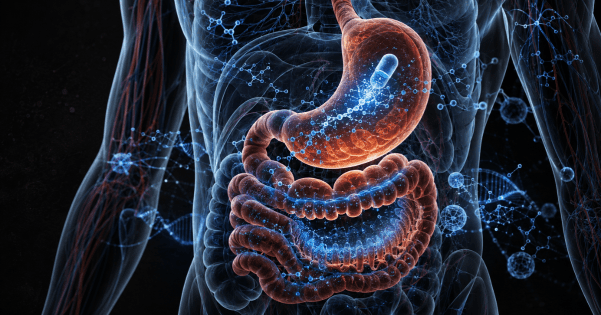
BPC-157 capsules have a stronger case than most oral peptides, because BPC-157 was discovered in gastric juice and stays intact in it. The more useful question is not whether the molecule survives your stomach, but what it does after it gets there, and the research points to a local gut effect that is far better documented than any systemic one.
There is one number driving most of the online argument about oral BPC-157, and it gets misread constantly. Understanding it changes what you should expect from a capsule.
Key Takeaways

The Short Version
BPC-157 is unusually stable in gastric juice, and researchers have documented activity through oral, injected, and topical routes.
Its plasma half-life is under 30 minutes, yet biological effects in animal studies persist for hours to days, so blood concentration is a poor measure of whether it worked.
The strongest oral evidence sits in gut and gastrointestinal models, where the tissue being studied is the tissue the capsule reaches first.
Human data remain limited to a small number of pilot studies, so BPC-157 is best understood as investigational, and formula transparency matters more than marketing claims.

Do BPC-157 Capsules Survive Stomach Acid?
Yes, and this is the part BPC-157 gets right that almost no other peptide does. BPC-157 is a fifteen amino acid fragment of a protein isolated from gastric juice, which means acid resistance is not a formulation trick added later. It is where the molecule came from.
A 2026 biopharmaceutical review in Pharmaceutics put it directly, noting that BPC-157 exhibits unusual stability in gastric juice and demonstrates activity via oral, parenteral, and topical routes. Earlier work describing it as stable in human gastric juice is the reason oral research on the compound exists at all.
Compare that to a typical peptide drug. Insulin, GLP-1 agonists, and most therapeutic peptides are injected precisely because stomach acid and digestive enzymes dismantle them before absorption. BPC-157 sits in a small group that does not have that problem.
Stability is not the same as absorption, though, and that distinction is where the real argument lives.
Why Blood Levels Are the Wrong Way to Judge BPC-157

Here is the finding that reframes the entire capsule debate. BPC-157 has a plasma half-life of under 30 minutes, confirmed in preclinical work across two species and in a small human pilot, yet its biological effects in animal studies last for hours to days.
Pharmacologists call this a pharmacokinetic-pharmacodynamic disconnect, and it means the drug is gone long before the effect is. That pattern is common for signaling molecules that trigger a cascade rather than occupying a receptor continuously.
The mechanism work supports that reading. A 2025 review of the musculoskeletal literature describes activity through VEGFR2 and nitric oxide synthesis via the Akt-eNOS axis, and in cell-based research on wound healing BPC-157 modulated ERK1/2 signaling along with downstream targets including c-Fos, c-Jun, and Egr-1. Those are switches. Once flipped, the cellular response continues without the peptide standing over it.
So a capsule does not need to produce a sustained blood level to do something. Judging oral BPC-157 by peak plasma concentration is like judging a text message by how long the phone was ringing.
What the Oral Studies Measured
Most of the BPC-157 animal literature is gastrointestinal, and much of it used oral or intragastric delivery rather than injection. That matters, because it means the oral route is not an afterthought applied to injection data. It is how a large share of the original research was run.
The gut findings are consistent across models:
- In an NSAID toxicity model, BPC-157 reduced diclofenac-induced lesions across the gastrointestinal tract and liver
- Reviews of the inflammatory bowel literature describe effects in both the upper and lower gastrointestinal tract, with the compound reaching phase II clinical testing as PL 14736
- Work on intestinal anastomosis and fistula models has reported improved closure outcomes in animals
Outside the gut, the picture is built mainly on injected and topical routes. Ligament healing improved in a rat model published in the Journal of Orthopaedic Research. Angiogenesis research on muscle and tendon healing found BPC-157 upregulated VEGF expression in vivo, though it produced no direct angiogenic effect in cell culture alone. A review of its vascular effects describes it as a notably active angiomodulatory agent working through nitric oxide, VEGF, and FAK pathways.
The honest summary is that oral BPC-157 has its deepest evidence base exactly where a capsule delivers it, which is the digestive tract. That is a strength, not a caveat.
Capsules or Injection: Which Route Fits Which Goal?
Route should follow the target tissue. The table below maps the common goals onto what the research supports.
| Your goal | Route with the strongest support | Why |
|---|---|---|
| Gut lining, digestive comfort, gastric support | Oral capsule | The compound reaches the target tissue directly, and most gut research used oral delivery |
| General recovery and inflammatory balance | Oral capsule | Systemic signaling effects persist well beyond plasma clearance |
| A specific joint or tendon | Injected or topical in research settings | Localized delivery concentrates the compound where the tissue is |
For everyday wellness use, the capsule is the practical format, and it happens to align with the best-documented application. That is a rare case of convenience and evidence pointing the same direction.
What Separates a Good BPC-157 Capsule From a Weak One
Four formulation details decide whether a capsule is worth the money. None of them are visible in the marketing copy, and all of them are visible on the label.
The peptide form. BPC-157 arginine salt is a stabilized form used specifically in oral products. A label that says only “BPC-157” without a form is telling you less than one that specifies.
The buffer. Sodium bicarbonate is included in serious oral peptide formulas to moderate the gastric environment the capsule opens into. It is a small ingredient with a specific job.
The exact dose per serving. Research doses are precise. A blend that lists a proprietary complex with no microgram amounts cannot be compared to any study, which makes evaluating it impossible.
Third-party verification. Peptide identity and purity should be confirmed by an independent lab with a Certificate of Analysis. This is the single largest quality gap in the peptide capsule market.

BioRestore is built to those four points. Each serving of two capsules delivers 1,000 mcg of BPC-157 arginine salt with 400 mg of sodium bicarbonate as a buffer, paired with 500 mg of palmitoylethanolamide and 100 mg of hyaluronic acid for recovery and connective tissue support. Our guide to PEA supplements explains why that second ingredient earns its place in a recovery formula.
If your priority is digestive support specifically, BioGutPro pairs BPC-157 with KPV, larazotide, GHK-Cu, tributyrin, and zinc carnosine instead. Our breakdown of how KPV and BPC-157 divide the work covers when each formula makes more sense.
What to Expect and How Long It Takes
Set expectations around tissue timelines, not sensation. BPC-157 is studied as a signaling and repair-support compound, so it does not produce the immediate perceptible effect that a stimulant or a sleep ingredient does.
In animal healing models, meaningful tissue changes typically appear over days to weeks of consistent administration rather than after a single dose. Consistency is the variable that matters most.
Reasonable things to pay attention to over a four to eight week period:
- Digestive comfort and regularity, especially if gut support was the reason you started
- How quickly you feel recovered between training sessions
- General resilience during periods of higher physical or dietary stress
One thing to know before you start. Human research on BPC-157 is limited to a small number of uncontrolled pilot studies involving fewer than 30 subjects in total, so it remains an investigational compound rather than a clinically established one. Ask a qualified clinician whether it fits your situation, particularly if you take medication.
Read More From the BioLongevity Blog
- KPV Peptide: Benefits, Oral Use, and What the Research Shows
- Leaky Gut Supplements: What the Research Supports
- Peptide Bioregulators Explained: What They Are and How They Fit Into Wellness
Frequently Asked Questions
Is oral BPC-157 as effective as injection?
For gastrointestinal applications, oral delivery has the deeper research base, since much of the original gut work used oral or intragastric administration. For a specific localized joint or tendon, injected and topical routes concentrate the compound at the site.
How much BPC-157 is in a typical capsule?
Oral products commonly land around 500 to 1,000 mcg per serving. Check whether that figure is per capsule or per multi-capsule serving, because the two are frequently confused on labels.
Does BPC-157 need to be taken on an empty stomach?
There is no established consumer protocol either way. Follow the product label, and pick a time you can repeat daily, since consistency matters more than timing in the healing models.
Are BPC-157 capsules safe?
Animal toxicology has been reassuring, and the three published human pilot studies reported no adverse effects. That said, the human safety database is small, so anyone pregnant, nursing, taking prescription medication, or managing a health condition should speak with a clinician first.
Can competitive athletes use BPC-157?
BPC-157 is on the World Anti-Doping Agency prohibited list, so athletes subject to drug testing should not use it in any form. This is a compliance issue independent of how the compound is taken.
Why is BPC-157 sometimes called PL 14736?
PL 14736 was the designation used when BPC-157 was developed as an investigational drug candidate for inflammatory bowel disease and taken into phase II testing. Same molecule, different name.
Ready to put an oral BPC-157 formula to work? BioRestore is built for recovery and connective tissue support, or browse the full peptide capsule collection to compare formulas by goal. Every amount is printed on the label, and our FAQ page covers how we handle testing and documentation. If you want the underlying science first, start with how peptide signaling works.
Ask a qualified clinician before starting any supplement if you are pregnant, nursing, taking medication, or managing a medical condition.
These statements have not been evaluated by the Food and Drug Administration. This product is not intended to diagnose, treat, cure, or prevent any disease.
References
- Mateescu DM, Gavrilescu DM, Constantinescu FE, et al. BPC-157 as an investigational peptide therapeutic: biopharmaceutical challenges, formulation strategies, and translational development barriers. Pharmaceutics. 2026;18(5):625. DOI
- McGuire FP, Martinez R, Lenz A, Skinner L, Cushman DM. Regeneration or risk? A narrative review of BPC-157 for musculoskeletal healing. Current Reviews in Musculoskeletal Medicine. 2025;18(12):611-619. DOI
- Sikiric P, Seiwerth S, Rucman R, et al. Focus on ulcerative colitis: stable gastric pentadecapeptide BPC 157. Current Medicinal Chemistry. 2012;19(1):126-132. DOI
- Ilic S, Drmic D, Zarkovic K, et al. Pentadecapeptide BPC 157 and its effects on a NSAID toxicity model: diclofenac-induced gastrointestinal, liver, and encephalopathy lesions. Life Sciences. 2011;88(11-12):535-542. DOI
- Cerovecki T, Bojanic I, Brcic L, et al. Pentadecapeptide BPC 157 (PL 14736) improves ligament healing in the rat. Journal of Orthopaedic Research. 2010;28(9):1155-1161. DOI
- Huang T, Zhang K, Sun L, et al. Body protective compound-157 enhances alkali-burn wound healing in vivo and promotes proliferation, migration, and angiogenesis in vitro. Drug Design, Development and Therapy. 2015;9:2485-2499. DOI
- Brcic L, Brcic I, Staresinic M, Novinscak T, Sikiric P, Seiwerth S. Modulatory effect of gastric pentadecapeptide BPC 157 on angiogenesis in muscle and tendon healing. Journal of Physiology and Pharmacology. 2009;60(Suppl 7):191-196. PubMed
- Seiwerth S, Brcic L, Vuletic LB, et al. BPC 157 and blood vessels. Current Pharmaceutical Design. 2014;20(7):1121-1125. DOI
- Sikiric P, Seiwerth S, Rucman R, et al. Fistulas healing. Stable gastric pentadecapeptide BPC 157 therapy. Current Pharmaceutical Design. 2020;26(25):2991-3000. DOI