


Dihexa and Semax get grouped together as brain peptides, but they are not the same kind of evidence object. Semax has been used in Russian clinical practice since the 1990s and has published human trial data behind it, while every study on dihexa in the literature is preclinical.
That gap is the most useful thing to know before comparing them, and almost no page covering this matchup says it out loud. Most flatten both into promising nootropic peptides, which tells you nothing about which one you can actually reason about.
Key Takeaways

The Short Version
Semax is a synthetic heptapeptide analog of ACTH(4-10) with human clinical research behind it in Russia, while dihexa is an angiotensin IV analog whose entire published record is preclinical.
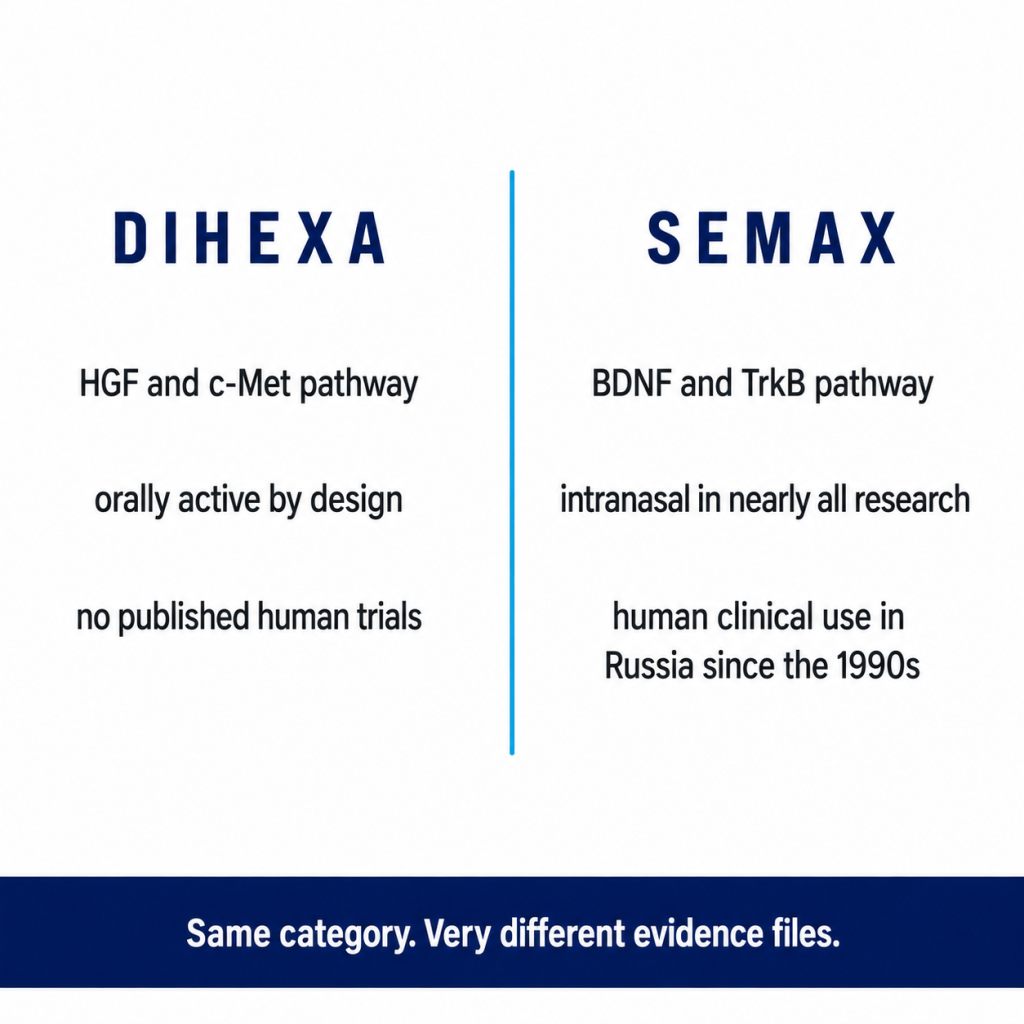
The two work through different pathways, with Semax acting largely on BDNF and its TrkB receptor and dihexa amplifying hepatocyte growth factor signaling at the c-Met receptor.
Route separates them in practice, since Semax is delivered intranasally in nearly all published work while dihexa was chemically engineered to survive the gut and cross the blood-brain barrier.
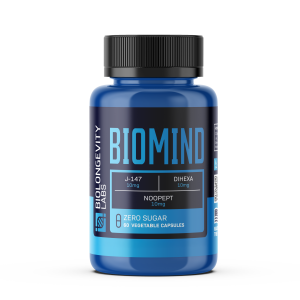
BioLongevity does not sell a Semax product, and dihexa appears in cycled cognitive formulas rather than daily capsules because of how its pharmacology behaves.
Only One of These Two Has Ever Been Given to a Patient
Semax has a human clinical file. Dihexa does not, and that single fact reorganizes the entire comparison.
Semax is a seven amino acid peptide, Met-Glu-His-Phe-Pro-Gly-Pro, built from the 4 to 7 fragment of adrenocorticotropic hormone with a Pro-Gly-Pro tail attached to slow its breakdown. The design keeps the neurological activity of the parent hormone without the hormonal effects, which is why it’s classed as a non-corticotropic melanocortin derivative.
Russian clinicians began studying it in patients in the 1990s. In an early controlled study of 30 patients in the acute phase of hemispheric ischemic stroke, compared against 80 patients on conventional therapy, researchers reported faster regression of focal neurological deficits, with 12 mg daily used for moderate strokes and 18 mg for severe ones. Russian research groups today still describe Semax as a peptide used in the treatment of patients with severe impairment of cerebral blood circulation.
Dihexa’s file reads differently. It’s a modified angiotensin IV analog, developed at Washington State University and engineered specifically to be orally active and blood-brain barrier permeant after its parent compound proved too fragile to survive serum. A 2026 review of therapeutic peptides grouped dihexa with selank and semax and noted a current lack of clinical trials for the category.
Two points of clarity before going further. Neither compound is approved by the FDA or the EMA, and BioLongevity does not sell Semax, so nothing below is a pitch for it.
What the Russian Semax Trials Measured, and What They Missed
The Semax human literature is real, specific, and narrower than its reputation suggests. It’s worth reading closely rather than taking on faith.
The most detailed recent example enrolled 110 patients recovering from ischemic stroke, split into early and late rehabilitation groups. Patients on the standard protocol received 6,000 mcg per day in two 10-day courses separated by a 20-day break. Plasma BDNF rose and stayed elevated for the whole study period, and Barthel index scores improved faster, with BDNF levels tracking the functional score.
Outside stroke, a controlled clinical study in optic nerve disease compared intranasal Semax and endonasal electrophoresis against a control group and reported improvements in visual acuity, visual field, and color vision alongside standard therapy.
The record also contains a genuine null. In an open-label trial in 27 patients with motor neuron disease, intranasal Semax at 12 mg daily produced no change in the course of denervation or in clinical rating scales, though quality of life scores improved through better emotional state and motivation.
Put the three side by side and the shape of the record is clear. Semax’s human data sits in acute neurological recovery, comes from small single-country studies, is published mostly in Russian-language journals, and has never passed through FDA or EMA review. Those are real limits on how far the findings travel.
It’s also more human data than the vast majority of nootropic ingredients ever accumulate, which is precisely why Semax keeps coming up in this comparison.
Semax Raises BDNF, Dihexa Amplifies HGF
The two peptides push on different growth factor systems, and that divergence explains almost every practical difference between them.
Semax acts largely through brain-derived neurotrophic factor and its receptor. In rat hippocampus, a single dose of 50 micrograms per kilogram raised BDNF protein about 1.4-fold and TrkB tyrosine phosphorylation about 1.6-fold, with a threefold rise in exon III BDNF messenger RNA, and the treated animals showed more conditioned avoidance responses. A separate study found specific, calcium-dependent Semax binding sites in rat basal forebrain with a dissociation constant of 2.4 nanomolar, and intranasal dosing raised BDNF there within three hours while leaving the cerebellum unchanged.
The melanocortin side of Semax matters too. In a chronic unpredictable stress model in rats, Semax reversed stress-induced anhedonia, adrenal hypertrophy, and the drop in hippocampal BDNF, performing similarly to a direct melanocortin receptor agonist. Transcriptome work in a rat stroke model found Semax suppressed inflammatory gene expression while activating neurotransmission-related genes, which is a broad signaling profile rather than a single narrow target.
Dihexa takes a different route entirely. It binds hepatocyte growth factor and potentiates that protein’s activity at the c-Met receptor, and researchers have described the brain HGF and c-Met system as a target for age-related cognitive decline because activating it drives dendritic arborization and new synapse formation. Our full breakdown of the dihexa research walks through the spine counts and electrophysiology behind that claim in detail.
The pathway split also sets the clock. Raising BDNF is a signaling change measured in hours, so a Semax course reads as an acute, repeatable intervention. Building new synaptic connections through c-Met is a structural change measured in weeks, which is why dihexa protocols are written as cycles rather than as a daily habit.
The Nose Versus the Gut
Route is the most practical difference between these two, and it follows directly from their chemistry.
Semax is a short unmodified peptide chain. Delivered by mouth, it faces the same problem every peptide of that shape does, which is why the published rodent work and the human courses both use intranasal delivery. The nasal route sidesteps digestion and gives the peptide a short path toward the brain, and it’s the reason Semax is dosed as nasal drops or spray rather than a capsule.
Dihexa was built to solve exactly this problem. Its parent compound broke down in rat serum within minutes, so chemists added a hexanoic acid group and an aminohexanoic amide tail to raise hydrophobicity and cut hydrogen bonding, producing an analog that stayed active after oral dosing and concentrated in brain tissue. If you want the general rules that decide this, size and structure are what determine which peptides survive digestion.
Which is why only one of the two can live in a capsule. A nasal peptide belongs to a drug-style protocol; an orally active small molecule fits a supplement routine.
One safety point belongs here. Because dihexa amplifies HGF and c-Met signaling, a growth pathway active in tissues throughout the body, anyone with a personal or family history of cancer, anyone taking medication that acts on the central nervous system, and anyone managing a neurological condition should speak with a qualified clinician before using it.
Reading the Two Files Side by Side
This table is arranged around the decisions a reader is actually making, not around a feature list.
| The question you’re really asking | Dihexa | Semax |
|---|---|---|
| Has it been given to people in a published trial? | No published human study exists | Yes, Russian clinical literature dating to the 1990s |
| How does that record hold up by Western standards? | Preclinical only, cell culture and rodents | Human data exists, but from small single-country studies outside FDA and EMA review, largely in Russian |
| What pathway does it move? | Hepatocyte growth factor at the c-Met receptor | BDNF at TrkB, plus melanocortin and neurotransmission signaling |
| What kind of change is it after? | Structural, new synaptic connections built over weeks | Signaling, measured in hours to days |
| Where is the evidence concentrated? | Synaptogenesis and spatial memory in aged and impaired rodents | Acute neurological recovery, mainly ischemic stroke |
| How is it delivered? | Orally active and blood-brain barrier permeant by design | Intranasal in nearly all published research |
| Can you buy it as a supplement? | Yes, in cycled cognitive formulas | Not offered by BioLongevity |
The two columns answer different questions rather than competing for the same answer. Semax carries the longer human track record; dihexa carries the more precisely mapped mechanism for building synaptic architecture.
Why Only One of These Two Ends Up in a Capsule
Dihexa’s oral activity is what makes it usable in a consumer formula, and that’s the practical reason it appears on supplement labels while Semax doesn’t.
BioMind is built around that logic. It delivers 20 mg of dihexa per serving for synaptic connectivity, alongside 20 mg of J-147 for mitochondrial energy metabolism in neural tissue and 20 mg of noopept for memory encoding and neuroprotective signaling. The suggested protocol is two capsules in the morning, two to three times per week on non-consecutive days, spacing that fits a mechanism working on structure rather than on signal.
If you’d rather have something for daily use, BioNervousSystem (Cerluten) is the other side of the shelf. It’s a nervous system peptide bioregulator at 40 mg per capsule, taken one to two capsules once or twice daily with food, designed to support healthy nervous system and cognitive function on an everyday schedule rather than a cycled one.
Label verification is the part of this category most people skip, and it’s the part that decides whether what you paid for is what’s in the capsule. BioLongevity runs every batch through a cGMP-certified U.S. facility and independent HPLC testing with mass spectrometry, then publishes every batch’s Certificate of Analysis so you can check identity and purity yourself.
Read More From the BioLongevity Blog
- Do Neuroplasticity Supplements Actually Rewire Your Brain?
- Noopept Supplement Guide: Benefits, Dosage, and Legal Status
- Cerluten Peptide Benefits: What the Research Shows
Choose your compound by the schedule you’ll keep. BioMind suits a cycled, twice-weekly protocol aimed at synaptic connectivity, with all three amounts printed on the label. Browse the brain and memory collection if you want to compare it against a daily option first.
Frequently Asked Questions
Is dihexa or Semax better studied?
Semax has the deeper human record, with clinical studies in Russia going back to the 1990s in stroke, optic nerve disease, and neurological recovery. Dihexa has no published human trials, so its file is entirely cell culture and animal research.
Do dihexa and Semax work the same way?
No. Dihexa amplifies hepatocyte growth factor signaling at the c-Met receptor to support new synapse formation. Semax works mainly by raising BDNF and TrkB activity, with additional effects on melanocortin and neurotransmission pathways.
Why is Semax taken through the nose?
Semax is a short seven amino acid peptide that doesn’t survive oral delivery well, so nearly all published research uses intranasal dosing. That route bypasses digestion and is how the human clinical courses were administered.
Can you take dihexa and Semax together?
There’s no published research on the combination in humans, so no protocol exists to point to. Anyone considering either compound should discuss it with a qualified clinician, particularly alongside medication acting on the central nervous system.
Does BioLongevity sell Semax?
No. BioLongevity’s cognitive formula, BioMind, contains dihexa, J-147, and noopept, and Semax is not part of the catalog.
Ask a qualified clinician before starting any supplement if you are pregnant, nursing, taking medication, or managing a medical condition. This article is educational and does not replace medical advice.
These statements have not been evaluated by the Food and Drug Administration. This product is not intended to diagnose, treat, cure, or prevent any disease.
References
- Gusev EI, Skvortsova VI, Miasoedov NF, Nezavibat’ko VN, Zhuravleva EIu, Vanichkin AV. [Effectiveness of semax in acute period of hemispheric ischemic stroke (a clinical and electrophysiological study)]. Zh Nevrol Psikhiatr Im S S Korsakova. 1997;97(6):26-34. Russian. PubMed
- Filippenkov IB, Stavchansky VV, Denisova AE, et al. Novel insights into the protective properties of ACTH(4-7)PGP (Semax) peptide at the transcriptome level following cerebral ischaemia-reperfusion in rats. Genes (Basel). 2020;11(6):681. DOI
- McCoy AT, Benoist CC, Wright JW, et al. Evaluation of metabolically stabilized angiotensin IV analogs as procognitive/antidementia agents. J Pharmacol Exp Ther. 2012;344(1):141-154. DOI
- Rahman OF, Lee SJ, Seeds WA. Therapeutic peptides in orthopaedics: applications, challenges, and future directions. J Am Acad Orthop Surg Glob Res Rev. 2026;10(1). DOI
- Gusev EI, Martynov MY, Kostenko EV, Petrova LV, Bobyreva SN. [The efficacy of semax in the treatment of patients at different stages of ischemic stroke]. Zh Nevrol Psikhiatr Im S S Korsakova. 2018;118(3. Vyp. 2):61-68. Russian. DOI
- Polunin GS, Nurieva SM, Baiandin DL, Sheremet NL, Andreeva LA. [Evaluation of therapeutic effect of new Russian drug semax in optic nerve disease]. Vestn Oftalmol. 2000;116(1):15-18. Russian. PubMed
- Serdiuk AV, Levitskii GN, Miasoedov NF, Skvortsova VI. [The study of chronic partial denervation and quality of life in patients with motor neuron disease treated with semax]. Zh Nevrol Psikhiatr Im S S Korsakova. 2007;107(4):29-39. Russian. PubMed
- Dolotov OV, Karpenko EA, Inozemtseva LS, et al. Semax, an analog of ACTH(4-10) with cognitive effects, regulates BDNF and trkB expression in the rat hippocampus. Brain Res. 2006;1117(1):54-60. DOI
- Dolotov OV, Karpenko EA, Seredenina TS, et al. Semax, an analogue of adrenocorticotropin (4-10), binds specifically and increases levels of brain-derived neurotrophic factor protein in rat basal forebrain. J Neurochem. 2006;97(Suppl 1):82-86. DOI
- Inozemtseva LS, Yatsenko KA, Glazova NY, et al. Antidepressant-like and antistress effects of the ACTH(4-10) synthetic analogs Semax and Melanotan II on male rats in a model of chronic unpredictable stress. Eur J Pharmacol. 2024;984:177068. DOI
- Wright JW, Harding JW. The brain hepatocyte growth factor/c-Met receptor system: a new target for the treatment of Alzheimer’s disease. J Alzheimers Dis. 2015;45(4):985-1000. DOI