


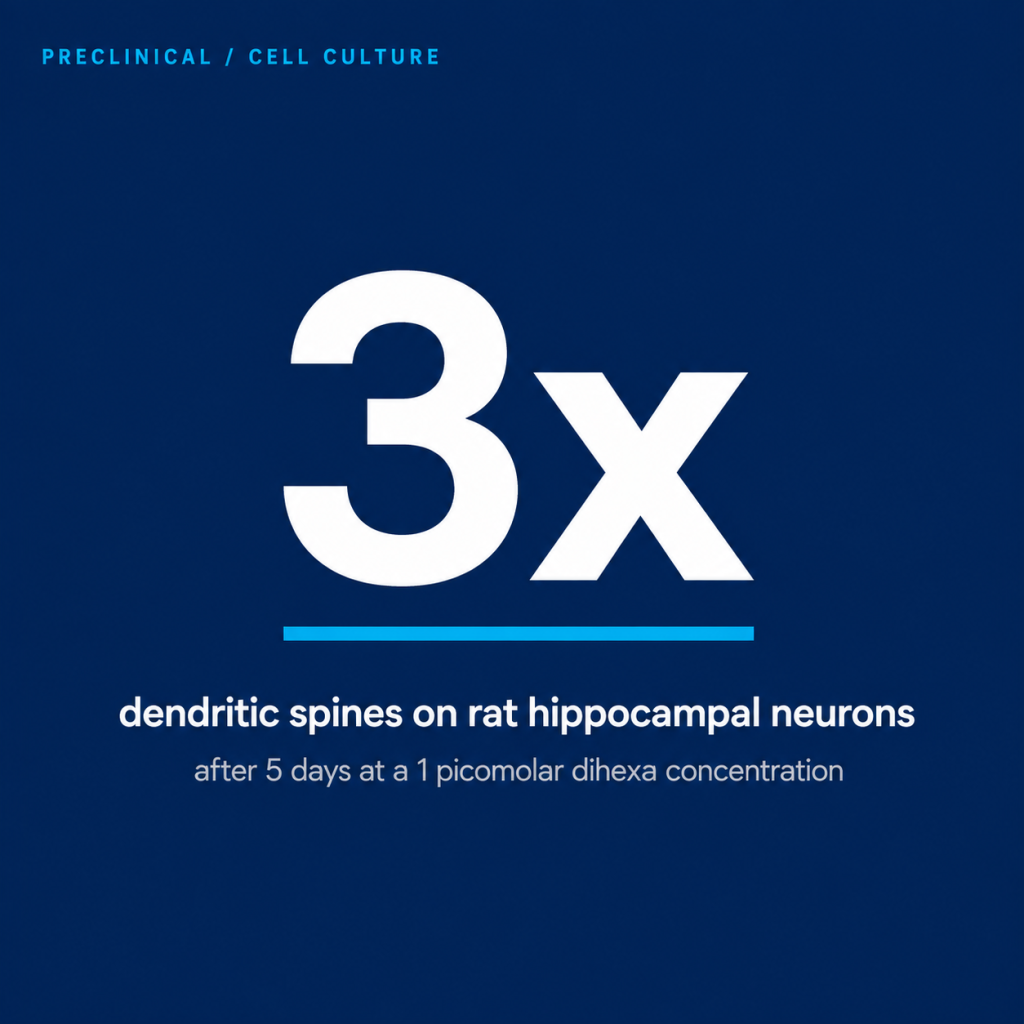
Dihexa is a synthetic angiotensin IV analog studied for its ability to build new connections between brain cells, and its headline finding is unusually specific. In cultured rat hippocampal neurons, five days of exposure at a concentration of one picomolar produced close to three times the number of dendritic spines seen in untreated cells.
That measurement is why the compound keeps showing up in advanced nootropic formulas, and it’s the right place to start. Most of what’s written about dihexa online skips the numbers and jumps straight to the promise.
Key Takeaways

The Short Version
Dihexa is an angiotensin IV analog, also called PNB-0408, studied for its effect on synapse formation in the brain.
It works by amplifying hepatocyte growth factor signaling at the c-Met receptor rather than activating that receptor on its own.
In cell-based research, dihexa nearly tripled dendritic spine counts at picomolar concentrations and raised the rate of functional synaptic signaling by about 60 percent.
All published dihexa research is preclinical, so the compound belongs in structured, cycled protocols rather than open-ended daily use.
The Spine Count That Put Dihexa on the Map
Dihexa’s reputation rests on a 2012 pharmacology paper that measured dendritic spines directly instead of inferring them from behavior. Dendritic spines are the small protrusions on a neuron where incoming connections land, and their number is one of the closest physical proxies for how densely a brain region is wired.
Researchers treated cultured rat hippocampal neurons with dihexa for five days at a concentration of one picomolar, which is about a trillionth of a mole per liter. The spine count rose from an average of 15 per 50 micrometers of dendrite to 41, close to a threefold increase over vehicle-treated controls.
You’ll see dihexa described online as being millions of times more potent than BDNF. The number in the published record is narrower and more useful: 15 spines becoming 41, at an exposure most nootropic ingredients never operate at.
Be precise about the setting, though. This was cell culture, so it tells you what dihexa does to a neuron rather than what it does to a memory.
Dihexa Amplifies a Growth Signal Your Brain Already Makes
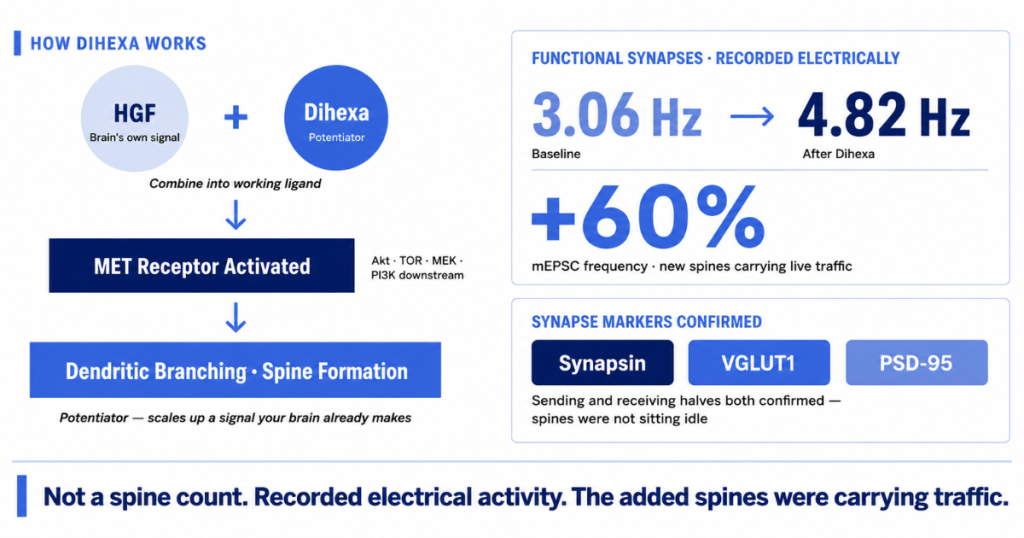
Dihexa doesn’t switch on a receptor by itself. It pairs with hepatocyte growth factor, a protein the brain already produces, and the two combine into a working ligand that activates the HGF receptor and the growth signaling downstream of it.
Two separate research groups have shown the effect depends on that pathway rather than on something else dihexa happens to do. In zebrafish, its protective effect on sensory hair cells weakened when researchers added an HGF blocker, and weakened again when they inhibited the downstream targets Akt, TOR, and MEK. In mice, blocking PI3K with wortmannin reversed dihexa’s anti-inflammatory and anti-apoptotic effects the same way.
For anyone reading a label, that makes dihexa a potentiator. It scales up a signal your own biology is already generating instead of flooding a receptor from the outside, which is why researchers have described the HGF and c-Met system as a target in its own right for age-related cognitive decline.
The receptor itself is well characterized independently of dihexa. In developing mouse forebrain, MET signaling drives dendritic branching and spine formation, and that finding comes from basic neurodevelopmental biology rather than supplement research. It’s worth understanding how peptides signal inside the body before you evaluate any claim in this category.
One wrinkle turns up if you go reading the primary literature yourself. The 2014 paper that first tied dihexa’s effects to HGF was retracted in 2025 over figure integrity, so the mechanism now rests on the independent work above rather than on that study. Our guide to dihexa side effects and safety covers what the retraction does and doesn’t change.
New Spines Only Count If They Carry a Signal
A higher spine count only matters if those spines become working synapses, and this is the part of the dihexa research that gets almost no coverage.
The 2012 team tested it two ways. They stained the treated neurons for synapsin, VGLUT1, and PSD-95, the standard markers for the sending and receiving halves of a synapse, and confirmed the new spines were paired with presynaptic terminals.
Then they recorded electrical activity. Miniature excitatory postsynaptic current frequency, which tracks the number of functional synapses, rose from 3.06 Hz to 4.82 Hz, an increase of roughly 60 percent, with no change in the size or shape of individual signals.
Read together, those results say the added spines were carrying traffic rather than sitting idle. That’s a stronger claim than a spine count on its own, and it’s the best single argument in dihexa’s file.
What Aged Rats Did After Oral Dihexa
Dihexa was engineered to survive the gut and reach the brain, which is rare for a peptide-derived molecule. Its parent compound, Nle1-angiotensin IV, broke down in rat serum in under two minutes, and the chemical changes that produced dihexa were designed to fix that.
They worked. In the same 2012 study, dihexa showed a terminal half-life of roughly 8.8 to 12.7 days in rats depending on the route, concentrated in brain tissue relative to blood, and stayed active by mouth. Most peptides can’t make that trip, and the size and structure rules that decide which ones survive digestion explain why dihexa’s chemistry is the unusual case rather than the norm.
The behavioral test used 24-month-old rats, an age at which spatial learning is already declining. Oral dihexa at 2 mg/kg per day significantly improved their performance in the Morris water maze, the standard rodent test of spatial memory, on most days of training.
The group was small and the animals weren’t screened for cognitive deficits beforehand. Still, an oral compound moving a behavioral endpoint in aged animals sits a tier above a cell-culture result, and it’s what turned dihexa from a chemistry curiosity into a research program.
How Dihexa Compares With the Rest of the Angiotensin IV Family
Dihexa is the most refined member of a peptide family studied for cognition since the 1980s, and the family-level evidence is broader than dihexa’s own. A systematic review of 32 experimental studies found that angiotensin IV and its analogs, including dihexa, improved performance in eight of nine models of cognitive impairment tested on spatial working memory and passive avoidance tasks.
Dihexa specifically has since been examined across several models of neurological stress:
| Model | What was measured | What the research found |
|---|---|---|
| APP/PS1 mouse, Alzheimer’s-type pathology | Spatial learning, neuronal counts, inflammatory markers | Dihexa restored maze performance and raised synaptic protein expression through PI3K and AKT signaling |
| Aged rat, 24 months old | Morris water maze latency | Oral dosing improved spatial learning on most training days |
| Zebrafish lateral line hair cells | Survival after aminoglycoside exposure | Dihexa protected hair cells, and an HGF blocker removed the protection |
| Rat, 3-nitropropionic acid model of Huntington’s | Motor function, spatial learning, histology | No protection against the toxin-induced deficits |
The mouse work on Alzheimer’s-type pathology is the most detailed of these, and the zebrafish study matters because it confirmed the growth factor mechanism in a tissue with nothing to do with memory. The Huntington’s model, where dihexa did not protect against a mitochondrial toxin, is just as informative. It points the compound’s likely value toward conditions where synaptic connectivity is the bottleneck rather than cellular energy failure.
One thing the whole family shares: none of it is human. A 2026 review of therapeutic peptides described dihexa alongside selank and semax as compounds with promising preclinical mechanisms and a current absence of clinical trials. That’s the honest tier, and it’s the same tier that applies to most compounds in this category, including noopept’s evidence base and the clinical report behind the Cerluten brain peptide complex.
Why Dihexa Is a Cycled Compound Rather Than a Daily One
The pharmacology argues for spaced dosing, and this is the most practical thing the research has to say. A molecule with a half-life measured in days accumulates, so daily intake compounds an exposure that hasn’t cleared yet.
The receptor biology points the same direction. In the mouse forebrain work, sustained MET activation actually held back the functional maturation of glutamatergic synapses, while normal time-limited signaling supported it. New connections need a quiet window to stabilize, which is the same reason a training block needs rest days.
That’s why serious dihexa protocols are built around non-consecutive dosing with scheduled off-periods rather than a daily capsule habit. With this compound, the schedule matters more than the size of the dose.
One safety point belongs here and only here. Because dihexa amplifies HGF and c-Met signaling, a growth pathway active in tissues throughout the body, anyone with a personal or family history of cancer, anyone taking medication that affects the central nervous system, and anyone managing a neurological condition should talk with a qualified clinician before using it.
Where Dihexa Shows Up in a Cognitive Formula
Dihexa is rarely used alone, because synaptic architecture is only one lever behind cognitive performance. Formulas that include it pair it with compounds working on separate pathways.
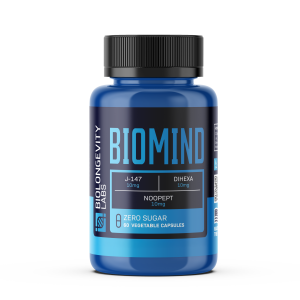
BioMind is built that way. It delivers 10 mg of dihexa per capsule for synaptic connectivity, alongside J-147 for mitochondrial energy metabolism in neural tissue and noopept for memory encoding and neuroprotective signaling. The suggested protocol is two capsules in the morning, two to three times per week on non-consecutive days, which matches what the pharmacology above would predict.
Quality verification matters more here than in almost any other category, because compounds like dihexa sit outside the conventional supplement framework and nobody is checking a label for you. Every BioLongevity batch is manufactured in a cGMP-certified U.S. facility, third-party tested by HPLC with mass spectrometry, and documented with a Certificate of Analysis you can read before you buy.
Sleep, aerobic exercise, and real cognitive demand are still what drives measurable neuroplasticity, and a synaptic compound works best layered on top of them. If you’re building a cognitive routine around connectivity rather than stimulants, BioMind and the rest of the brain and memory formulas are the place to start.
Frequently Asked Questions
What is dihexa peptide used for?
Dihexa has been studied in preclinical research for synapse formation, spatial memory, and neuroprotection. In consumer formulas it’s included to support synaptic connectivity and cognitive performance as part of a structured, cycled protocol.
Is dihexa the same as angiotensin IV?
No. Dihexa is a chemically modified analog derived from angiotensin IV, engineered to resist breakdown, cross the blood-brain barrier, and stay active after oral dosing. Angiotensin IV itself degrades in the bloodstream within minutes.
Are there human studies on dihexa?
Not as of now. Every published study on dihexa is preclinical, using cell cultures, rodents, or zebrafish, and a 2026 peptide review noted the absence of clinical trials. That’s the accurate evidence tier for any claim you read about it.
How does dihexa differ from BDNF-based nootropics?
Dihexa acts on the hepatocyte growth factor and c-Met system, a separate pathway from BDNF and TrkB. Rather than raising a growth factor’s level, it makes the brain’s existing HGF signal more effective at its receptor.
Why is dihexa taken only a few times per week?
Dihexa has a long half-life measured in days, and preclinical receptor research suggests that continuous MET activation can interfere with synapse maturation. Non-consecutive dosing with scheduled off-periods gives new connections time to stabilize.
Ask a qualified clinician before starting any supplement if you are pregnant, nursing, taking medication, or managing a medical condition. This article is educational and does not replace medical advice.
These statements have not been evaluated by the Food and Drug Administration. This product is not intended to diagnose, treat, cure, or prevent any disease.
References
- McCoy AT, Benoist CC, Wright JW, et al. Evaluation of metabolically stabilized angiotensin IV analogs as procognitive/antidementia agents. J Pharmacol Exp Ther. 2012;344(1):141-154. DOI
- Uribe PM, Kawas LH, Harding JW, Coffin AB. Hepatocyte growth factor mimetic protects lateral line hair cells from aminoglycoside exposure. Front Cell Neurosci. 2015;9:3. DOI
- Wright JW, Harding JW. The brain hepatocyte growth factor/c-Met receptor system: a new target for the treatment of Alzheimer’s disease. J Alzheimers Dis. 2015;45(4):985-1000. DOI
- Sun X, Deng Y, Fu X, et al. AngIV-analog dihexa rescues cognitive impairment and recovers memory in the APP/PS1 mouse via the PI3K/AKT signaling pathway. Brain Sci. 2021;11(11):1487. DOI
- Peng Y, Lu Z, Li G, et al. The autism-associated MET receptor tyrosine kinase engages early neuronal growth mechanism and controls glutamatergic circuits development in the forebrain. Mol Psychiatry. 2016;21(7):925-935. DOI
- Ho JK, Nation DA. Cognitive benefits of angiotensin IV and angiotensin-(1-7): a systematic review of experimental studies. Neurosci Biobehav Rev. 2018;92:209-225. DOI
- Wells RG, Azzam AF, Hiller AL, Sardinia MF. Effects of an angiotensin IV analog on 3-nitropropionic acid-induced Huntington’s disease-like symptoms in rats. J Huntingtons Dis. 2024;13(1):55-66. DOI
- Rahman OF, Lee SJ, Seeds WA. Therapeutic peptides in orthopaedics: applications, challenges, and future directions. J Am Acad Orthop Surg Glob Res Rev. 2026;10(1). DOI