



Noopept is a synthetic dipeptide sold online as a nootropic “research compound” for memory, focus, and brain support. Most of the research behind those claims comes from animal and cell studies, not human trials, and U.S. regulators classify it as an unapproved drug rather than a dietary supplement.
That gap between the marketing and the evidence is the whole story with noopept. The compound is genuinely interesting, with decades of preclinical work behind it, but the human data is thin and the legal picture is murkier than most product pages admit. Here’s what’s actually been shown, in what kind of study, and what to know before you go looking for it.
Key Takeaways

The Short Version
Noopept is a synthetic cognitive compound studied mainly in animals and cells, with limited human trial data.
It is thought to work through a metabolite that influences acetylcholine signaling and raises neurotrophic factors like BDNF and NGF in animal research.
The FDA does not recognize noopept as a dietary supplement and has issued import alerts and warning letters treating it as an unapproved drug.
If you research noopept, third-party testing and a Certificate of Analysis matter more here than with conventional supplements, because the category is unregulated.
What Is Noopept?
Noopept is a synthetic dipeptide developed in Russia in the 1990s as a cognitive compound. Its chemical name is N-phenylacetyl-L-prolylglycine ethyl ester, and it also goes by GVS-111 and omberacetam.
It’s often grouped with the racetams, the family that includes piracetam, but its structure is different. Noopept lacks the pyrrolidone ring that defines a true racetam, so it’s more accurately described as racetam-adjacent.
One practical difference drives a lot of the interest: noopept is active at far lower doses than piracetam, measured in milligrams rather than grams. People sometimes read that as “stronger,” but a lower effective dose is not the same as a better-proven effect.
In Russia and several post-Soviet countries, noopept is an approved prescription medicine. In the United States it has no approved medical or dietary use, which is why sellers tend to label it a research compound.
How Noopept Is Thought to Work
Noopept’s proposed mechanism centers on a metabolite, not the compound itself. The parent molecule clears the bloodstream quickly, and researchers attribute its longer-lasting effects to cycloprolylglycine, a breakdown product that forms after dosing.
From there, the picture is built almost entirely on preclinical research. The main pathways studied include cholinergic signaling, glutamate receptor activity, and neurotrophic factor expression.
In rat hippocampus, a study published in the Bulletin of Experimental Biology and Medicine found that noopept increased expression of nerve growth factor (NGF) and brain-derived neurotrophic factor (BDNF), two proteins tied to neuroplasticity and memory. A separate rat study reported that it also lowered the activity of stress-induced kinases linked to neurodegeneration while raising BDNF.
In cell-based research, noopept has been shown to activate the transcription factor HIF-1 in human neuroblastoma cells, a pathway involved in how cells respond to low oxygen.
Here’s how the main proposed mechanisms line up against the strength of evidence behind each:
| Proposed mechanism | What it may do | Strongest evidence to date |
|---|---|---|
| Cycloprolylglycine metabolite | Modulates acetylcholine and AMPA receptor signaling | Animal and cell research |
| BDNF and NGF increase | Supports neuroplasticity and memory pathways | Animal research |
| Antioxidant activity | Reduces lipid peroxidation and oxidative stress | Animal research |
| HIF-1 activation | Influences cellular oxygen-response genes | Cell-based research |
The honest takeaway: these are plausible, repeatedly studied mechanisms, but they’re mostly demonstrated in rats and cell cultures, not in people.
What the Research Actually Shows: Humans, Animals, and Cells
The evidence on noopept is wide in animals and narrow in humans, and that distinction matters more than any single benefit claim. Sorting the studies by what was actually tested is the most useful thing a reader can do here.
The human data is limited and dated. In an open-label clinical study of 60 stroke patients, 20 mg of noopept daily for two months was associated with improved cognitive test scores and was described as well tolerated. An earlier clinical EEG study in patients with mild cognitive impairment from trauma or vascular disease reported brain-activity changes and an anxiety-reducing effect.
Both human studies were small, open-label rather than blinded, and conducted in clinical patient groups, not healthy adults seeking a focus boost. That’s a meaningful limitation when you’re reading benefit claims aimed at the general public.
The animal evidence is broader. In a rat model of Alzheimer-type pathology, noopept reduced memory deterioration and markers of oxidative damage. In diabetic rats, it reduced oxidative neurotoxicity and neuropathic pain, and in a prediabetes mouse model it protected against DNA damage in several organs.
Here’s the evidence stacked by study type:
| Evidence tier | What’s been studied | Strength |
|---|---|---|
| Human trials | Small open-label studies in stroke and cognitive-impairment patients | Limited, low certainty |
| Animal studies | Memory, neuroprotection, antioxidant, and anti-inflammatory effects | Moderate volume, indirect for humans |
| Cell studies | Receptor signaling, neurotrophic and HIF-1 pathways | Mechanistic only |
Researchers are still investigating whether these preclinical findings translate to healthy people. As of now, that translation hasn’t been established in large, controlled human trials.
Potential Benefits People Look For
People typically turn to noopept for memory, focus, and general brain support, and the research offers partial, mostly preclinical backing for those goals. None of it rises to the level of a proven benefit in healthy adults.
The most commonly cited reasons people research noopept are:
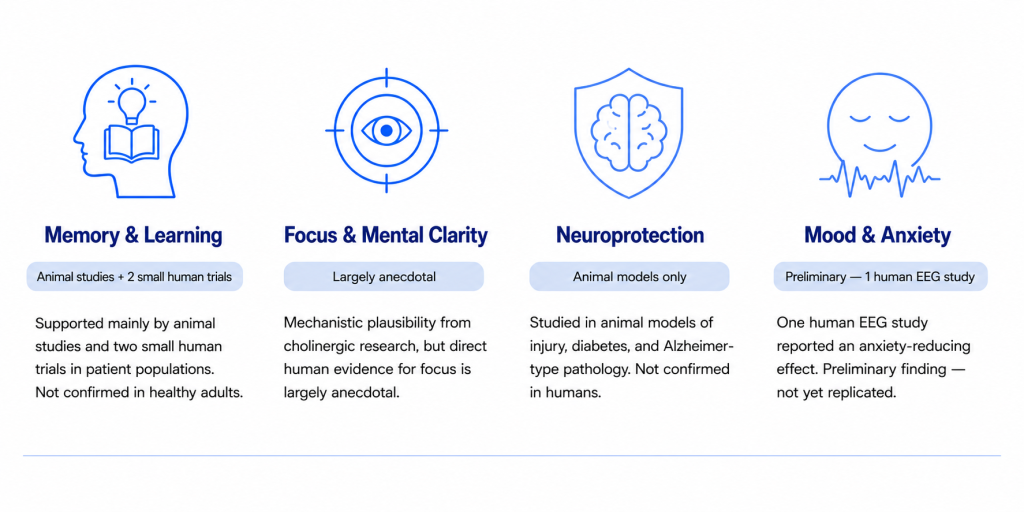
- Memory and learning. Supported mainly by animal studies and two small human trials in patient populations.
- Focus and mental clarity. Largely anecdotal, with mechanistic plausibility from cholinergic research.
- Neuroprotection. Studied in animal models of injury, diabetes, and Alzheimer-type pathology, not confirmed in humans.
- Mood and anxiety. One human EEG study reported an anxiety-reducing effect, which is preliminary.
A fair way to read this: noopept has been studied for these outcomes, and some animal results are encouraging, but “studied for” is not “shown to work” in people. Treat any product page that states these as settled benefits with skepticism.
Noopept Dosage and How People Use It
In the available studies and community use, noopept doses typically fall between 10 and 30 mg, taken one to three times daily. The human stroke study used 20 mg per day, which sits in the middle of that range.
Common usage patterns reported by users include:
- Taking it with food, since absorption is reported to improve that way.
- Pairing it with a choline source such as alpha-GPC or CDP-choline, because some users report headaches without one.
- Cycling on and off rather than using it continuously, given the lack of long-term safety data.
These are observational patterns, not validated protocols. There’s no established optimal dose for healthy adults, and no long-term human dosing studies to draw on.
Ask a qualified clinician before starting any new compound, especially one that is not an approved supplement and may interact with medications or existing conditions.
Side Effects and Safety Considerations
Reported noopept side effects are usually mild and dose-dependent, but the long-term safety picture in humans is essentially unknown. The short human studies that exist described it as well tolerated, which is reassuring but far from conclusive.
The side effects most commonly reported include:
- Headaches, often linked to low choline
- Irritability
- Sleep disturbances or insomnia
- Reports of elevated blood pressure at higher doses
There’s also a mechanism-based caution worth flagging. Because noopept can activate HIF-1, a pathway that can increase oxygen supply to tissues including tumors, some sources advise against use by anyone with a history of cancer. This is precautionary and based on the compound’s biology rather than human outcome data.
The bigger issue is the absence of long-term human safety research. Nobody has rigorously studied what daily noopept use does over months or years.
Is Noopept Legal? The Regulatory Reality
The FDA has issued import alerts treating noopept as an active pharmaceutical ingredient related to piracetam, and has sent warning letters to companies selling it with structure-function or disease claims.
The regulatory status of noopept varies sharply by country:
- United States. Not approved as a drug or supplement; sold in a regulatory gray area.
- Russia and some post-Soviet states. Approved prescription or over-the-counter medicine.
- United Kingdom. Not illegal to possess, but sale for human consumption is restricted.
- Other countries. Rules range from unregulated to controlled, so local law matters.
None of this makes noopept inherently dangerous, but it does mean buyers carry more responsibility for verifying what they’re getting. There is no regulatory body checking that a given product contains what the label says.
What to Look for If You’re Researching Noopept
Because noopept sits outside the typical supplement framework, quality verification falls entirely on the buyer, and the usual label-literacy rules apply with extra force. This nootropic category is exactly where third-party testing earns its keep.
If you’re evaluating a source, look for:
- A current Certificate of Analysis (COA) that matches the specific batch.
- Third-party testing for both identity and purity, ideally by HPLC or LC-MS.
- Transparent labeling that states the exact compound and amount, with no proprietary blends hiding the dose.
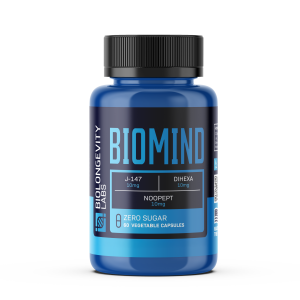
BioLongevity includes noopept within BioMind, a neurocognitive formula that also includes J-147 and Dihexa, and it’s documented with the same testing and Certificate of Analysis standards applied across our catalog.
Frequently Asked Questions
Is noopept a legal dietary supplement in the United States?
No. The FDA does not recognize noopept as a dietary supplement and treats it as an unapproved drug, having issued import alerts and warning letters. It is generally sold as a research compound rather than a supplement.
How is noopept different from piracetam?
Noopept is structurally distinct from piracetam and lacks the pyrrolidone ring that defines true racetams. It’s active at much lower doses, milligrams rather than grams, though a lower dose doesn’t mean a better-proven effect.
How long does noopept take to work?
Users commonly report effects within 15 to 30 minutes, with the compound itself clearing the bloodstream quickly. Its longer-acting effects are attributed to a metabolite, cycloprolylglycine, rather than the parent molecule.
Do you need to take choline with noopept?
Some users pair noopept with a choline source like alpha-GPC or CDP-choline because headaches are a common complaint without one. This is based on user reports rather than controlled studies.
Is noopept safe for long-term use?
The long-term safety of noopept in humans has not been studied. Short human trials described it as well tolerated, but there’s no rigorous data on daily use over months or years.
A Note Before You Decide
Noopept is one of the more researched compounds in the nootropic space, yet most of that research lives in animals and cell cultures. The smartest move is to weigh the preclinical promise against the thin human evidence, rather than the confident benefit claims you’ll see on most sales pages.
For readers comparing advanced cognitive compounds, BioLongevity’s formulas are documented with third-party testing and Certificates of Analysis, so you can at least verify what you’re looking at.
Ask a qualified clinician before starting any supplement if you are pregnant, nursing, taking medication, or managing a medical condition.
These statements have not been evaluated by the Food and Drug Administration. This product is not intended to diagnose, treat, cure, or prevent any disease.
References
[1] Amelin AV, Iliukhina AIu, Shmonin AA. Noopept in the treatment of mild cognitive impairment in patients with stroke. Zhurnal nevrologii i psikhiatrii imeni S.S. Korsakova. 2011;111(10 Pt 1):44-46. PubMed
[2] Bochkarev VK, Teleshova ES, Siuniakov SA, Davydova DV, Neznamov GG. Clinical and electroencephalographic characteristic of noopept in patients with mild cognitive impairment of posttraumatic and vascular origin. Zhurnal nevrologii i psikhiatrii imeni S.S. Korsakova. 2008;108(11):47-54. PubMed
[3] Ostrovskaya RU, Gudasheva TA, Zaplina AP, et al. Noopept stimulates the expression of NGF and BDNF in rat hippocampus. Bulletin of Experimental Biology and Medicine. 2008;146(3):334-337. doi:10.1007/s10517-008-0297-x
[4] Ostrovskaia RU, Vakhitova IuV, Salimgareeva MKh, et al. On the mechanism of noopept action: decrease in activity of stress-induced kinases and increase in expression of neurotrophins. Eksperimental’naia i klinicheskaia farmakologiia. 2010;73(12):2-5. PubMed
[5] Ostrovskaia RU, Tsaplina AP, Vakhitova IuV, Salimgareeva MKh, Iamidanov RS. Effect of the novel nootropic and neuroprotective dipeptide noopept on the streptozotocin-induced model of sporadic Alzheimer disease in rats. Eksperimental’naia i klinicheskaia farmakologiia. 2010;73(1):2-6. PubMed
[6] Zainullina LF, Ivanova TV, Sadovnikov SV, Vakhitova YuV, Seredenin SB. Cognitive Enhancer Noopept Activates Transcription Factor HIF-1. Doklady Biochemistry and Biophysics. 2020;494(1):256-260. doi:10.1134/S1607672920050129
[7] Düzova H, Nazıroğlu M, Çiğ B, Gürbüz P, Akatlı AN. Noopept Attenuates Diabetes-Mediated Neuropathic Pain and Oxidative Hippocampal Neurotoxicity via Inhibition of TRPV1 Channel in Rats. Molecular Neurobiology. 2021;58(10):5031-5051. doi:10.1007/s12035-021-02478-8
[8] Ostrovskaya RU, Yagubova SS, Zhanataev AK, Anisina EA, Gudasheva TA, Durnev AD. Neuroprotective Dipeptide Noopept Prevents DNA Damage in Mice with Modeled Prediabetes. Bulletin of Experimental Biology and Medicine. 2019;168(2):233-237. doi:10.1007/s10517-019-04681-z