


Cerluten is a natural peptide complex, Peptide Complex A-5, extracted from the cerebral cortex of young calves and studied within Vladimir Khavinson’s organ-specific peptide bioregulator framework. Unlike Peptide Complex A-18 (Gotratix), Cerluten does have a dedicated clinical report behind it, a 48-patient study from the Saint Petersburg Institute of Bioregulation and Gerontology, but it was never published in a peer-reviewed journal.
This article walks through what that study actually found, what it didn’t test, and how Cerluten differs from Cortexin, a related but separate pharmaceutical that people frequently confuse it with.
Key Takeaways

The Short Version
Cerluten (Peptide Complex A-5) is a natural peptide complex from young calf cerebral cortex tissue, part of Khavinson’s organ-specific bioregulator system.
A 48-patient clinical report, published by the developing institute rather than a peer-reviewed journal, found improvements in cognitive testing and EEG measures in patients with stroke, brain injury, and vascular cognitive decline.
Cerluten is a different product from Cortexin, a registered pharmaceutical from the same tissue source with a far larger peer-reviewed research base. The two are commonly confused.
No PubMed-indexed study currently isolates Peptide Complex A-5 and tests it under independent peer review.
What Is Cerluten (Peptide Complex A-5)?
Cerluten is a natural peptide complex, commercially labeled Peptide Complex A-5, extracted from the cerebral cortex of calves no older than 12 months. It belongs to the Cytomax category in Khavinson’s system, a natural tissue extract, as opposed to Cytogens, the lab-synthesized short peptides like Pinealon and Cortagen that share the same theoretical target.
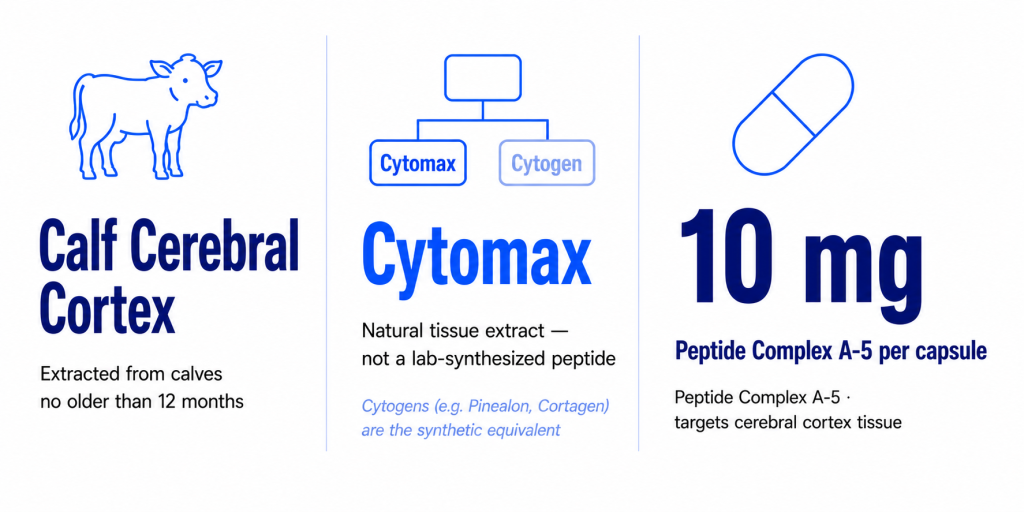
Commercial capsules typically deliver 10 mg of the peptide complex per dose. BioLongevity Supplements sells this peptide complex as BioNervousSystem.
The Manufacturer-Published Clinical Study Behind Cerluten
Cerluten’s primary evidence is a 48-patient study conducted at the Medical Center of the Saint Petersburg Institute of Bioregulation and Gerontology between October 2003 and February 2004. Patients had long-term effects of traumatic brain injury, post-stroke conditions, vascular encephalopathy, or general decline in memory and attention.
The 48 patients took Cerluten alongside their standard treatment, while 37 similar patients received standard treatment alone as a comparison group. Researchers measured outcomes with a correction task (a standard test of attention and processing speed) and EEG, tracking a measure called the alpha index.
Reported results favored the Cerluten group:
| Measure | Standard treatment only | Standard treatment + Cerluten |
| Rated a “good” outcome | 27.0% | 64.6% |
| Rated “unsatisfactory” | 32.5% | 12.5% |
| Correction task errors | 11.1 | 8.7 |
| EEG alpha index (after treatment) | 41.3 | 47.9 |
This isn’t a null or fabricated result. It’s a real, reasonably detailed dataset with defined groups, named test instruments, and numbers that could in principle be checked. But it has real limitations too:
- Patients weren’t randomized into groups; allocation methods weren’t described.
- Neither patients nor evaluators were blinded to which treatment a person received.
- The study was designed, conducted, and published by the same institute that developed and sells Cerluten, and the write-up is credited directly to Vladimir Khavinson.
- It was published as manufacturer literature, not submitted to or accepted by a peer-reviewed journal, and it doesn’t appear in PubMed.
That combination, real data plus a clear conflict of interest and no independent review, is a meaningfully different evidence tier than a published RCT.
Cerluten vs. Cortexin: Two Different Products From the Same Tissue
Cerluten and Cortexin are not the same thing, even though both are derived from bovine brain cortex tissue. This is worth being precise about, because the confusion runs in Cerluten’s favor: people sometimes read Cortexin’s much larger research base as if it applies to Cerluten.
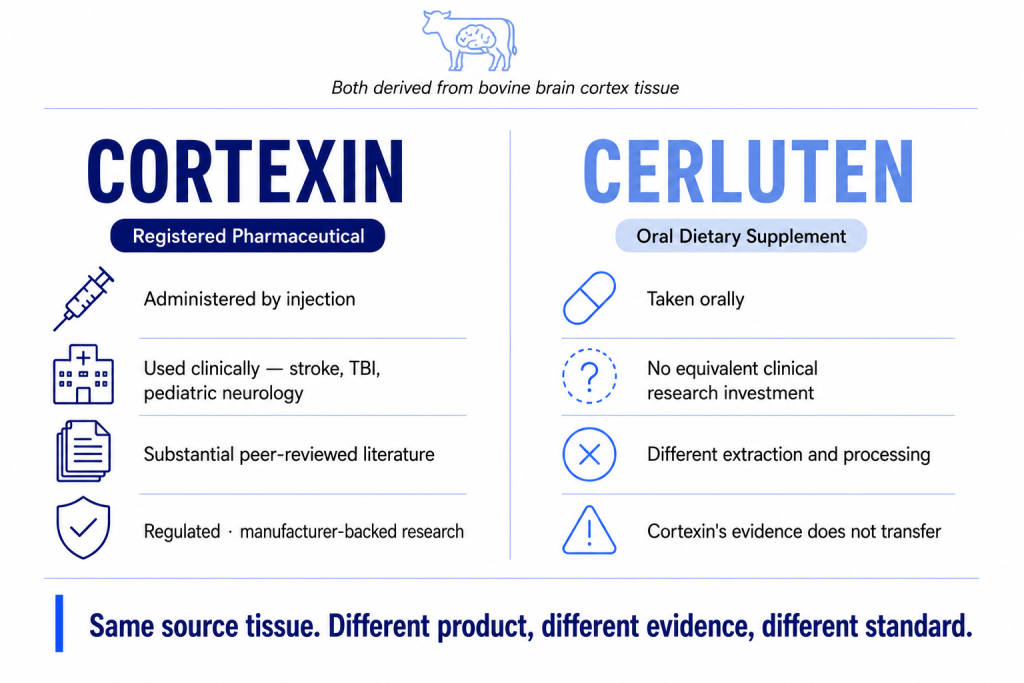
Cortexin is a registered pharmaceutical in Russia, manufactured by a different company, administered by injection, and used clinically for stroke, traumatic brain injury, and pediatric neurological conditions. It has a substantial and still-growing peer-reviewed literature, including a 2025 study on developmental brain injury models in rats that measured neuronal damage directly through histology [1].
Cerluten is an oral dietary supplement, extracted and processed differently, without the same regulatory status or research investment. Sharing a source tissue doesn’t mean sharing an evidence base, and Cortexin’s research shouldn’t be read as support for Cerluten.
Where This Leaves the General Bioregulator Theory
Khavinson’s broader model proposes that short peptides can bind gene promoter regions and support protein synthesis in the matching tissue, a mechanism described across his organ-specific bioregulator system [2]. A 2013 review from his group specifically compares neuroprotective peptide categories, polypeptide complexes like Cortexin and Cerebrolysin against short synthetic peptides like Semax, Cortagen, and Pinealon [3].
That review doesn’t examine Cerluten by name. It’s useful for understanding the theoretical framework Cerluten is built on, not as evidence for the specific formula.
Beyond the Clinical Evidence
Cerluten’s synthetic relative is Cortagen (AEDP), a tetrapeptide derived from amino acid analysis of Cortexin, the registered pharmaceutical, not from Cerluten itself. Cortexin and Cerluten both come from calf cerebral cortex tissue, but they’re separately developed preparations. A peer-reviewed animal study on Cortagen exists, testing its effect on sciatic nerve regeneration, though it doesn’t tell you anything about Cerluten specifically.
Cortexin is one of the six Khavinson-developed peptide preparations that received pharmaceutical drug registration from the Russian Ministry of Health. Cerluten is not among them and has remained in the dietary-supplement category since its introduction.
A broader review of neuroprotective peptide bioregulators groups compounds like Cortexin and Cerebrolysin together as “polypeptide complexes,” distinct from short synthetic peptides like Semax, Cortagen, and Pinealon. Cerluten fits that same polypeptide-complex category by composition, even though that particular review doesn’t name it directly.
What Cerluten Can Reasonably Offer Today
Cerluten has more going for it than Gotratix, a described, numbers-based clinical report exists rather than an unsourced marketing line, but less than Cortexin, whose evidence has passed independent peer review. The honest position is that Cerluten’s own study is real but unverified by anyone outside the institute that profits from it.
What can be checked independently right now is manufacturing quality: third-party testing, a Certificate of Analysis, and consistent GMP production. BioLongevity’s BioNervousSystem formulation is tested and documented on that basis, separate from any claim about the underlying study’s strength.
Frequently Asked Questions
What is Cerluten made of?
Cerluten is a natural peptide complex, Peptide Complex A-5, extracted from the cerebral cortex of calves no older than 12 months, typically delivered at 10 mg per capsule.
Is Cerluten the same as Cortexin?
No. Cortexin is a separately manufactured, injectable pharmaceutical registered in Russia with a substantial peer-reviewed research base. Cerluten is an oral dietary supplement from the same general tissue source with a much thinner, non-peer-reviewed evidence base.
Is Cerluten backed by a clinical study?
Yes, a 48-patient study conducted by the developing institute in 2003-2004 reported improvements in cognitive testing and EEG measures. It was never published in a peer-reviewed journal and doesn’t appear in PubMed.
Is Cerluten safe?
The 2003-2004 report described no adverse effects, but formal, independently reviewed safety data specific to this complex hasn’t been published. Check with a healthcare provider before use, especially if you’re pregnant, nursing, or managing a medical condition.
The Bottom Line on Cerluten
Cerluten sits in the middle of the three peptide bioregulators covered so far. It has a real, detailed clinical study behind it, unlike Gotratix, but that study was never peer-reviewed or independently verified, unlike the literature backing Vesugen or Cortexin [1][2][3]. The theory it’s built on is well documented at the category level; the product-specific proof is not.
Muscle loss, vascular decline, and cognitive aging are each real, independently studied problems. Whether any single organ-specific peptide complex measurably addresses them is a separate question from whether the problem itself is legitimate, and for Cerluten specifically, that question remains open.
Exploring peptide bioregulators as a category? BioLongevity’s BioNervousSystem is manufactured under U.S. GMP standards with third-party testing and a Certificate of Analysis available for every batch.
Ask a qualified clinician before starting any supplement if you are pregnant, nursing, taking medication, or managing a medical condition. This article is educational and does not replace medical advice.
These statements have not been evaluated by the Food and Drug Administration. This product is not intended to diagnose, treat, cure, or prevent any disease.
References
[1] Kurkin DV, Bakulin DA, Morkovin EI, et al. Neurotropic Effects of Cortexin on Models of Mental and Physical Developmental Delay. Biomedicines. 2025;13(4):860. doi:10.3390/biomedicines13040860
[2] Khavinson VKh. Peptide regulation of aging: 35-year research experience. Bulletin of Experimental Biology and Medicine. 2009;148(1):94-98. doi:10.1007/s10517-009-0650-8
[3] Umnov RS, Lin’kova NS, Khavinson VKh. Neuroprotective effects of peptides bioregulators in people of various age. Advances in Gerontology. 2013;26(4):671-678. PubMed
[4] Turchaninova LN, Kolosova LI, Malinin VV, Moiseeva AB, Nozdrachev AD, Khavinson VK. Effect of tetrapeptide cortagen on regeneration of sciatic nerve. Bulletin of Experimental Biology and Medicine. 2000;130(12):1172-1174. doi:10.1023/A:1017532001908. PMID: 11276314