

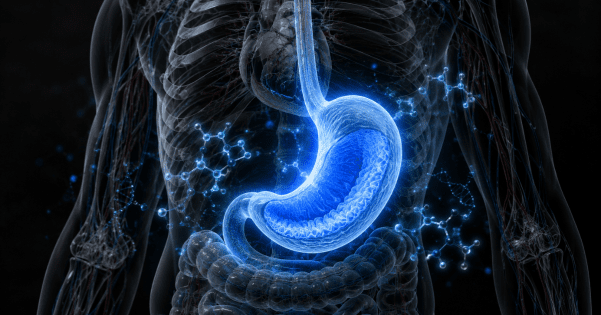
Stamakort is the stomach peptide bioregulator, a capsule built around the A-10 peptide complex extracted from gastric mucosa and studied for supporting normal stomach lining function. It’s worth attention because the stomach lining is one of the few tissues that measurably loses its ability to defend and repair itself with age.
Almost nothing sold as gut health is aimed at that problem. The category is crowded, and it’s pointed somewhere else entirely.
Key Takeaways

The Short Version
Stamakort is a stomach-derived peptide bioregulator studied for supporting normal gastric mucosa function and digestive comfort.
Gastroenterology researchers use the term aging gastropathy to describe a stomach lining with weaker defenses, less blood flow, and slower repair after injury.
Reduced stomach acid from atrophic gastritis is linked to poorer vitamin B12 status in older adults, and fortified foods alone don’t fully correct it.
Each BioStomach capsule delivers 40 mg of the A-10 peptide complex, taken in 30-day courses rather than continuously.

Gut Health Supplements Are Mostly Intestine Supplements
The word “gut” in supplement marketing almost always means the small and large intestine, not the stomach. Probiotics colonize the colon. Fiber ferments there. Glutamine and butyrate are studied for the intestinal barrier.
All of it lands downstream of the organ food actually hits first.
| Organ | Main job | What the supplement aisle offers |
|---|---|---|
| Stomach | Acid, pepsin, protective mucus layer, B12 release from food | Very little that targets the tissue itself |
| Small intestine | Nutrient absorption, barrier function | Glutamine, zinc carnosine, digestive enzymes |
| Colon | Fermentation, microbiome, short-chain fatty acids | Probiotics, prebiotics, butyrate and tributyrin |
That gap is the whole reason a stomach-specific peptide exists as a category. If you’ve already worked through the usual gut barrier supplements and want to move upstream, this is the next stop.
Researchers Have a Name for the Aging Stomach Lining

Gastroenterologists call it aging gastropathy, and it describes a real, measurable set of changes rather than a vague sense of getting older.
A review in the World Journal of Gastroenterology describes the aging gastric mucosa as having impaired mucosal defense, increased susceptibility to injury from agents like aspirin, other NSAIDs and alcohol, and delayed, incomplete healing once injury happens [1].
The mechanisms behind it are specific:
- Reduced mucosal blood flow, which leaves the tissue hypoxic.
- Upregulated PTEN and activated pro-apoptotic caspase-3 and caspase-9, pushing more cells toward programmed death.
- Lower survivin, an anti-apoptosis protein that helps cells stay alive under stress.
- Less vascular endothelial growth factor and nerve growth factor, both of which drive repair and new blood vessel formation.
Read that list again and notice what it isn’t. None of those are acid problems. They’re tissue problems, and antacids don’t touch them.
The broader picture matches. A review of the ageing gastrointestinal tract reports structural and functional mucosal defense defects across the digestive system, alongside more inflammation and oxidative stress with age [2].
One point worth stating plainly and once: if you take low-dose aspirin, regular NSAIDs, or a proton pump inhibitor, or you’ve been diagnosed with gastritis, an ulcer, or H. pylori, talk with your clinician before adding a stomach peptide. That’s coordination with existing care, not a warning about the peptide.
Low Stomach Acid Comes With a Nutrition Bill

Weaker acid output isn’t just a digestion issue. It changes what your body can pull out of food, and vitamin B12 is the clearest example.
B12 in food arrives bound to protein. Gastric acid is what frees it. When acid production drops, that step falters, and the vitamin passes through unabsorbed.
The numbers are striking. In a study of 3,299 adults aged 60 and over, atrophic gastritis was identified in 15 percent of participants, and 38 percent of that group showed markers of vitamin B12 deficiency, compared with 15 percent of controls [3]. Proton pump inhibitors had been used for six months or longer by 37 percent of the whole cohort, and higher doses tracked with lower holotranscobalamin, the active form of circulating B12 [3].
Here’s the detail that makes the case for supporting the tissue itself. Regular consumption of fortified foods improved B12 markers across the board, but it wasn’t enough to restore normal status in the participants with atrophic gastritis [3].
Adding more nutrient didn’t fix a machinery problem. That’s the argument for working at the tissue level instead of only the intake level.
What A-10 Is and Where the Peptide Evidence Sits
Stamakort is a short-chain peptide complex extracted from gastric mucosa and classified as A-10 in the Khavinson bioregulator system. Each BioStomach capsule delivers 40 mg of the complex.
The category rests on tissue specificity. Peptides isolated from one organ are studied for supporting that same organ, with the peptide’s own sequence determining which genes it influences.
Two mechanistic findings anchor the science. A systematic review in Molecules documented that short peptides of two to seven amino acids can enter the cell nucleus, interact with DNA and histone proteins, and change which genes get transcribed, including through effects on DNA methylation [5]. And peptide-driven regulation has been shown to direct cell differentiation across a range of tissues [6].
The stomach has its own thread in that research. Work published in the Bulletin of Experimental Biology and Medicine reported that a geroprotective peptide normalized the synthesis of antioxidant and anti-inflammatory proteins in gastric tissue by regulating expression of the corresponding genes [4]. Separately, a rat study on geroprotector peptides found that administering epithalon restored the normal age-related pattern of pepsin activity in animals whose digestive enzyme dynamics had been disrupted [7].
Both of those are laboratory and animal findings, and they read as mechanism rather than outcome. That’s the honest tier, and it’s a promising one.
Sitting behind them is a much longer record. Decades of work on the bioregulator family reported that long-term peptide treatment slowed age-related changes in biomarkers of aging, tracked clinically across six to twelve years [8].
If the category is new to you, our primer on what peptide bioregulators are covers the fundamentals, and the story behind the Khavinson research program explains how the organ-by-organ system was built.
Fitting Stamakort Into a Routine
Bioregulators are taken in courses, not continuously. For Stamakort, that means one to two capsules once or twice daily with food for 30 days, repeated a few times across the year. Follow the product label unless your clinician recommends otherwise.
It tends to suit a few kinds of people:
- Adults over 45 who want organ-level support rather than another intestinal formula.
- Bioregulator users filling the digestive gap in an organ-system stack.
- Anyone who has already handled the basics and wants to work further upstream.
Because the stomach and liver work the same digestive shift, it pairs naturally with BioLiver (Svetinorm). The full peptide bioregulator range is organized by organ system if you’re building something broader.
Frequently Asked Questions
These are the questions that come up most often about the A-10 complex.
What is Stamakort used for?
Stamakort is used to support normal stomach and digestive mucosal function as part of a longevity routine. It’s an educational and wellness product, not a treatment for any condition.
Is Stamakort an antacid or a digestive enzyme?
Neither. It’s a peptide complex aimed at the stomach tissue itself, which is a different job from neutralizing acid or supplying enzymes.
Can Stamakort be taken with a proton pump inhibitor?
Ask your clinician first. PPIs change stomach acid directly and are usually prescribed for a specific reason, so any addition belongs in that conversation.
How long is a Stamakort course?
A typical course runs 30 days, with one to two capsules taken once or twice daily with food, repeated a few times per year.
Is Stamakort the same as a probiotic?
No. Probiotics are live bacteria studied mainly for the intestine and colon. Stamakort is a peptide complex aimed at the stomach lining, upstream of where probiotics act.
Can Stamakort be stacked with other bioregulators?
Yes. Bioregulators are routinely combined across organ systems, and the stomach complex pairs naturally with liver, pancreas, or intestinal formulas.
Read More From the BioLongevity Blog
- Pielotax Peptide Benefits: Inside the Kidney Bioregulator
- Glandokort Peptide Benefits: Adrenal Fatigue vs. Reality
Ready to give the stomach the same attention your routine already gives the microbiome? BioStomach – A-10 Stomach Peptide Bioregulator (Stamakort) delivers a transparent 40 mg A-10 peptide complex, third-party tested through an independent CLIA-certified lab, with the Certificate of Analysis published before you buy rather than after.
Ask a qualified clinician before starting any supplement if you are pregnant, nursing, taking medication, or managing a medical condition.
These statements have not been evaluated by the Food and Drug Administration. This product is not intended to diagnose, treat, cure, or prevent any disease.
References
- Tarnawski AS, Ahluwalia A. Increased susceptibility of aging gastric mucosa to injury and delayed healing: Clinical implications. World Journal of Gastroenterology. 2018;24(42):4721-4727. https://doi.org/10.3748/wjg.v24.i42.4721
- Soenen S, Rayner CK, Jones KL, Horowitz M. The ageing gastrointestinal tract. Current Opinion in Clinical Nutrition and Metabolic Care. 2016;19(1):12-18. https://doi.org/10.1097/MCO.0000000000000238
- Porter KM, Hoey L, Hughes CF, Ward M, Clements M, Strain J, Cunningham C, Casey MC, Tracey F, O’Kane M, Pentieva K, McAnena L, McCarroll K, Laird E, Molloy AM, McNulty H. Associations of atrophic gastritis and proton-pump inhibitor drug use with vitamin B-12 status, and the impact of fortified foods, in older adults. The American Journal of Clinical Nutrition. 2021;114(4):1286-1294. https://doi.org/10.1093/ajcn/nqab193
- Khavinson VKh, Lin’kova NS, Dudkov AV, Polyakova VO, Kvetnoi IM. Peptidergic regulation of expression of genes encoding antioxidant and anti-inflammatory proteins. Bulletin of Experimental Biology and Medicine. 2012;152(5):615-618. https://doi.org/10.1007/s10517-012-1590-2
- Khavinson VK, Popovich IG, Linkova NS, Mironova ES, Ilina AR. Peptide Regulation of Gene Expression: A Systematic Review. Molecules. 2021;26(22):7053. https://doi.org/10.3390/molecules26227053
- Khavinson V, Linkova N, Diatlova A, Trofimova S. Peptide Regulation of Cell Differentiation. Stem Cell Reviews and Reports. 2020;16(1):118-125. https://doi.org/10.1007/s12015-019-09938-8
- Morozov AV, Khizhkin EA, Svechkina EB, Vinogradova IA, Ilyukha VA, Anisimov VN, Khavinson VKh. Effects of Geroprotectors on Age-Related Changes in Proteolytic Digestive Enzyme Activities at Different Lighting Conditions. Bulletin of Experimental Biology and Medicine. 2015;159(6):761-763. https://doi.org/10.1007/s10517-015-3069-4
- Anisimov VN, Khavinson VKh. Peptide bioregulation of aging: results and prospects. Biogerontology. 2010;11(2):139-149. https://doi.org/10.1007/s10522-009-9249-8