


Khavinson peptides are short, tissue-specific peptides developed by Russian gerontologist Vladimir Khavinson and studied for their role in healthy aging. They’re the compounds behind the entire peptide bioregulator category, named after the scientist who spent four decades building it.
That name is worth understanding before you shop, because it tells you where the science comes from and how far along it really is. This guide covers who Khavinson was, the two very different families of peptides he created, the handful you’ve probably heard of, and how his work reaches a modern supplement shelf.
Key Takeaways

The Short Version
Khavinson peptides are short, tissue-specific peptides, usually two to four amino acids long, developed by Russian gerontologist Vladimir Khavinson and studied for healthy aging.
They come in two families: natural extracts pulled from animal tissue, and synthetic peptides with an exact, lab-made sequence such as Epitalon, Vilon, and Vesugen.
The finding most tied to Khavinson’s name is a long-term clinical study in which older adults given his pineal and thymus peptides had lower mortality than untreated controls.
None are FDA-approved, so third-party testing and a Certificate of Analysis matter more than any marketing claim you’ll read online.
Who Was Vladimir Khavinson?
Vladimir Khavinson (1946 to 2024) was a Russian gerontologist who spent roughly forty years studying short peptides and how they influence aging. He directed the St. Petersburg Institute of Bioregulation and Gerontology and served as a senior figure in the international gerontology community.
His work started in an unlikely place: the Soviet military. In the 1970s, at the Kirov Military Medical Academy, he was tasked with finding compounds that could help personnel hold up under radiation, extreme stress, and the accelerated aging those conditions can cause. The answer his group pursued was a class of very short peptides that seemed to steady the function of specific organs.
Over the following decades that military project grew into a full research program. Khavinson’s group reported isolating more than twenty peptide complexes from animal tissue and synthesizing a further set in the lab, and he introduced six peptide-based pharmaceuticals and dozens of peptide food supplements into practice. He described these compounds as geroprotectors, a term for agents studied to support healthy aging. In his own review of that work, long-term peptide treatment increased average lifespan in rodents by 20 to 40 percent, which is animal data but helps explain why the longevity world took notice.
The Two Families: Natural Extracts and Synthetic Short Peptides
The single most useful thing to know about Khavinson peptides is that they split into two families, and most articles blur them together. One is natural, one is synthetic, and they aren’t the same molecule
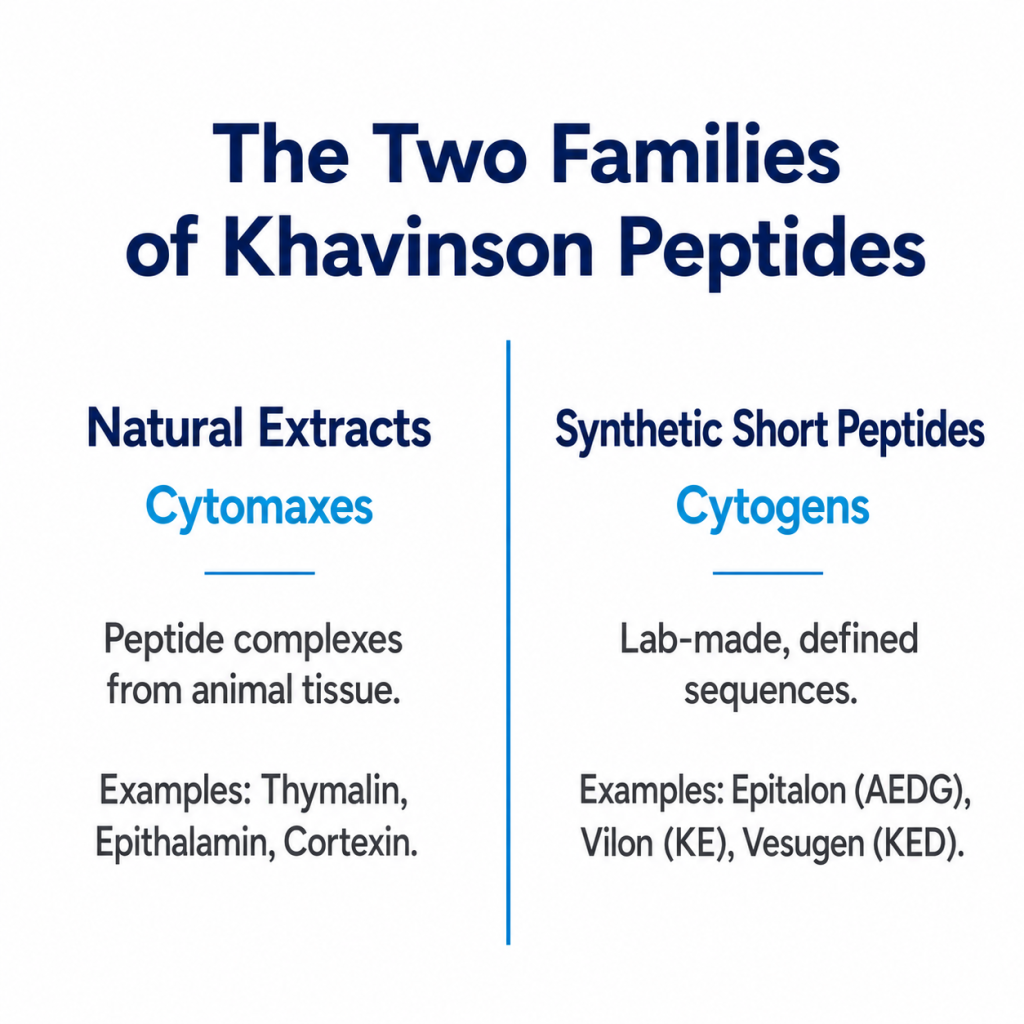
The first family is the natural extracts, often called Cytomaxes or Cytamins. These are peptide complexes pulled directly from animal organs. They’re mixtures rather than one defined molecule, and they were the original generation Khavinson’s team developed in the 1980s and 1990s. Thymalin, from the thymus, has the longest clinical track record of anything in the category.
The second family is the synthetic short peptides, often called Cytogens. Once researchers worked out which fragments in those extracts were active, they rebuilt them in the lab as peptides with a known, exact amino acid sequence. These are the compounds you see referenced by their letter codes.
| Family | Also called | What it is | Examples |
|---|---|---|---|
| Natural extracts | Cytomaxes, Cytamins | Peptide complexes taken from animal organs; mixtures, not one defined molecule | Thymalin (thymus), Epithalamin (pineal), Cortexin (brain) |
| Synthetic short peptides | Cytogens | Lab-made peptides with a precise, reproducible amino acid sequence | Epitalon (AEDG), Vilon (KE), Vesugen (KED), Pinealon (EDR) |
Why does the split matter? Because the evidence isn’t interchangeable. Early studies used the extracts, later ones used the defined peptides, and a claim about one doesn’t automatically transfer to the other. When you read that a “Khavinson peptide” did something in a study, it’s worth knowing which family was actually tested.
The Khavinson Peptides Most People Have Heard Of
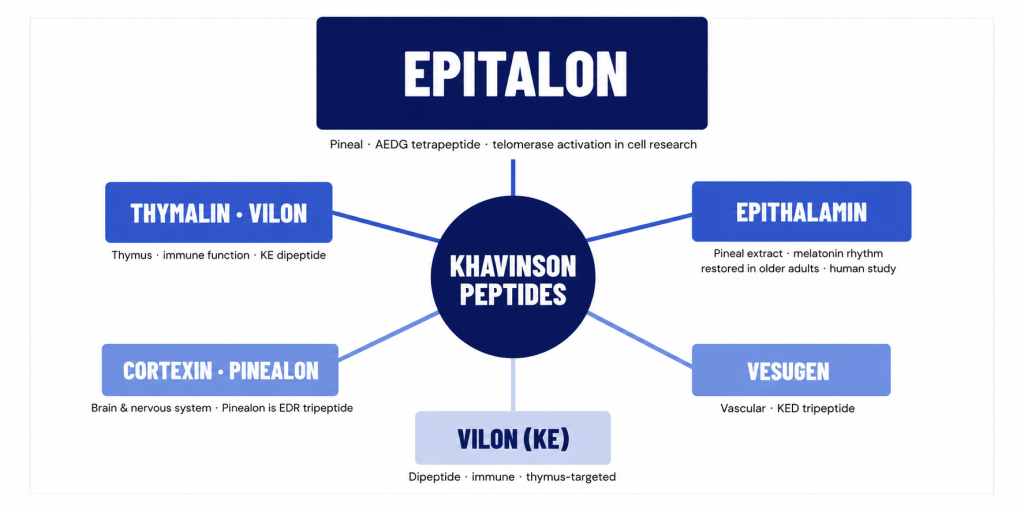
A few of these peptides carry the category, and Epitalon leads the list. It’s the pineal peptide, a tetrapeptide with the sequence AEDG, and it’s the one most associated with longevity. In cell-based research, Epitalon switched telomerase back on in human cells and lengthened their telomeres, which is a lab finding rather than a human outcome but a genuinely interesting one.
The rest map cleanly to the tissues they were drawn from:
- Thymalin and Vilon target the thymus and immune function. Vilon is the dipeptide KE, and Thymalin is the original thymus extract with the deepest clinical history.
- Epithalamin is the pineal extract that came before the synthetic Epitalon. In a clinical study, it shifted the nighttime melatonin rhythm of older adults back toward a younger pattern, a real human effect on a specific measure.
- Cortexin and Pinealon focus on the brain and nervous system, with Pinealon being the tripeptide EDR.
- Vesugen is the vascular peptide, the tripeptide KED.
There’s an elegant piece of design logic here that’s easy to miss. The KED sequence in Vesugen shows up as a building block across the family: add a glycine and you get Testagen for the testes, swap in an alanine and you get Livagen for the liver, and drop to just the first two residues and you have Vilon for the thymus. A single short motif, tuned one amino acid at a time to point at a different organ. Whether that tuning truly redirects tissue specificity is still an open research question, and it’s one of the more interesting threads in the whole field.
Why One Long-Term Study Made His Name
The result most tied to Khavinson is a multi-year clinical study of his pineal and thymus peptides in older adults. In that study, 266 people over 60 received Thymalin, Epithalamin, or both over six to eight years, and the treated groups showed lower mortality than the controls, with the largest reduction in the group given both peptides on a repeated annual schedule.
That’s a striking number, and it’s the reason the category sits in the longevity conversation at all. It also deserves context. The work comes largely from Khavinson’s own institutes, independent replication under modern trial standards is still emerging, and the study used injectable pharmaceutical forms rather than oral capsules. So it’s best read as a promising, well-documented signal from one dedicated research lineage rather than a closed case.
If you want the fuller evidence picture, including the mechanism and the animal and cell studies behind it, our explainer on what peptide bioregulators are walks through it study by study. For where these compounds sit among other proven and emerging options, our guide to the best longevity supplements puts them in a wider routine.
From a St. Petersburg Lab to a Daily Capsule
Khavinson’s system reaches everyday routines as oral, tissue-specific bioregulator capsules, and BioLongevity carries that full oral bioregulator collection. Each capsule is matched to one organ system, which is the same one-peptide-one-tissue logic Khavinson built the category on.
The mechanism behind that logic is gene regulation, not hormone signaling. A systematic review describes how peptides this short can enter the cell nucleus and interact with DNA and the proteins that package it, nudging which genes are read in a matching tissue. It’s proposed as an epigenetic effect, meaning it may change gene activity without changing the DNA sequence itself.
Here’s how the best-known peptides line up with the tissues they target:
| Target tissue | Best-known Khavinson peptide | BioLongevity oral bioregulator |
|---|---|---|
| Pineal gland | Epitalon, Epithalamin | BioPineal (Endoluten) |
| Thymus | Thymalin, Vilon | BioThymus (Vladonix) |
| Blood vessels | Vesugen | BioBloodVessels (Ventfort) |
| Brain and nervous system | Pinealon, Cortexin | BioNervousSystem (Cerluten) |
The oral line follows that tissue map directly: BioThymus (Vladonix) for the thymus, BioBloodVessels (Ventfort) for the vasculature, and BioNervousSystem (Cerluten) for the brain and nervous system. One practical note on format: most of Khavinson’s published studies used injections, while consumer bioregulators are oral capsules, so the delivery route differs from the research and expectations are best kept measured.
Frequently Asked Questions
A few questions come up once the basics click into place.
Are Khavinson peptides and peptide bioregulators the same thing?
Essentially, yes. “Khavinson peptides” is the common name for the short peptide bioregulators he developed, so the terms point to the same category. The Khavinson label just credits the scientist and signals where the research originated.
What is the most famous Khavinson peptide?
Epitalon, the pineal peptide, is the best-known, mostly because of its telomerase and longevity research. Thymalin, the thymus extract, is a close second and actually has the longest clinical history of any compound in the group.
Are Khavinson peptides FDA-approved?
No. None are approved by the FDA for any use in the United States, and they’re sold as supplements or research compounds rather than approved drugs. That’s exactly why independent third-party testing and a Certificate of Analysis carry so much weight when you choose a product.
What is the difference between natural and synthetic Khavinson peptides?
Natural Khavinson peptides, the Cytomaxes, are complexes extracted from animal tissue and are mixtures rather than one defined molecule. Synthetic ones, the Cytogens, are lab-made peptides with a single precise sequence, such as Epitalon or Vesugen. Same research program, two different types of material.
How are Khavinson peptides taken?
Bioregulators are usually taken in short courses, often one to three weeks, repeated a few times per year, rather than continuously. The idea is a brief signal rather than constant stimulation. Ask a qualified clinician before starting any supplement if you are pregnant, nursing, taking medication, or managing a medical condition.
Read More From the BioLongevity Blog
Curious where to start with Khavinson’s work? The pineal peptide is the natural entry point, and BioPineal (Endoluten) is BioLongevity’s oral pineal bioregulator, made to support healthy aging and backed by third-party testing and a Certificate of Analysis on every batch.
Ask a qualified clinician before starting any supplement if you are pregnant, nursing, taking medication, or managing a medical condition.
These statements have not been evaluated by the Food and Drug Administration. This product is not intended to diagnose, treat, cure, or prevent any disease.
References
- Khavinson VKh, Morozov VG. Peptides of pineal gland and thymus prolong human life. Neuro Endocrinol Lett. 2003;24(3-4):233-240. PubMed
- Khavinson VK, Popovich IG, Linkova NS, Mironova ES, Ilina AR. Peptide Regulation of Gene Expression: A Systematic Review. Molecules. 2021;26(22):7053. https://doi.org/10.3390/molecules26227053
- Anisimov VN, Khavinson VKh. Peptide bioregulation of aging: results and prospects. Biogerontology. 2009;11(2):139-149. https://doi.org/10.1007/s10522-009-9249-8
- Khavinson VKh, Bondarev IE, Butyugov AA. Epithalon peptide induces telomerase activity and telomere elongation in human somatic cells. Bull Exp Biol Med. 2003;135(6):590-592. https://doi.org/10.1023/a:1025493705728
- Korkushko OV, Khavinson VKh, Shatilo VB, Magdich LV. Effect of peptide preparation epithalamin on circadian rhythm of epiphyseal melatonin-producing function in elderly people. Bull Exp Biol Med. 2004;137(4):389-391. https://doi.org/10.1023/b:bebm.0000035139.31138.bf