

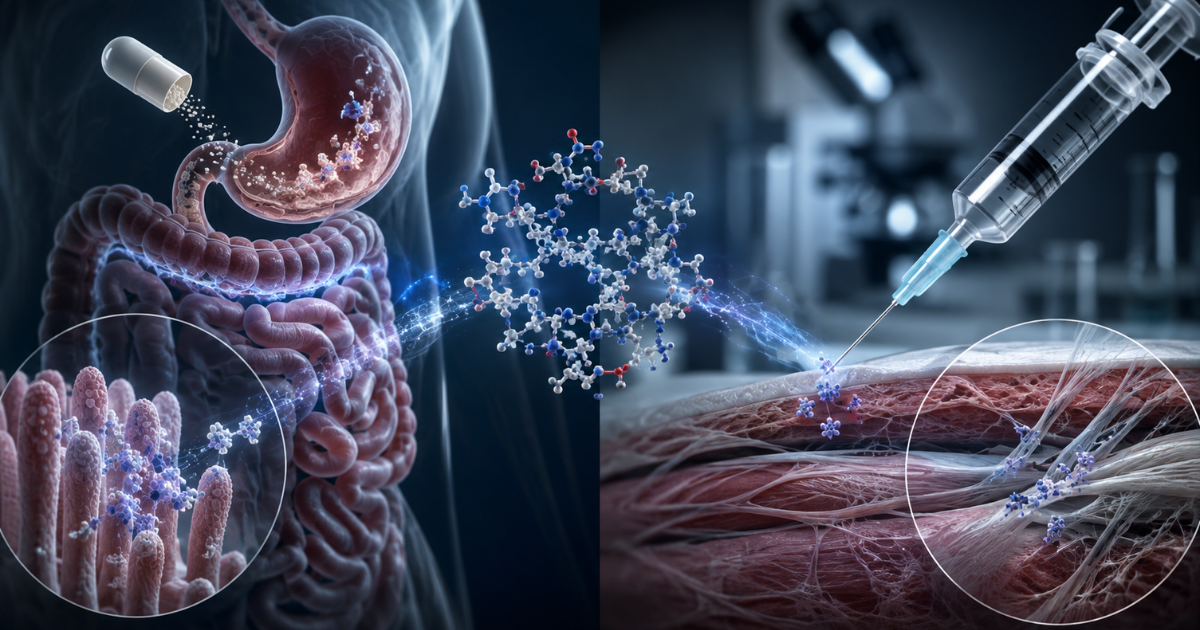
Choosing between oral and injected BPC-157 comes down to which tissue you want to support, not which route has a higher number attached to it. Injection concentrates the peptide at a single site and reaches the bloodstream more efficiently, while oral delivery has the deeper published record in gut, fistula, and wound-healing models, and has also produced whole-body effects in animal research.
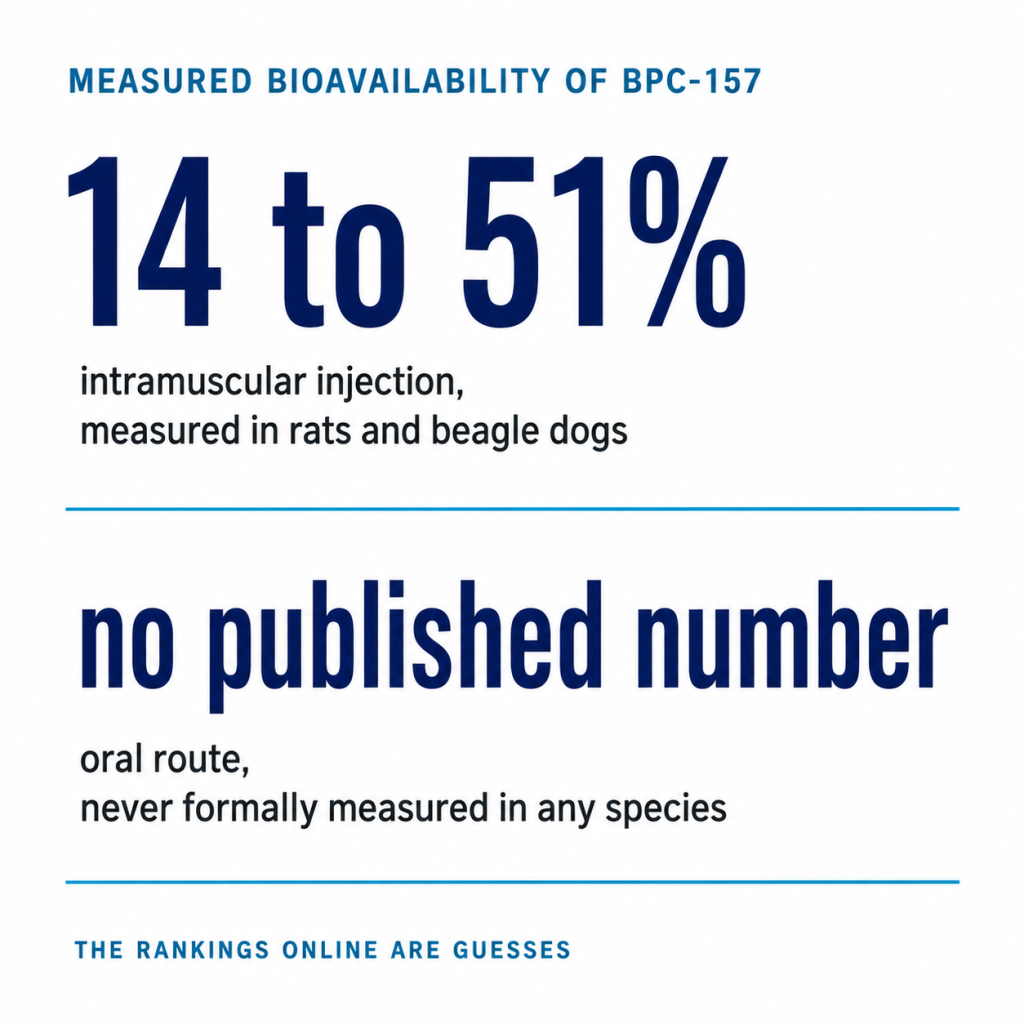
Here is the part almost nobody mentions. The bioavailability rankings you see in most oral-versus-injection comparisons are invented, because that number has never been published for oral BPC-157.
Key Takeaways

The Short Version
The only measured bioavailability figures for BPC-157 come from intramuscular injection in animals, at roughly 14 to 51 percent depending on species, and no equivalent number has ever been published for the oral route.
In the one rat study that compared both routes head to head, oral and injected BPC-157 each reduced ulcer size, with injection producing the larger effect at a lower dose.
Oral dosing has produced healing effects well outside the gut in animal research, including ligament, skin, and fistula models.
BPC-157 stays intact in gastric juice, which is the structural reason it can be studied orally when most peptides its size cannot be.
Oral vs Injected BPC-157 at a Glance
Both routes have real research behind them, and they answer different questions. This table is the short version of everything below.
| Factor | Oral BPC-157 | Injected BPC-157 |
|---|---|---|
| Measured bioavailability | Never published for any species | Roughly 14 to 19 percent in rats, 45 to 51 percent in beagle dogs, intramuscular |
| Deepest research base | Gastric, intestinal, fistula, and wound-healing models | Tendon, ligament, and tendon-to-bone models |
| How most studies delivered it | Intragastric dosing or dissolved in drinking water | Intraperitoneal or intramuscular injection |
| Dose needed for effect | Higher, in the head-to-head comparison | Lower, in the same comparison |
| Practical fit | Daily routine use | Research and clinical settings |
| Availability to consumers | Capsule formulas | Not sold as a consumer supplement |
The row that matters most is the first one, so start there.
The Bioavailability Number That Does Not Exist for Oral BPC-157
There is one formal pharmacokinetic study of BPC-157, and it did not test the oral route. Published in Frontiers in Pharmacology in 2022, it dosed rats and beagle dogs intravenously and intramuscularly and tracked what happened next.
The findings were specific. Absolute bioavailability after intramuscular injection came in at roughly 14 to 19 percent in rats and 45 to 51 percent in beagle dogs, with an elimination half-life under 30 minutes and linear kinetics across doses.
Two things follow from that. First, even injection does not deliver anywhere near all of the peptide into circulation, and the figure swings widely between two species. Second, the study never dosed orally, so there is no matching number to compare it to.
A 2026 biopharmaceutical review in Pharmaceutics makes the gap explicit, describing BPC-157’s human pharmacokinetic profile as critically undercharacterized and noting the peptide still lacks permeability characterization entirely. No permeability data means no oral bioavailability figure.
So when a comparison chart gives capsules two stars and injection five, those stars are editorial opinion dressed as pharmacology.
The Study That Ran Injection and Oral Side by Side
One team did the experiment properly, and its result is more interesting than either side of the internet argument. Researchers publishing in the World Journal of Gastroenterology gave rats BPC-157 either intramuscularly or intragastrically across three separate gastric ulcer models.
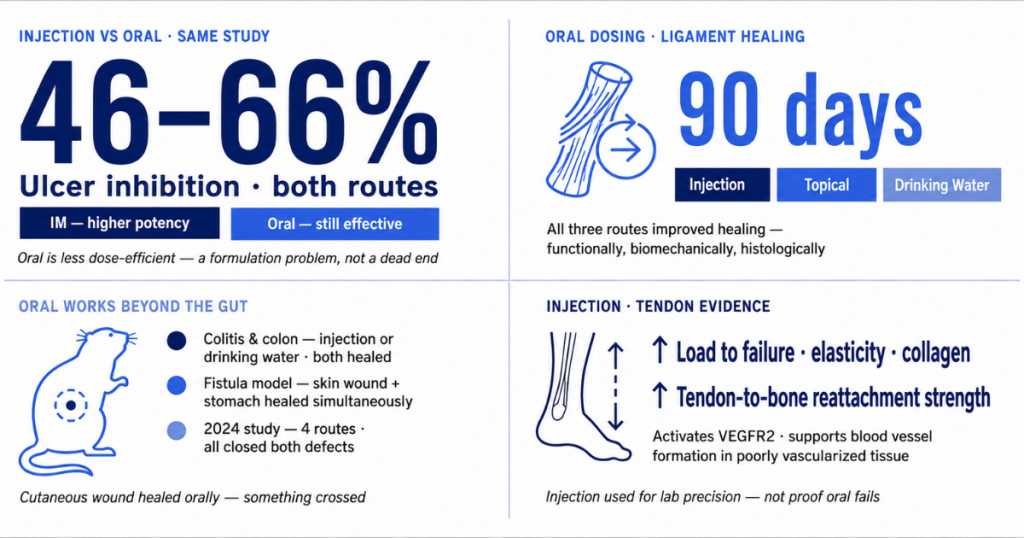
Both routes worked. At the higher doses tested, ulcer formation was inhibited by roughly 46 to 66 percent, and the injected arm outperformed the standard acid-blocking drug used as a comparison in all three models.
The route difference showed up in dose, not in whether the compound did anything:
- Intramuscular dosing produced the larger effect at any given dose
- Intramuscular dosing also reached an effective result at a lower dose than intragastric
- Intragastric dosing still reduced ulcer area and accelerated healing in every model
That is a meaningfully different conclusion from “oral does not work.” It says the oral route is less dose-efficient, which is a formulation problem rather than a dead end.
When Rats Drank BPC-157, Their Ligaments Still Healed
The oral evidence reaches well past the gut, and this is the finding that reframes the whole route question. In a rat medial collateral ligament study published in the Journal of Orthopaedic Research, researchers transected the ligament and then delivered BPC-157 three different ways: by injection, as a topical cream, and dissolved in the animals’ drinking water.
All three improved healing over 90 days, measured functionally, biomechanically, macroscopically, and histologically. The drinking-water arm was not a control that failed. It was one of three working arms.
Similar route pairings show up across the animal literature:
- In a colitis and colon anastomosis model, BPC-157 healed both injuries whether it was injected or given in drinking water
- In a gastrocutaneous fistula model, drinking-water dosing improved skin wound healing and stomach mucosal healing at the same time, and closed the fistula
- In a 2024 duodenocolic fistula study, rats given the peptide locally, intragastrically, orally in drinking water, or intraperitoneally all closed both defects
The skin result is the one worth sitting with. A cutaneous wound is nowhere near the digestive tract, so an orally dosed animal healing one is not a local gut effect. Something crossed.
This is where BPC-157 separates from peptides generally. It stays intact in gastric juice and shows activity through oral, parenteral, and topical routes, a combination the 2026 review calls unusual. If you want the broader picture of which peptides survive digestion and why, our guide to whether peptides can be taken orally covers the category-level rules that BPC-157 happens to break.
Where the Injection Research Is Deepest
Injection carries the tendon literature, and that is a genuine advantage for anyone focused on a specific connective tissue. In a transected Achilles tendon model, intraperitoneal BPC-157 improved load to failure, elasticity, functional index scores, and collagen organization compared to controls.
The same pattern held for tendon-to-bone reattachment after Achilles detachment, where injected peptide improved stiffness and collagen type I content and offset the healing setback caused by corticosteroids.
Both studies used injection exclusively, so we know the injected route works there and we do not know how oral dosing would have compared. A 2025 review of the musculoskeletal literature describes why these tissues are the interesting target: BPC-157 activates VEGFR2 and nitric oxide synthesis through the Akt-eNOS axis, which supports blood vessel formation in tissues like tendon that are poorly vascularized to begin with.
One practical note about reading this literature. Rodent studies favor injection partly because it is the cleanest way to control an exact dose in a small animal, which means route selection in a paper reflects lab logistics as much as biology.
Matching the Route to What You Want Support For
Pick the format that matches your target tissue and your situation, because that is what the evidence actually differentiates on.
| If your priority is | The better-supported route | Why |
|---|---|---|
| Gastric comfort and gut lining resilience | Oral | The compound arrives at the target tissue first, and most of this research used oral or intragastric dosing |
| General recovery and connective tissue support | Oral | Drinking-water dosing produced ligament, skin, and systemic healing effects in animal models |
| A single injured tendon in a clinical setting | Injected or topical | Localized delivery concentrates the peptide at one defined site |
| A daily routine you will actually keep | Oral | Capsules are the only format available as a consumer supplement |
For most people reading this, the choice is already made by availability. BPC-157 is not sold as an injectable consumer product, and the oral evidence base happens to line up with the goals most people bring to it.
Why an Oral BPC-157 Formula Uses Arginine Salt and a Buffer
Two formulation details exist specifically to make the oral route work better, and both are visible on the label. The head-to-head study told us oral BPC-157 needs a higher dose to match injection, so a serious formula treats that as an engineering problem.
Arginine salt. BPC-157 arginine salt is a stabilized form chosen for oral products. A label that lists only “BPC-157” with no form is telling you less.
Sodium bicarbonate. A buffer moderates the gastric environment the capsule opens into. BPC-157 tolerates gastric juice better than most peptides, and buffering supports that head start rather than betting everything on it.
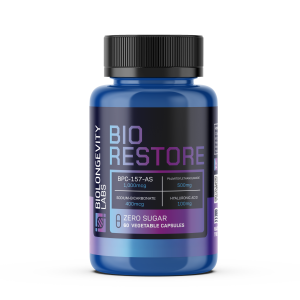
BioRestore is built on both. Each two-capsule serving delivers 1,000 mcg of BPC-157 arginine salt with 400 mg of sodium bicarbonate, plus 500 mg of palmitoylethanolamide and 100 mg of hyaluronic acid for recovery and connective tissue support. Every amount is printed on the label, which is the only way to compare a product against a research dose.
If digestive support is the specific goal rather than recovery, BioGutPro pairs BPC-157 with KPV, larazotide, GHK-Cu, tributyrin, and zinc carnosine instead. You can compare the full range in our peptide capsule collection.
What the Route Choice Means for Athletes and Regulation
Route does not change BPC-157’s regulatory position, and that is worth knowing before you compare formats. BPC-157 is on the World Anti-Doping Agency prohibited list, so anyone subject to drug testing should avoid it in every form, oral included.
There is also no approved pharmaceutical formulation of BPC-157 by any route. The 2026 review is direct about it, noting that no pharmaceutical-grade formulation has been developed or validated and that available human data come from fewer than 30 subjects across three uncontrolled pilot studies.
That makes verification the real differentiator between products. Independent identity and purity testing with a published Certificate of Analysis is what separates a peptide capsule you can evaluate from one you are taking on faith, and you can review our COAs for every batch we sell.
Frequently Asked Questions
Is injected BPC-157 stronger than oral BPC-157?
In the one rat study that compared them directly, intramuscular dosing produced a larger effect and worked at a lower dose than intragastric dosing. Both routes reduced ulcer area and accelerated healing, so the difference was dose efficiency rather than whether the compound was active.
What is the bioavailability of oral BPC-157?
No published study has measured it. The only bioavailability figures available are for intramuscular injection, at roughly 14 to 19 percent in rats and 45 to 51 percent in beagle dogs.
Does oral BPC-157 work outside the gut?
In animal models, yes. Rats given BPC-157 in drinking water showed improved healing in ligament, skin, and fistula models, which are tissues well outside the digestive tract.
Why is BPC-157 studied orally when most peptides are injected?
BPC-157 is a fragment of a protein found in human gastric juice and stays stable in that environment. Most therapeutic peptides are broken down by stomach acid and digestive enzymes before absorption, which is why they are injected.
How much oral BPC-157 do capsule products contain?
Oral formulas commonly land between 500 and 1,000 mcg per serving. Check whether the number on the label is per capsule or per multi-capsule serving, since those are easy to confuse.
Can athletes use oral BPC-157 instead of injections?
No. BPC-157 is prohibited in competitive sport regardless of how it is taken, so switching routes does not change anything for a tested athlete.
Read More From the BioLongevity Blog
- Do BPC-157 Capsules Work? Why Half-Life Is the Wrong Test
- KPV vs BPC-157: Calm the Inflammation or Rebuild the Tissue
- Best Leaky Gut Supplements: What the Evidence Shows
Ready to put an oral BPC-157 formula into a daily routine? BioRestore pairs 1,000 mcg of BPC-157 arginine salt with PEA, hyaluronic acid, and a bicarbonate buffer for recovery and connective tissue support, third-party tested with the Certificate of Analysis published for every batch. If you want the underlying biology first, start with how peptide signaling works.
Ask a qualified clinician before starting any supplement if you are pregnant, nursing, taking medication, or managing a medical condition.
These statements have not been evaluated by the Food and Drug Administration. This product is not intended to diagnose, treat, cure, or prevent any disease.
References
- He L, Feng D, Guo H, et al. Pharmacokinetics, distribution, metabolism, and excretion of body-protective compound 157, a potential drug for treating various wounds, in rats and dogs. Frontiers in Pharmacology. 2022;13:1026182. DOI
- Mateescu DM, Gavrilescu DM, Constantinescu FE, et al. BPC-157 as an investigational peptide therapeutic: biopharmaceutical challenges, formulation strategies, and translational development barriers. Pharmaceutics. 2026;18(5):625. DOI
- Xue XC, Wu YJ, Gao MT, et al. Protective effects of pentadecapeptide BPC 157 on gastric ulcer in rats. World Journal of Gastroenterology. 2004;10(7):1032-1036. DOI
- Cerovecki T, Bojanic I, Brcic L, Radic B, Vukoja I, Seiwerth S, Sikiric P. Pentadecapeptide BPC 157 (PL 14736) improves ligament healing in the rat. Journal of Orthopaedic Research. 2010;28(9):1155-1161. DOI
- Klicek R, Kolenc D, Suran J, et al. Stable gastric pentadecapeptide BPC 157 heals cysteamine-colitis and colon-colon-anastomosis and counteracts cuprizone brain injuries and motor disability. Journal of Physiology and Pharmacology. 2013;64(5):597-612. PubMed
- Skorjanec S, Dolovski Z, Kocman I, et al. Therapy for unhealed gastrocutaneous fistulas in rats as a model for analogous healing of persistent skin wounds and persistent gastric ulcers. Digestive Diseases and Sciences. 2009;54(1):46-56. DOI
- Vukusic D, Zenko Sever A, Sever M, et al. Duodenocolic fistula healing by pentadecapeptide BPC 157 in rats. A cytoprotection viewpoint. Journal of Physiology and Pharmacology. 2024;75(1). DOI
- Staresinic M, Sebecic B, Patrlj L, et al. Gastric pentadecapeptide BPC 157 accelerates healing of transected rat Achilles tendon and in vitro stimulates tendocytes growth. Journal of Orthopaedic Research. 2003;21(6):976-983. DOI
- Krivic A, Anic T, Seiwerth S, Huljev D, Sikiric P. Achilles detachment in rat and stable gastric pentadecapeptide BPC 157: promoted tendon-to-bone healing and opposed corticosteroid aggravation. Journal of Orthopaedic Research. 2006;24(5):982-989. DOI
- McGuire FP, Martinez R, Lenz A, Skinner L, Cushman DM. Regeneration or risk? A narrative review of BPC-157 for musculoskeletal healing. Current Reviews in Musculoskeletal Medicine. 2025;18(12):611-619. DOI