


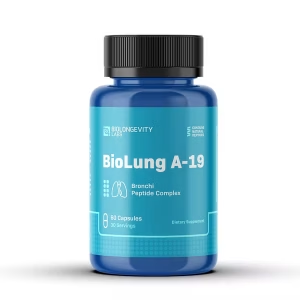
Taxorest is the lung peptide bioregulator, a capsule of peptide complex A-19 drawn from bronchial mucosa and studied for supporting the airway lining that keeps your lungs clear. It matters because lung function turns out to be one of the sharper predictors of how long people live, and the tissue Taxorest targets is the one that quietly fades first.
Most of what’s written about this peptide frames it around coughs and chest conditions. That framing sells it short and misses the more interesting story.
The better question is what happens to your airways over four decades of ordinary breathing, and whether a tissue-specific peptide is a sensible thing to point at it.
Key Takeaways

The Short Version
Taxorest is a bronchial mucosa peptide bioregulator, labelled A-19, studied for supporting the airway lining and healthy respiratory aging.
Lung function is a strong independent predictor of mortality, and the risk starts climbing well inside the range most people would call normal.
The airway lining runs a self-cleaning system called mucociliary clearance, and that system measurably slows with age.
Because these are animal-derived peptide extracts, third-party testing and a Certificate of Analysis matter more here than with an everyday supplement.
Lung Function Predicts Lifespan Better Than Most People Expect
Reduced lung function is one of the strongest and most generalisable predictors of mortality that population research has produced. The PURE study followed 126,359 adults across 17 countries for a median of nearly eight years, measuring how much air each person could force out in one second, and tracked what happened to them (a large international cohort study published in The Lancet Global Health).
The results climbed in a straight line. Mild impairment carried a 27% higher risk of death, moderate impairment 74%, and severe impairment more than doubled it (Duong et al. 2019).
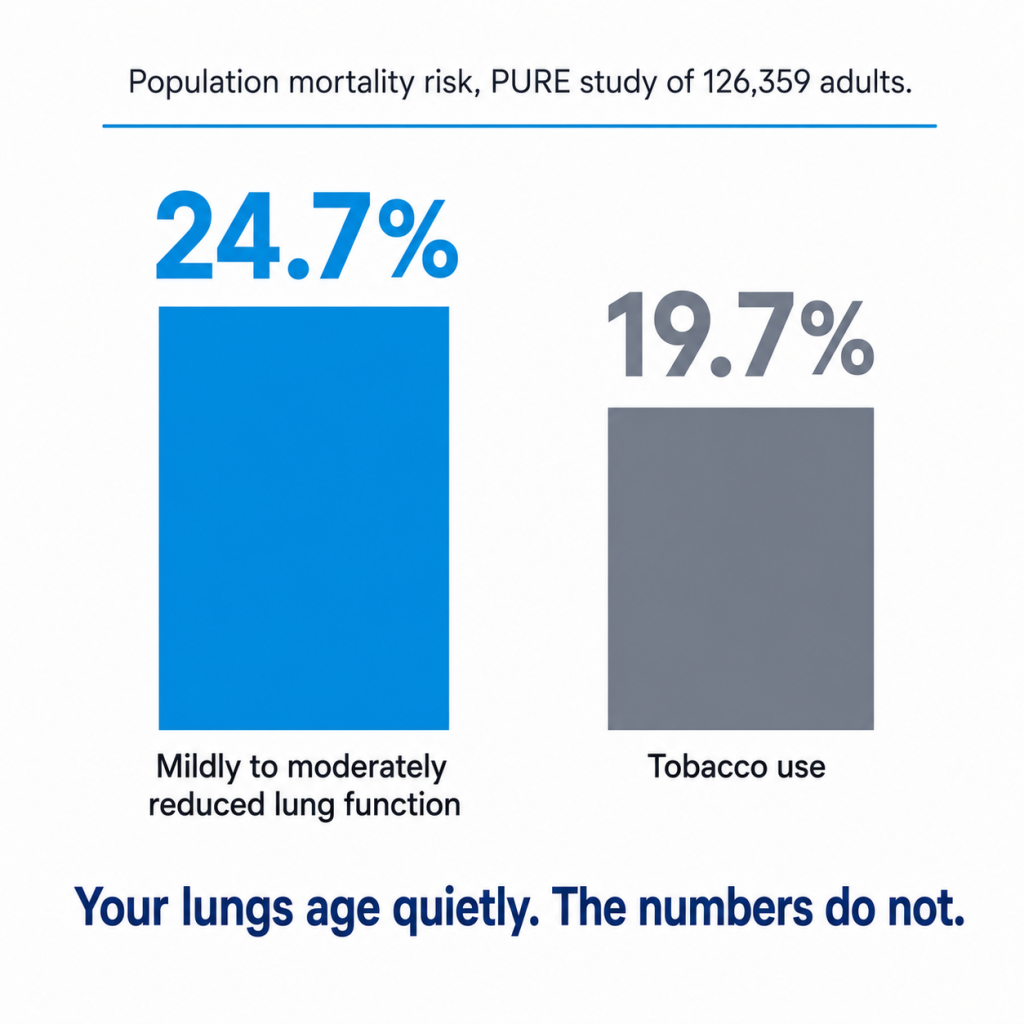
Here’s the number that reframes the whole category. When the researchers calculated how much of the population’s total mortality risk traced back to each factor, mildly to moderately reduced lung function accounted for 24.7%, which was larger than the share attributed to tobacco use at 19.7%.
The biggest burden wasn’t sitting with the sickest people. It was sitting with the enormous number of adults whose lung function looks clinically unremarkable and is simply drifting downward.
Which makes respiratory tissue a legitimate longevity target rather than a niche concern for people with a diagnosis.
The Airway Lining Runs a Conveyor Belt, and It Slows Down
Your airways clean themselves continuously through a system called mucociliary clearance. The lining of your bronchial tubes is carpeted with microscopic hairs called cilia, sitting under a thin layer of mucus, and they beat in coordinated waves that push inhaled dust, pollen, and microbes up and out of the lungs (a 2022 review in Advances in Geriatric Medicine and Research).
It’s a genuine conveyor belt, and it runs every minute of your life. It’s also one of the first lines of innate immune defence your body has against anything you breathe in.
Aging degrades it on several fronts at once (Bailey 2022):
- Cilia beat more slowly, so the belt moves at a reduced pace.
- Mucus changes in composition and consistency, which alters how well it carries particles.
- The structure of the airway epithelium itself shifts with age.
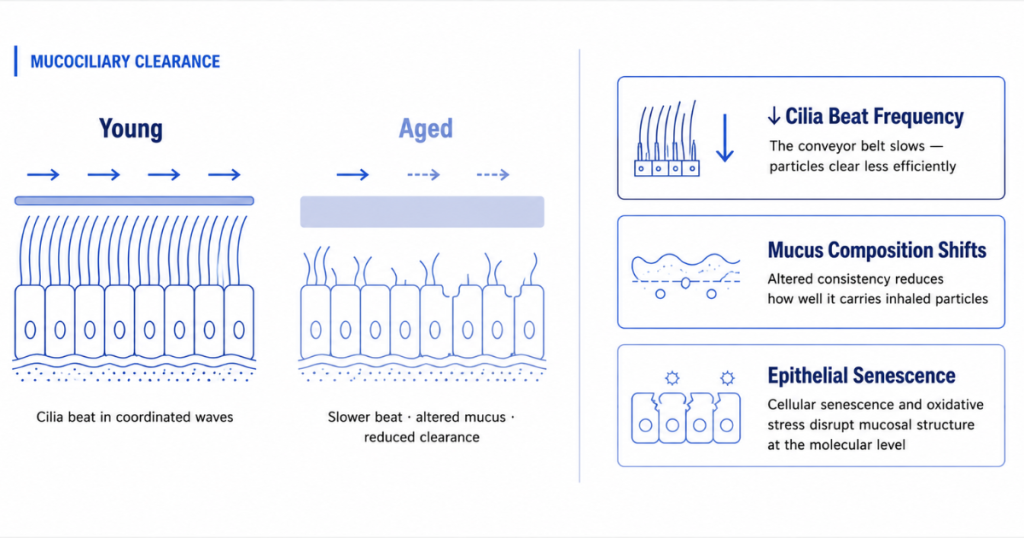
A 2025 systematic review of airway aging traced the same picture down to the molecular level, describing reduced ciliary function and disrupted mucin balance at the mucosal layer, driven by cellular senescence and oxidative stress (research in the International Journal of Molecular Sciences).
So the bronchial mucosa is a tissue with a specific, measurable, age-related decline. That’s precisely the kind of target a tissue-specific peptide is built for.
Taxorest Is Made From the Tissue It Aims At
Taxorest is a complex of short peptides extracted from bronchial mucosa, designated A-19 in the bioregulator system and sold by BioLongevity as BioLung. The whole premise of the category is tissue specificity, meaning peptides taken from one organ are studied for supporting that same organ.
Our guide to what peptide bioregulators are covers the category properly, so this article won’t re-teach it. The short version is that these peptides are small enough to enter cells and influence which genes get switched on, an effect documented across the research program in a 2021 systematic review of peptide regulation of gene expression.
The compounds trace back to work led by Vladimir Khavinson, and the story of the Khavinson peptide research explains where the whole family came from. For lungs, the tissue chosen was bronchial mucosa, which is the same lining that runs the clearance system described above.
What the Bronchial Peptide Research Shows
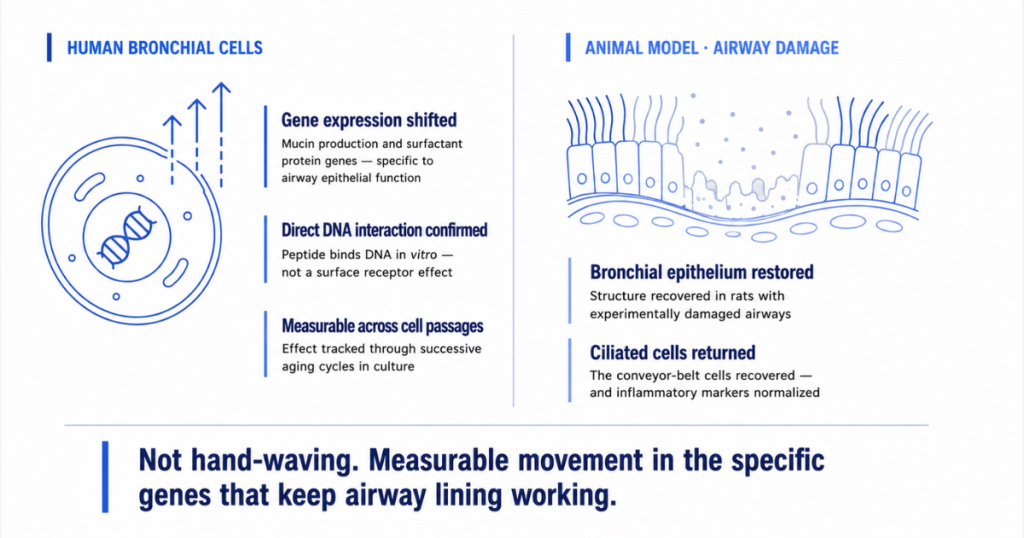
Research on bronchial peptides is genuinely encouraging, and it splits into two clear tiers. Reading them separately is the honest way to judge this compound, and it’s also where the interesting findings live.
In human bronchial cells
The most detailed work sits at the cellular level, and it’s specific. Researchers applied a short bronchial peptide to cultured human bronchoepithelial cells and measured what happened to gene activity across successive passages as the cells aged (a 2014 study in Lung).
The peptide shifted expression of genes tied to airway epithelial identity and function, including those governing mucin production and surfactant protein. The same team confirmed the peptide interacts directly with DNA in vitro (Khavinson et al. 2014).
This is a more concrete result than the category usually gets credit for. The mechanism isn’t hand-waving about “cellular support,” it’s measurable movement in the specific genes that keep airway lining tissue working properly.
In animal models of airway damage
The next tier moves into living tissue. In rats whose airways had been experimentally damaged, a course of peptide therapy restored the structure of the bronchial epithelium, with ciliated cells returning and inflammatory markers in the airway normalising (a 2015 study in the Bulletin of Experimental Biology and Medicine).
The return of the ciliated cells is the part worth noticing. Those are the cells that run the conveyor belt, and their recovery in an animal model lines up neatly with what the cell-culture work predicted.
Worth being precise about the scope of all this, because precision is the point. Both studies used the synthesised bronchial tetrapeptide rather than the natural A-19 complex in Taxorest, and much of the clinical reporting on bioregulators as a class comes from the group that originated them (a review of clinical study results in Advances in Gerontology). Taxorest sits firmly in the promising and worth watching column, which is exactly why verified sourcing carries so much weight with these products.
Building a Respiratory Longevity Routine
A lung peptide works best layered on top of the habits that move respiratory aging the most, not instead of them. The foundation does the heavy lifting.
- Train your aerobic capacity. Regular cardiovascular exercise is the most reliable lever you have on how well your respiratory system performs over decades.
- Take indoor air seriously. You breathe most of your air indoors, so filtration, ventilation, and keeping combustion sources down all reduce the particle load your cilia have to clear.
- Avoid smoke exposure, including secondhand. Nothing degrades the airway lining faster.
- Keep humidity reasonable. Very dry air thickens airway mucus, which makes the clearance system work harder.
Peptide bioregulators are traditionally taken in short courses of around 30 days rather than continuously, with repeat courses spaced across the year. Follow the product label for the exact protocol, since concentrations vary between suppliers.
People building a systems-based routine often pair tissue peptides that work on connected systems. Your airways sit at the meeting point of immune defence and oxygen delivery, which is why the lung bioregulator is commonly stacked with BioThymus (A-6) for immune support and BioBloodVessels (A-3) for vascular health. You can browse the full peptide bioregulator collection if you’re mapping a multi-tissue routine.
Two practical notes before you start. This peptide complex is derived from animal tissue, so it isn’t suitable during pregnancy or nursing. And if you use an inhaler or any prescribed respiratory medication, loop in your clinician first so your care team can coordinate.
Quality is where the real decision gets made. Because these are animal-derived extracts, you want transparent sourcing, third-party testing, and batch documentation you can open and read. BioLongevity publishes a Certificate of Analysis for every batch, which is what separates a verified product from a name on a label.
Frequently Asked Questions
What is Taxorest used for?
Taxorest is a bronchial mucosa peptide bioregulator positioned to support normal respiratory function and healthy lung aging as part of a longevity routine. It’s a dietary supplement for general respiratory wellness, not a treatment for any medical condition.
Is Taxorest the same as Bronchogen?
They’re related but different products. Taxorest is the natural peptide complex extracted from bronchial mucosa, while Bronchogen is a shorter synthesised peptide studied mainly as a research compound. Taxorest is the form used in bioregulator supplements.
How is Taxorest taken?
Taxorest is usually taken as a capsule in courses of around 30 days, with repeat courses spaced several months apart. Follow the product label for the specific protocol.
Can Taxorest be taken alongside respiratory medication?
Check with your clinician first. Taxorest is not a substitute for prescribed respiratory medication, and anyone managing a respiratory condition should coordinate any new supplement with their care team.
What should I look for in a lung peptide supplement?
Look for a Certificate of Analysis, third-party testing, clear sourcing of the peptide complex, and a label stating the exact amount per capsule. Verification matters more for animal-derived peptides than for most everyday supplements.
Read More From the BioLongevity Blog
- Ventfort Peptide Benefits: The Blood Vessel Bioregulator
- Cerluten Peptide Benefits: The Brain Peptide Bioregulator
- Glandokort and “Adrenal Fatigue”: What the Science Really Says
Ready to bring your airways into your longevity routine? BioLung – A-19 Lung Peptide Bioregulator (Taxorest) delivers a transparent 40 mg bronchial peptide complex in a single-ingredient capsule, third-party tested and backed by a Certificate of Analysis, so you can verify exactly what you’re taking before you take it.
Ask a qualified clinician before starting any supplement if you are pregnant, nursing, taking medication, or managing a medical condition.
These statements have not been evaluated by the Food and Drug Administration. This product is not intended to diagnose, treat, cure, or prevent any disease.
References
- Duong M, Islam S, Rangarajan S, et al. Mortality and cardiovascular and respiratory morbidity in individuals with impaired FEV1 (PURE): an international, community-based cohort study. Lancet Glob Health. 2019;7(5):e613-e623. https://doi.org/10.1016/S2214-109X(19)30070-1
- Bailey KL. Aging Diminishes Mucociliary Clearance of the Lung. Adv Geriatr Med Res. 2022;4(2):e220005. https://doi.org/10.20900/agmr20220005
- Salahoru C, Hînganu MV, Salahoru P, Hînganu D. Advances in Molecular Research of Tracheobronchial Tree Aging: A Systematic Review. Int J Mol Sci. 2025;26(11):5128. https://doi.org/10.3390/ijms26115128
- Khavinson VKh, Tendler SM, Vanyushin BF, et al. Peptide Regulation of Gene Expression and Protein Synthesis in Bronchial Epithelium. Lung. 2014;192(5):781-791. https://doi.org/10.1007/s00408-014-9620-7
- Kuzubova NA, Lebedeva ES, Dvorakovskaya IV, Surkova EA, Platonova IS, Titova ON. Modulating Effect of Peptide Therapy on the Morphofunctional State of Bronchial Epithelium in Rats with Obstructive Lung Pathology. Bull Exp Biol Med. 2015;159(5):685-688. https://doi.org/10.1007/s10517-015-3047-x
- Khavinson VK, Popovich IG, Linkova NS, Mironova ES, Ilina AR. Peptide Regulation of Gene Expression: A Systematic Review. Molecules. 2021;26(22):7053. https://doi.org/10.3390/molecules26227053
- Khavinson VKh, Kuznik BI, Ryzhak GA. Peptide bioregulators: the new class of geroprotectors. Message 2. Clinical studies results. Adv Gerontol. 2013;26(1):20-37. https://pubmed.ncbi.nlm.nih.gov/24003726/