

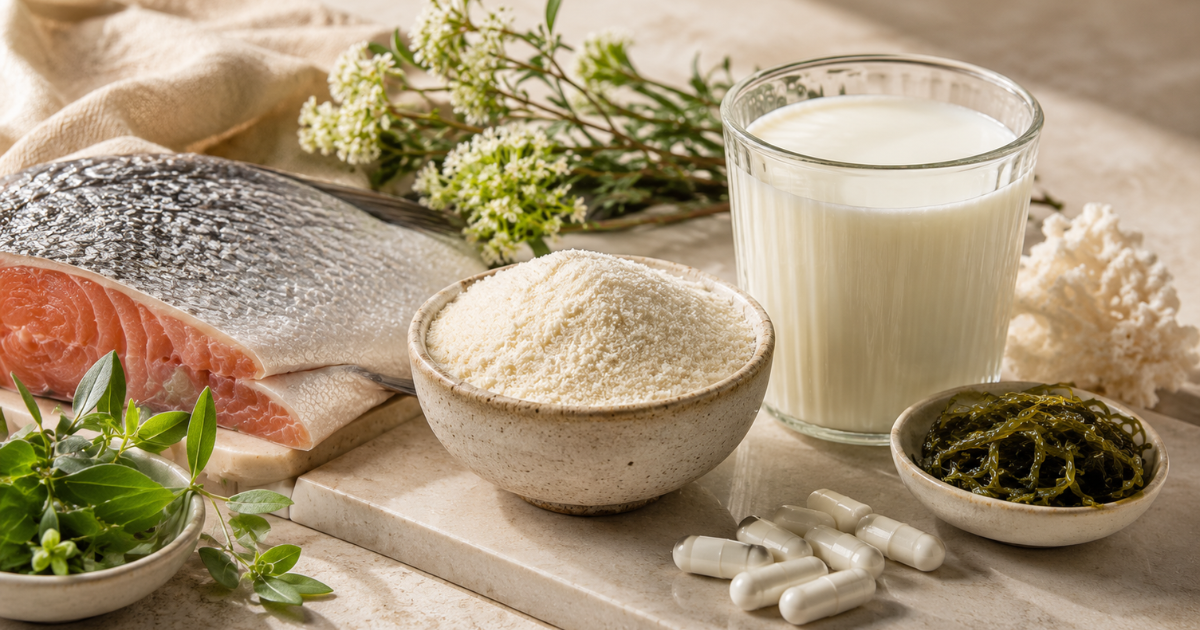
Natural peptides supplements contain peptides released from a real protein source, usually milk, fish, collagen, plants, or animal tissue, instead of being assembled amino acid by amino acid in a synthesizer. The word “natural” on the label tells you where the peptide came from, and nothing else.
That single fact reshapes how you shop this category. Four different raw materials sit behind almost every product on the shelf, they do different jobs, and the human research behind them is not evenly distributed.
Key Takeaways

The Short Version
Natural peptides supplements contain peptides cut out of food or tissue proteins by enzymes, fermentation, or digestion rather than built from scratch in a lab.
The four commercial sources are milk and dairy, marine and collagen, plants and fermented foods, and animal tissue peptide bioregulators.
Collagen peptides and milk-derived lactotripeptides carry the most human trial data, while tissue-derived bioregulators are the most targeted option for organ-system and healthy aging support.
Every natural peptide product is a hydrolysate, meaning a mixture of many fragments, so the milligram figure on the label only means something when a Certificate of Analysis stands behind it.
What “Natural” Means on a Peptide Supplement Label
A natural peptide is one that was cut out of a larger protein rather than built from individual amino acids. Manufacturers do that cutting three ways: with enzymes, with microbial fermentation, or by letting digestion finish the job in your gut, and a 2025 review of marine-derived peptides describes all three as standard production routes.
Peptides made this way are short by design. That same review puts marine-derived bioactive peptides at 3 to 40 amino acid residues, most commonly 2 to 20, and that size range is what lets them do anything once swallowed.
Most guides skip the next part. A peptide with a given amino acid sequence is the same molecule whether it came out of a fish or out of a synthesizer, and your gut has no way to tell the difference.
So treat “natural” as a sourcing statement. It describes the raw material and the manufacturing route, not the dose, the purity, or whether anyone has verified the contents. If you want the underlying chemistry first, our primer on what a peptide is and how it behaves in the body covers it in plain language.
The Four Sources Behind Almost Every Natural Peptide Product
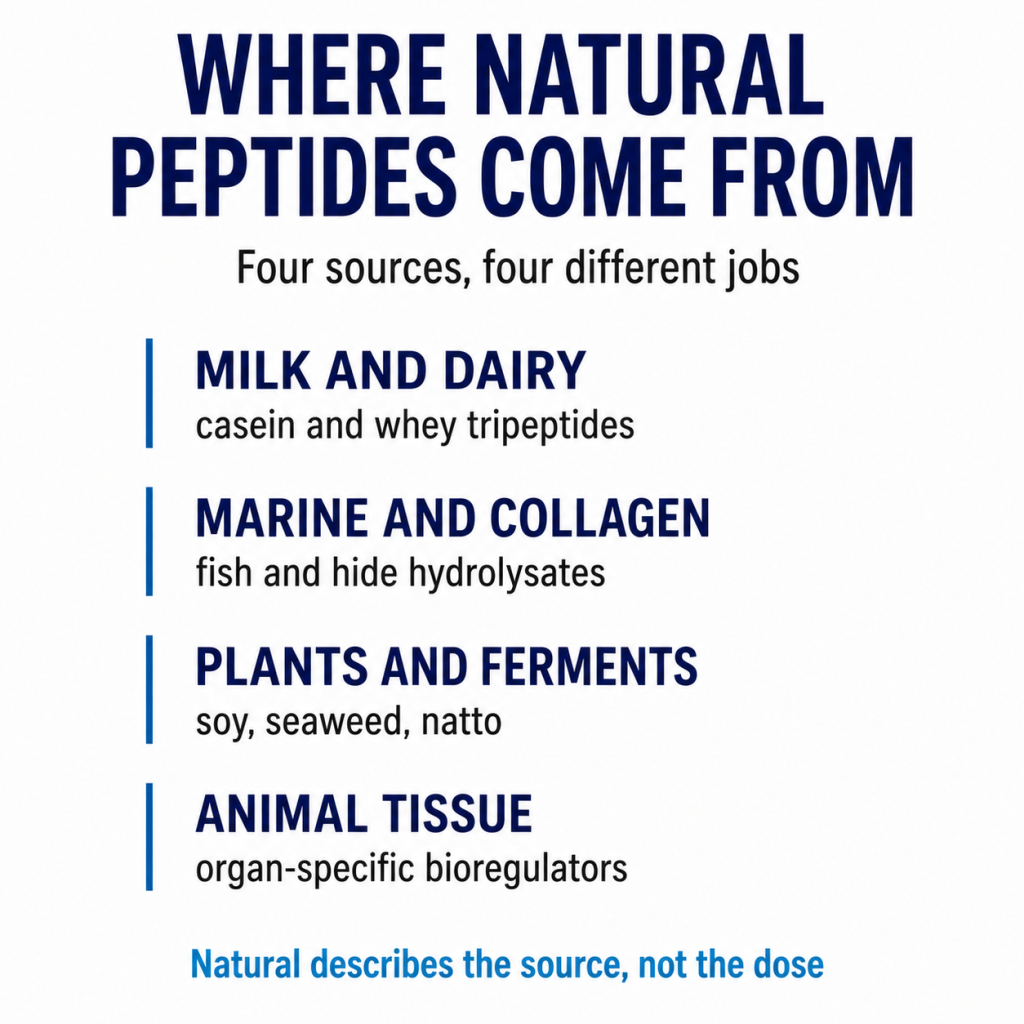
Nearly every natural peptide supplement on the market traces back to one of four raw materials, and identifying which one you are buying tells you most of what you need to know.
| Source family | Made from | Best studied for | Usual format |
|---|---|---|---|
| Milk and dairy | Casein and whey, fermented or enzyme-treated | Blood pressure outcomes in human trials | Powders, functional dairy drinks |
| Marine and collagen | Fish skin and scales, bovine hide, marine by-products | Skin hydration, elasticity, connective tissue | Powder, dosed in grams |
| Plants, algae, and ferments | Soy, seaweed, natto, kefir | Antioxidant and metabolic support | Whole food or powdered hydrolysate |
| Animal tissue bioregulators | Organ-specific peptide complexes | Organ-system and healthy aging support | 40 mg capsules, short courses |
The gap in evidence between these four is wide, so each one is worth a closer look.
Milk peptides have the longest trial record
Milk peptides are the most studied natural peptides in human research, and the star of that literature is a pair of tripeptides called IPP and VPP. Both are released when bacteria ferment casein, which is why they show up in sour milk drinks and casein hydrolysate powders.
The effect that has been measured most often is on blood pressure. A meta-analysis of 18 placebo-controlled trials found an average systolic reduction of 3.73 mmHg and a diastolic reduction of 1.97 mmHg, with the largest responses in Asian participants.
A larger pooled analysis of 28 trials in 1,919 people found a smaller average effect, roughly 1.66 mmHg systolic. Read together, the two put a realistic bracket around what a food-derived peptide does: consistent, measurable, and modest.
That’s a genuine human finding on a naturally derived peptide, which is more than most of this category can claim. Milk peptides are best framed as support for healthy blood pressure already within the normal range, not as a substitute for anything a clinician has prescribed.
Collagen and marine peptides own the skin and connective tissue data
Collagen peptides are the highest-volume natural peptide product in the world, and the research supports the popularity. They are made by hydrolyzing hide, bone, or fish skin down into fragments small enough to absorb.
A systematic review and meta-analysis of 19 randomized trials in 1,125 participants found that 90 days of hydrolyzed collagen improved skin hydration and elasticity and reduced wrinkles compared with placebo. A later analysis of 26 randomized controlled trials in 1,721 people confirmed the hydration and elasticity findings.
Marine sources belong in the same bucket. Fish skin, scales, and processing by-products yield peptide hydrolysates studied for antioxidant, anti-inflammatory, and wound-healing activity, and collagen is the dominant protein behind them.
If your goal is skin, hair, nails, or joint comfort, this is the source family with the strongest case. It’s also dosed in grams rather than milligrams, which is why collagen arrives as a scoop instead of a capsule.
Plant, algae, and fermented sources are the emerging edge
Plant and fermented sources produce bioactive peptides through the same enzymatic and microbial routes, and they are the fastest-moving part of this field. Soy, seaweed, natto, kefir, and sourdough all generate peptide fragments during fermentation.
A review of seaweed proteins describes peptides with antioxidant, antihypertensive, antidiabetic, and anti-inflammatory activity, all from a protein source that needs no arable land or irrigation. A review of fermented foods identifies fermentation-derived bioactive peptides as one of the main mechanisms behind their proposed benefits.
Most of this work sits at the laboratory and mechanism stage rather than the clinical trial stage. That makes it promising and worth watching, and it’s the reason plant-derived peptides are usually sold as whole foods or general protein hydrolysates rather than as targeted formulas.
Tissue-derived bioregulators are the most targeted option
Peptide bioregulators are the only natural peptides matched to a specific organ. Each one is a short-peptide complex extracted from a single tissue, catalogued with an A-number, and taken as a capsule in short courses.
The proposed mechanism is gene signaling rather than nutrition. A systematic review of peptide regulation of gene expression reports that peptides of two to seven amino acid residues can enter cell nuclei and interact with histone proteins and DNA, which is the basis for the tissue-specific idea.
There is human data behind the category, and it’s the boldest result on this page. In a long-term clinical program in 266 older adults, the researchers who developed the thymus and pineal peptide preparations reported improved cardiovascular, endocrine, immune, and nervous system measures alongside lower mortality over six to eight years of follow-up.
That work came from a single institute and has not been independently replicated in the West, which puts it in the promising column rather than the settled one. For the full background, read how peptide bioregulators work and the Khavinson research lineage behind them.
“Hydrolysate” Is the Word That Should Change How You Shop
Every natural peptide product is a hydrolysate, which means it’s a mixture of many peptide fragments rather than one purified molecule. That’s the most useful thing to understand about this category, and it rarely makes it onto a label.
Take collagen as the clearest example. A 10 g scoop is not 10 g of any one active peptide, and researchers have to use mass spectrometry to find the specific fragments that reach the bloodstream. A human pilot study tracked one of them, cyclic Pro-Hyp, peaking in plasma about two hours after a dose of collagen hydrolysate.
The fragments that get through are small ones. The gut wall carries a dedicated transporter for di- and tripeptides called PepT1, and a review of its function describes it as the main route by which dietary peptides become available to the body.
Three practical consequences follow from that:
- A big milligram number is not automatically a big dose of anything active. It is a dose of mixture.
- Source matters less than specification. Two collagen powders from the same fish can behave differently depending on how they were hydrolyzed.
- Third-party testing stops being optional. With a mixture, the label claim is the only thing standing between you and a guess, so it needs verifying.
Reading a Natural Peptide Label in Four Lines
Four phrases carry almost all of the useful information on a natural peptide label, and each one has a follow-up question attached to it.
| What the label says | What it tells you | What to check next |
|---|---|---|
| “Natural” or “naturally derived” | The peptide came from a protein source, not a synthesizer | Which source, named specifically |
| “Hydrolyzed” or “hydrolysate” | You are buying a mixture of fragments | The total amount per serving, stated in mg or g |
| “Peptide complex A-__” | A tissue-specific bioregulator with a catalogued designation | Milligrams per capsule and the tissue of origin |
| “Proprietary blend” | The individual amounts are hidden | Whether the brand publishes a Certificate of Analysis |
Two green flags matter more than the rest. The brand states the amount of every active per serving, and it publishes batch testing you can read before you buy rather than after.
One red flag outranks the rest as well. A product that names a peptide but not its quantity is asking you to trust a number it has chosen not to print.
Matching a Natural Peptide to What You Want
The right natural peptide depends on the system you are supporting, not on which source sounds most wholesome. This table maps the common goals onto the source that has the best case for each.
| If your goal is | Start with | What to look for |
|---|---|---|
| Skin, hair, nails, joint comfort | Collagen or marine collagen peptides | A gram-scale daily serving, single-ingredient powder |
| Blood pressure already in the normal range | Milk-derived lactotripeptides | Named IPP and VPP content |
| General antioxidant and metabolic support | Fermented foods and plant hydrolysates | Whole-food sources first |
| A specific organ system | A tissue-matched peptide bioregulator | Disclosed mg per capsule, published COA |
| Broad healthy aging support | A multi-tissue geroprotector complex | Every peptide component listed by A-number |
That last row is where BioLongevity’s catalog is strongest. BioMale and BioFemale each pack six tissue peptide complexes plus alpha-lipoic acid into a single 65 mg capsule, with every component listed by A-number on the label. BioMale runs pancreas, vessels, brain, liver, pineal, and testes; BioFemale swaps in thyroid and ovary.
If you’d rather start with one tissue instead of six, BioPineal delivers the A-8 pineal complex at a disclosed 40 mg per capsule. It’s the pineal preparation from that long-term clinical program, and it’s the usual entry point into the category. The full peptide bioregulator collection covers the remaining organ systems.
Where Synthetic Peptides Fit Alongside Natural Ones
Synthetic peptides earn their place by doing what natural sources cannot: delivering one exact sequence at one exact dose. That precision is why compounds like BPC-157 and KPV are made synthetically even though versions of them occur in the body.
Natural and synthetic are not rival teams. A sensible routine often runs a food-derived peptide daily for its nutritional role and a targeted peptide in short courses for a specific job.
The question that decides whether any peptide works in capsule form is delivery, not sourcing. Our guide to whether peptides survive being swallowed walks through which ones clear the gut and which ones never had a chance.
Frequently Asked Questions
A few questions come up repeatedly once the four source families make sense.
Are natural peptides better than synthetic peptides?
Neither is better by default. A synthetic peptide with the same amino acid sequence as a natural one is the same molecule, so the meaningful differences are dose precision, purity, and verification rather than origin. Synthetic production gives you one exact sequence, while natural sourcing gives you a mixture with a longer history of food use.
Which natural peptide supplement has the strongest human evidence?
Collagen peptides, by volume of trials. Multiple meta-analyses covering more than a thousand participants each show improved skin hydration and elasticity after roughly 90 days. Milk-derived lactotripeptides come second, with two meta-analyses showing small but consistent blood pressure effects.
Do natural peptides survive stomach acid?
The short ones do. Di- and tripeptides are absorbed intact through a dedicated transporter in the gut wall, which is why collagen fragments can be measured in human blood after a dose. Longer peptides are broken down before they get that far, which is why most of them are sold as injectables.
Are collagen peptides and peptide bioregulators the same thing?
No, and the difference is the whole point. Collagen peptides are a nutrient your body dismantles for raw material, dosed in grams. Peptide bioregulators are studied as tissue-specific signals, dosed in milligrams and taken in short courses rather than continuously.
How do I know a natural peptide supplement contains what it claims?
Ask for the Certificate of Analysis. A COA is independent lab documentation showing identity, purity, and that the amount in the capsule matches the amount on the label. A brand that will not show you one for the batch you are buying has told you something useful.
Natural sourcing is a good starting filter. Verification is what turns it into a good purchase, and that is where BioLongevity puts its money: every peptide complex is disclosed by A-number and milligram, every batch is third-party tested, and you can read the Certificate of Analysis before you order rather than after. Start with BioMale or BioFemale if you want broad healthy aging support from six tissue peptides in one capsule.
Ask a qualified clinician before starting any supplement if you are pregnant, nursing, taking medication, or managing a medical condition.
These statements have not been evaluated by the Food and Drug Administration. This product is not intended to diagnose, treat, cure, or prevent any disease.
References
- Shahidi F, Saeid A. Bioactivity of marine-derived peptides and proteins: a review. Marine Drugs. 2025;23(4):157. DOI
- Cicero AFG, Gerocarni B, Laghi L, Borghi C. Blood pressure lowering effect of lactotripeptides assumed as functional foods: a meta-analysis of current available clinical trials. Journal of Human Hypertension. 2011;25(7):425-436. DOI
- Qin LQ, Xu JY, Dong JY, Zhao Y, van Bladeren P, Zhang W. Lactotripeptides intake and blood pressure management: a meta-analysis of randomised controlled clinical trials. Nutrition, Metabolism and Cardiovascular Diseases. 2013;23(5):395-402. DOI
- de Miranda RB, Weimer P, Rossi RC. Effects of hydrolyzed collagen supplementation on skin aging: a systematic review and meta-analysis. International Journal of Dermatology. 2021;60(12):1449-1461. DOI
- Pu SY, Huang YL, Pu CM, et al. Effects of oral collagen for skin anti-aging: a systematic review and meta-analysis. Nutrients. 2023;15(9):2080. DOI
- Alboofetileh M, Hamzeh A, Abdollahi M. Seaweed proteins as a source of bioactive peptides. Current Pharmaceutical Design. 2021;27(11):1342-1352. DOI
- Dimidi E, Cox SR, Rossi M, Whelan K. Fermented foods: definitions and characteristics, impact on the gut microbiota and effects on gastrointestinal health and disease. Nutrients. 2019;11(8):1806. DOI
- Khavinson VK, Popovich IG, Linkova NS, Mironova ES, Ilina AR. Peptide regulation of gene expression: a systematic review. Molecules. 2021;26(22):7053. DOI
- Khavinson VKh, Morozov VG. Geroprotective effect of thymalin and epithalamin. Advances in Gerontology. 2002;10:74-84. PubMed
- Shigemura Y, Iwasaki Y, Tateno M, Suzuki A, Kurokawa M, Sato Y, Sato K. A pilot study for the detection of cyclic prolyl-hydroxyproline (Pro-Hyp) in human blood after ingestion of collagen hydrolysate. Nutrients. 2018;10(10):1356. DOI
- Spanier B, Rohm F. Proton coupled oligopeptide transporter 1 (PepT1) function, regulation, and influence on the intestinal homeostasis. Comprehensive Physiology. 2018;8(2):843-869. DOI