

Vladonix is the thymus peptide bioregulator, a capsule built around the A-6 peptide complex extracted from thymus tissue and studied for supporting normal immune function. It’s the one bioregulator whose target organ has a well-mapped decline curve and whose peptide family carries the longest human follow-up in the category.
The thymus is unusual. Most organs decline gradually across adulthood. This one begins shrinking in childhood and is largely gone, as functional tissue, by the time most people start thinking about longevity.
Key Takeaways

The Short Version
Vladonix is a thymus-derived peptide bioregulator studied for supporting normal immune system function and healthy immune aging.
Age-related thymic involution replaces working thymus tissue with fat, cutting the supply of new naive T cells and shifting the immune system toward memory cells.
Thymic tissue can be regenerated in humans, which a 2019 clinical study demonstrated using a hormone-based protocol.
The thymic peptide family carries the longest human follow-up in the bioregulator catalog, with 266 older adults tracked across six to eight years.
The Thymus Is Scheduled to Shut Down Early
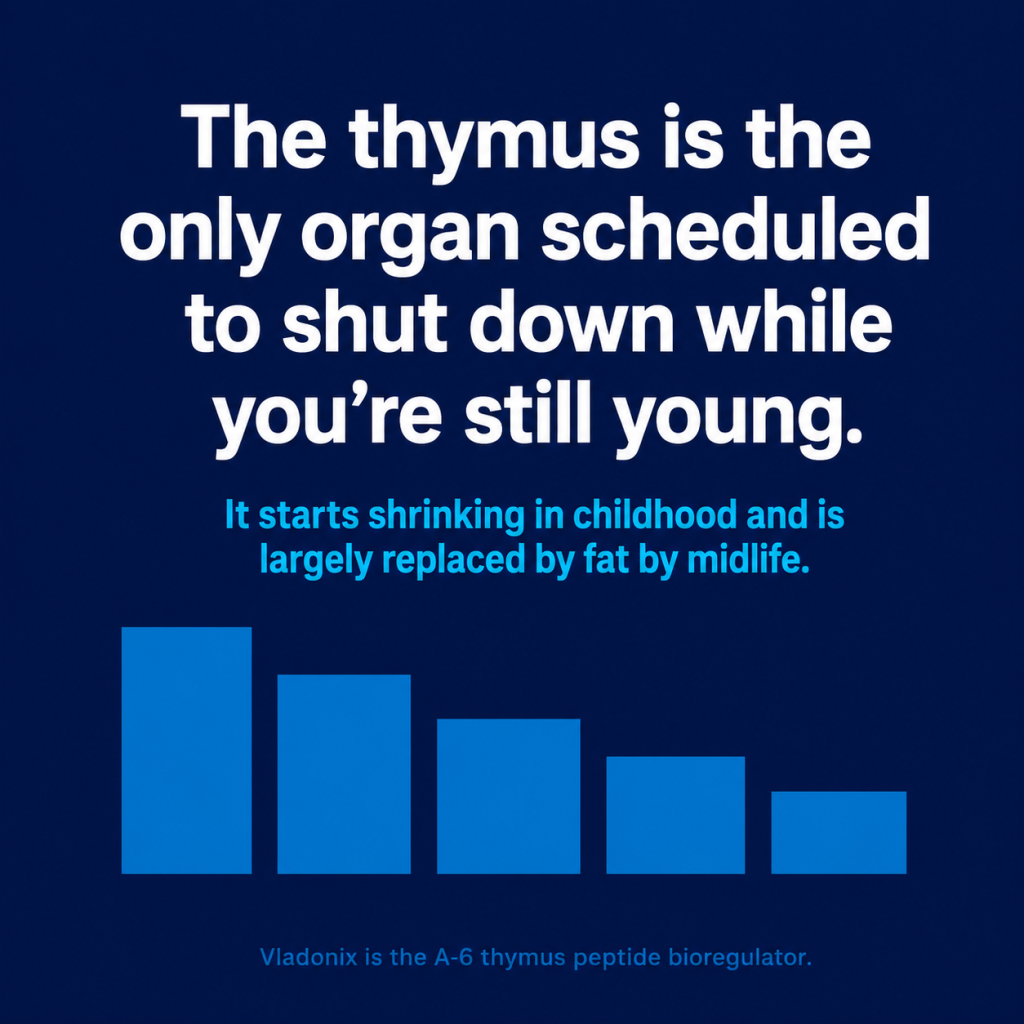
Thymic involution is the technical name, and it’s one of the most predictable processes in human biology.
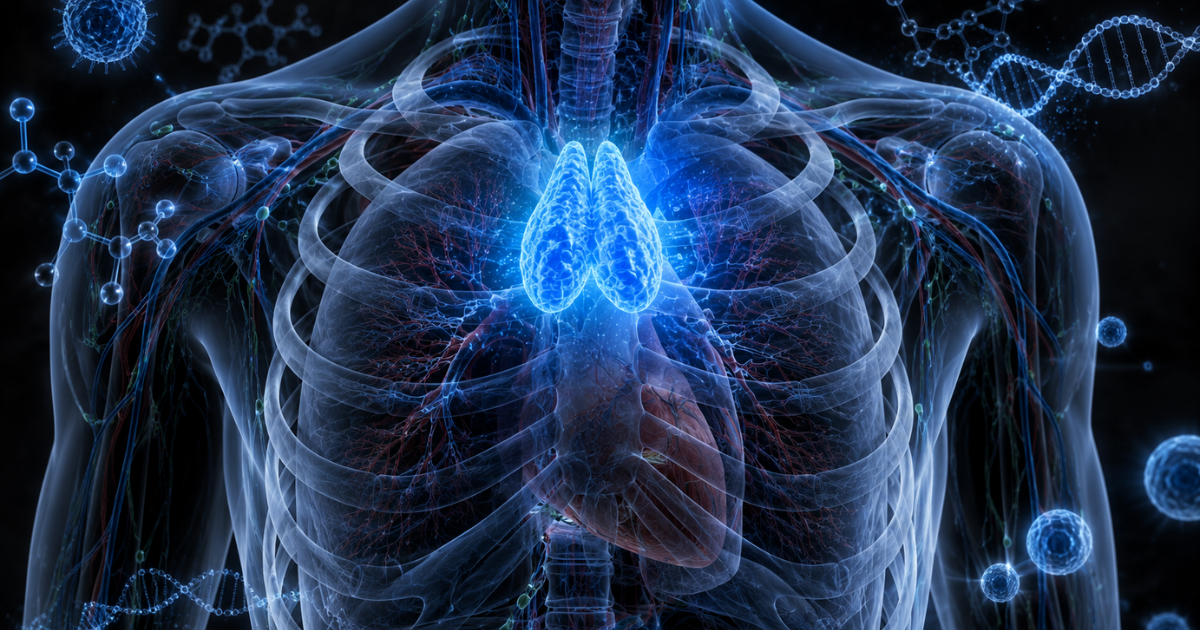
The thymus sits behind the breastbone and does a single, irreplaceable job: it trains T cells. Immature progenitor cells arrive, get educated to recognize threats without attacking the body’s own tissue, and leave as naive T cells ready for pathogens they’ve never met.
Then the factory closes. A 2024 review in Immunologic Research describes age-related thymic involution as the loss of T cell development along with the supporting epithelial network, both progressively replaced by adipose tissue [1].
The measurable consequence is a shift in the mix:
- Naive T cells fall. Fewer new recruits capable of responding to unfamiliar threats.
- Memory T cells rise. The immune system leans harder on what it already knows.
- Thymic output drops. Researchers track this using T cell receptor excision circles, molecular receipts left behind by newly made T cells [1].
That trade works fine against familiar pathogens. It works less well against new ones, which is a reasonable description of what changes about immunity with age.
Thymic Regeneration Has Been Shown in People
This is the finding that makes the thymus interesting rather than depressing, and it comes from a real human study.
In a 2019 clinical study published in Aging Cell, healthy men aged 51 to 65 followed a protocol designed to regenerate the thymus for one year. Participants showed protective immunological changes, improved risk indices across several age-related conditions, and a mean epigenetic age roughly 1.5 years below baseline, a 2.5-year difference compared with no treatment [2].
The GrimAge predictor showed a two-year decrease in epigenetic versus chronological age, and it held six months after treatment stopped [2].
Two things to be clear about. That protocol used growth hormone, DHEA and metformin, not a peptide bioregulator, so it isn’t evidence for Vladonix. And it was a small pilot study.
What it establishes is the premise: the thymus is not a closed door. Supporting the organ is a target worth aiming at, and the animal work agrees. In the same Immunologic Research paper, transplanting fetal thymus tissue into aged mice restored thymic output and reversed impaired T cell production [1].
The Thymic Peptide Family Has the Longest Human Follow-Up
Most bioregulators rest on mechanism plus animal data. The thymic branch has something the others don’t: a multi-year clinical dataset in older adults.
Researchers at the St. Petersburg Institute of Bioregulation and Gerontology and the Institute of Gerontology in Kiev tracked 266 elderly participants over six to eight years, administering thymic and pineal peptide preparations during the first two to three years [3].
| What was measured | What the researchers reported |
|---|---|
| Cardiovascular, endocrine, immune and nervous system indices | Improvement toward normal ranges across all four |
| Acute respiratory illness incidence | 2.0 to 2.4 times lower than controls |
| Mortality over the observation period, thymic peptide group | 2.0 to 2.1 times lower than controls |
| Mortality, thymic plus pineal peptides given annually for six years | 4.1 times lower than controls |
The pairing matters. The strongest result in that dataset came from combining the thymic peptide with the pineal one, which is the same logic behind stacking Vladonix with Endoluten, the pineal bioregulator.
Two qualifiers keep this honest. The preparation studied was Thymalin, an injectable clinical formulation, not an oral capsule, and the work came from the same research group that developed it. Vladonix delivers the same A-6 thymic peptide complex in a dietary supplement format, which is a different product in a different setting.
Even with those caveats, this is the deepest human record in the bioregulator catalog, and it happens to sit on the thymus. The wider Khavinson research program explains where these compounds came from.
Inside A-6: What KE and EW Do
The thymic complex has been narrowed down to two very short peptides, which is unusual precision for a tissue extract.
The active dipeptides are KE (lysine and glutamic acid) and EW (glutamic acid and tryptophan). A 2023 paper in the International Journal of Molecular Sciences mapped how each binds double-stranded DNA and identified the gene targets each one reaches [4]. In cell-based work on human blood mononuclear cells, both dipeptides reduced synthesis of the inflammatory cytokines IL-1β, IL-6 and TNF-α by 1.4 to 6.0 times [4].
That fits the general mechanism behind the whole family. Short peptides of two to seven amino acids can enter the cell nucleus, interact with DNA and histone proteins, and change which genes get transcribed [5]. Peptide signaling has also been shown to direct cell differentiation across multiple tissue types [6].
Behind all of it sits decades of geroprotector research reporting that long-term peptide treatment slowed age-related changes in biomarkers of aging [7]. If the category is new to you, our primer on what peptide bioregulators are covers the basics.
Courses, Pairings, and Who Vladonix Suits
Bioregulators are taken in courses, not continuously. For Vladonix that means one to two capsules once or twice daily with food for 30 days, repeated a few times across the year. Each BioThymus capsule delivers 40 mg of the A-6 peptide complex. Follow the product label unless your clinician recommends otherwise.
It tends to suit:
- Adults over 45 building an immune-aging layer into a longevity routine.
- Bioregulator users who want the organ with the deepest human research behind it.
- Anyone stacking across systems who wants a foundational complex rather than a niche one.
The natural companion is BioPineal (Endoluten), since the two were studied together and produced the strongest results in combination. The immune support collection groups formulas by goal, and the full peptide bioregulator range is organized by organ system.
One safety point, stated once: if you have an autoimmune condition, take immunosuppressive medication, or are being treated for a condition involving the immune system, talk with your clinician before adding a thymic peptide. Anything aimed at immune signaling belongs in that conversation.
Frequently Asked Questions
These come up most often about the A-6 complex.
What is Vladonix used for?
Vladonix is used to support normal immune system function and healthy immune aging as part of a longevity routine. It’s an educational and wellness product, not a treatment for any condition.
Is Vladonix the same as Thymalin?
They’re related but not identical. Thymalin is an injectable clinical preparation of thymic peptides. Vladonix is the A-6 thymic peptide complex in an oral dietary supplement.
Can Vladonix regrow the thymus?
No supplement should be described that way. Thymic regeneration has been demonstrated in humans using a hormone-based protocol, and Vladonix is aimed at supporting normal thymic and immune function rather than reproducing that result.
How long is a Vladonix course?
A typical course runs 30 days, with one to two capsules taken once or twice daily with food, repeated a few times per year.
What should Vladonix be stacked with?
The pineal bioregulator is the most researched pairing, since the two were studied together in the same long-term follow-up. Beyond that, most people combine across the organ systems they care about.
Is Vladonix suitable for people with autoimmune conditions?
That’s a clinician question. Anything aimed at immune signaling should be discussed with whoever manages your care before you start.
Read More From the BioLongevity Blog
- Thyreogen Peptide Benefits and Thyroid Support Guide
- Best Longevity Supplements in 2026 Ranked by Evidence
Ready to add the organ with the deepest research record to your routine? BioThymus – A-6 Thymus Peptide Bioregulator (Vladonix) delivers a transparent 40 mg A-6 peptide complex, third-party tested through an independent CLIA-certified lab, with the Certificate of Analysis published before you buy rather than after.
Ask a qualified clinician before starting any supplement if you are pregnant, nursing, taking medication, or managing a medical condition.
These statements have not been evaluated by the Food and Drug Administration. This product is not intended to diagnose, treat, cure, or prevent any disease.
References
- Li L, Xu F, Han Y, Zeng J, Du S, Wang C. Thymic microenvironment’s impact on immunosenescence. Immunologic Research. 2024;72(5):1161-1173. https://doi.org/10.1007/s12026-024-09519-z
- Fahy GM, Brooke RT, Watson JP, Good Z, Vasanawala SS, Maecker H, Leipold MD, Lin DTS, Kobor MS, Horvath S. Reversal of epigenetic aging and immunosenescent trends in humans. Aging Cell. 2019;18(6):e13028. https://doi.org/10.1111/acel.13028
- Khavinson VKh, Morozov VG. Peptides of pineal gland and thymus prolong human life. Neuro Endocrinology Letters. 2003;24(3-4):233-240. https://pubmed.ncbi.nlm.nih.gov/14523363/
- Linkova N, Khavinson V, Diatlova A, Petukhov M, Vladimirova E, Sukhareva M, Ilina A. The Influence of KE and EW Dipeptides in the Composition of the Thymalin Drug on Gene Expression and Protein Synthesis Involved in the Pathogenesis of COVID-19. International Journal of Molecular Sciences. 2023;24(17):13377. https://doi.org/10.3390/ijms241713377
- Khavinson VK, Popovich IG, Linkova NS, Mironova ES, Ilina AR. Peptide Regulation of Gene Expression: A Systematic Review. Molecules. 2021;26(22):7053. https://doi.org/10.3390/molecules26227053
- Khavinson V, Linkova N, Diatlova A, Trofimova S. Peptide Regulation of Cell Differentiation. Stem Cell Reviews and Reports. 2020;16(1):118-125. https://doi.org/10.1007/s12015-019-09938-8
- Anisimov VN, Khavinson VKh. Peptide bioregulation of aging: results and prospects. Biogerontology. 2010;11(2):139-149. https://doi.org/10.1007/s10522-009-9249-8