


The best urolithin A supplement gives you finished urolithin A at a dose the clinical trials actually used, and shows you the lab work that proves the capsule matches the label. Everything else on a urolithin A product page is decoration.
That sounds obvious until you start reading labels. Two bottles can both say “urolithin A” on the front and deliver wildly different amounts of the compound to your bloodstream, for reasons that have nothing to do with price.
Key Takeaways

The Short Version
The best urolithin A supplement lists finished urolithin A, not a pomegranate precursor, at 500 to 1,000 mg per daily serving.
Only about 40 percent of adults convert pomegranate compounds into meaningful urolithin A, so a precursor-based product is a gamble on your own gut bacteria.
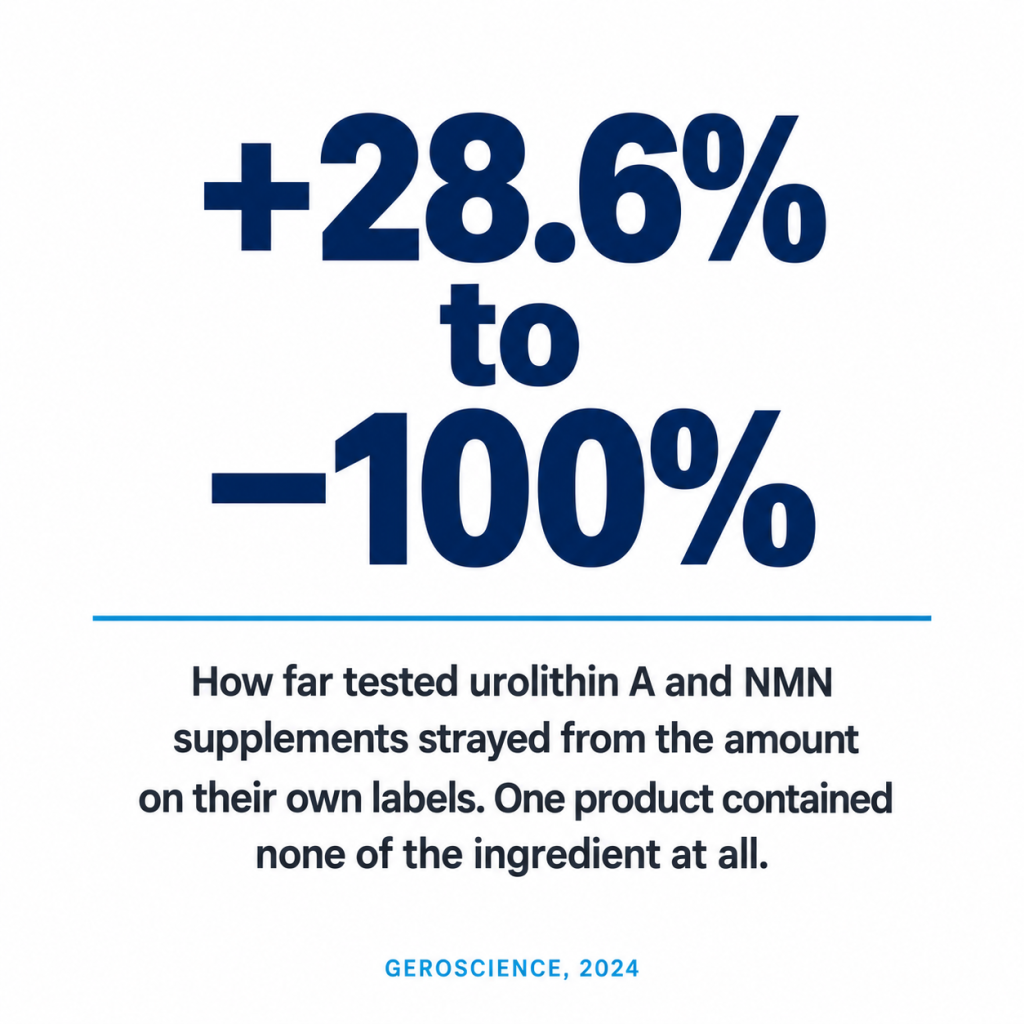
Independent lab testing of urolithin A and NMN products found active-ingredient amounts ranging from 28.6 percent above the label claim to 100 percent below it.
Check the dose per serving rather than per capsule, and ask to see a Certificate of Analysis before you buy.
What Separates One Urolithin A Supplement From Another
The difference comes down to arithmetic. Urolithin A is a single, well-characterized compound, so the questions that decide a purchase are how much of it reaches you and whether anyone verified the number.
Researchers put that second question to the test. In a 2024 analysis published in GeroScience, scientists bought urolithin A and NMN supplements off the shelf and measured what was inside them. Active ingredient content deviated from the label claim by as much as 28.6 percent above and 100 percent below, meaning at least one product on the market contained none of the compound it advertised.
That’s the honest starting point for a buyer’s guide. Four checks catch nearly every way a urolithin A purchase goes sideways, and they take about ninety seconds to run.
| Check | What you’re looking for |
|---|---|
| 1. The form | Finished urolithin A, listed by name with a milligram amount |
| 2. The dose | 500 to 1,000 mg per daily serving, matching the trials |
| 3. The proof | Third-party testing with a Certificate of Analysis you can read |
| 4. The pairing | Supporting compounds that add something, at real amounts |
Check 1: Is It Urolithin A, or a Precursor You Have to Convert Yourself?
Urolithin A isn’t in food. Your gut bacteria make it from ellagitannins, the polyphenols in pomegranates, walnuts, and berries, which means a pomegranate extract capsule is selling you the raw material and hoping your microbiome finishes the job.
For most people, it doesn’t. Researchers gave 100 healthy adults a glass of pomegranate juice and measured what their gut produced. Only 12 percent had detectable urolithin A at baseline, and roughly 40 percent converted the precursors into meaningful amounts. The rest produced little to none, and the ones who did convert had measurably different gut bacteria.
The same trial ran the direct comparison. A 500 mg dose of urolithin A itself delivered more than six times the plasma exposure of the pomegranate juice group.
So when you’re comparing labels, sort them into two piles:
- Direct urolithin A. The Supplement Facts panel names urolithin A and gives it a milligram amount. You know exactly what you’re getting.
- Precursor only. The panel lists pomegranate extract, punicalagins, or ellagic acid, with no urolithin A line. Whether this works depends on bacteria you can’t see and probably haven’t tested.
Pomegranate extract is a genuinely useful antioxidant ingredient and it belongs in a well-built formula. It just can’t stand in for the compound the research was done on.
Check 2: Does the Serving Reach the Dose Used in the Trials?
Human trials of urolithin A cluster at 500 mg and 1,000 mg per day, and the 1,000 mg dose carries the widest range of measured outcomes. A product listing 100 or 250 mg is describing a smaller experiment than the ones behind the results people come to this compound for.
Here’s where the human evidence sits by dose:
| Dose | What the trial measured | Population |
|---|---|---|
| 500 mg and 1,000 mg daily, 4 weeks | Favorable safety profile, plus changes in plasma acylcarnitines and muscle mitochondrial gene expression | Healthy older adults |
| 500 mg and 1,000 mg daily, 4 months | About 12 percent improvement in muscle strength, plus lower C-reactive protein | Middle-aged adults |
| 1,000 mg daily, 4 months | Improved muscle endurance, lower acylcarnitines, ceramides, and C-reactive protein | Adults aged 65 to 90 |
| 1,000 mg daily, 4 weeks | Expanded naive-like CD8 T cells and improved fatty acid oxidation in immune cells | Healthy middle-aged adults |
The first-in-human dose-ranging study is the one to anchor on. It tested urolithin A across a range of single and repeated doses and found that 500 mg and 1,000 mg were the levels that moved mitochondrial biomarkers in muscle tissue.
From there the outcomes get more specific. A randomized placebo-controlled trial in middle-aged adults found roughly a 12 percent gain in muscle strength over four months, alongside lower inflammatory markers. In adults aged 65 to 90, 1,000 mg daily improved muscle endurance and lowered several plasma markers tied to mitochondrial and cellular health. And a 2025 randomized trial found that four weeks at 1,000 mg shifted immune cell composition toward younger, less exhausted T cells.
One label trap deserves a mention here. Read the dose per serving, not per capsule. A bottle advertising “500 mg urolithin A” in 60 capsules may be a 250 mg product where a serving is two capsules, and the math changes your cost per month considerably.
If mitophagy is new to you, our explainer on how cells clear out damaged mitochondria covers the mechanism these trials were built around. For a fuller walkthrough of what the human trials on urolithin A found, start there instead.
Check 3: Can You See the Test That Proves It?
A Certificate of Analysis is the document that turns a label claim into a verified number, and any brand serious about urolithin A will show you one. The GeroScience findings are the reason this check isn’t optional paperwork.
A useful COA answers four questions:
- Identity. Is the compound in the capsule actually urolithin A? HPLC and mass spectrometry confirm molecular identity.
- Potency. How many milligrams are present, measured rather than assumed?
- Purity. What percentage is the active compound, typically stated as 98 percent or higher?
- Contaminants. Heavy metals, microbials, and residual solvents, tested and within limits.
Two red flags are worth naming. A proprietary blend that hides the urolithin A amount makes the dose unverifiable by design. And “lab tested” with no document behind it is a marketing phrase, not a test result.
BioLongevity publishes batch documentation across the catalog for exactly this reason. A number you can check is worth more than a claim you have to trust.
Check 4: What the Urolithin A Is Paired With
The right supporting compounds extend what urolithin A does rather than duplicating it. Urolithin A drives mitophagy, the cellular cleanup and replacement cycle. Pairing it with antioxidants that protect mitochondria while that cycle runs is a coherent formulation choice, provided the amounts are real.
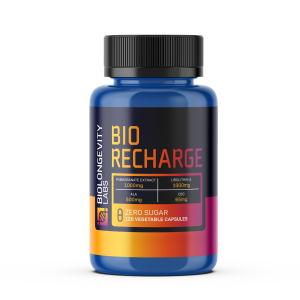
BioRecharge is built on that logic, with 1,000 mg of urolithin A per daily serving, the dose carried through the broadest set of human trials. It adds three compounds that each do a different job:
- Pomegranate extract, 1,000 mg. Polyphenol antioxidant support, included as a complement to the urolithin A rather than a substitute for it.
- C60 fullerene, 65 mg. A catalytic antioxidant that neutralizes multiple free radicals per molecule without being used up.
- Alpha-lipoic acid, 500 mg. Supports glutathione production and antioxidant capacity in both water-soluble and fat-soluble environments.
Four capsules deliver the full serving, which is a direct consequence of dosing to the research rather than to a smaller pill count. Every batch is third-party tested in a cGMP-certified U.S. facility.
One safety point worth stating plainly: alpha-lipoic acid can affect blood glucose and insulin sensitivity. If you manage diabetes, take blood sugar medication, or use thyroid medication, talk with your clinician before adding a formula that contains it.
So Which Urolithin A Supplement Should You Buy?
Buy the one that names finished urolithin A, hits 1,000 mg in a single daily serving, and hands you the lab documentation without being asked. That combination is rarer than the category’s marketing suggests, and it’s what puts your bottle in the same territory as the products the researchers handed their participants.
BioRecharge meets all four checks, and it’s the formula we’d point a first-time urolithin A buyer toward. Give it 12 to 16 weeks of consistent daily use, which lines up with the four-month trials. If you’d rather compare it against the rest of the lineup first, the longevity and healthy aging collection is where to start.
Read More From the BioLongevity Blog
- Best Longevity Supplements in 2026 Ranked by Evidence
- AMPK Activation Supplements: Do They Actually Work?
- The Beginner’s Guide to Longevity Supplements
Frequently Asked Questions
How many milligrams of urolithin A should be in one serving?
Between 500 and 1,000 mg per daily serving. Human trials have used both, and 1,000 mg is the dose linked to the widest range of measured results including muscle endurance, inflammatory markers, and immune cell changes.
Does a pomegranate extract supplement count as a urolithin A supplement?
No. Pomegranate extract supplies ellagitannins, the precursors your gut bacteria convert into urolithin A. Roughly 40 percent of adults make meaningful amounts from those precursors, and direct supplementation delivered more than six times the plasma exposure of pomegranate juice in a head-to-head trial.
What should a urolithin A Certificate of Analysis show?
Molecular identity confirmed by HPLC or mass spectrometry, measured potency in milligrams, purity stated as a percentage, and screening for heavy metals and microbial contaminants. If a brand can’t produce one, treat the label as an unverified claim.
Is a more expensive urolithin A supplement always better?
Not by price alone, but cost per gram of verified urolithin A is a fair way to compare. A cheaper bottle at 250 mg per serving with no lab documentation can easily work out more expensive per verified milligram than a fully tested 1,000 mg formula.
Who should check with a clinician before taking urolithin A?
Anyone who is pregnant, nursing, taking prescription medication, or managing a medical condition. Pay particular attention if the formula includes alpha-lipoic acid and you take blood sugar or thyroid medication, since it can influence glucose and insulin sensitivity.
Ask a qualified clinician before starting any supplement if you are pregnant, nursing, taking medication, or managing a medical condition.
These statements have not been evaluated by the Food and Drug Administration. This product is not intended to diagnose, treat, cure, or prevent any disease.
References
- Sandalova E, Li H, Guan L, et al. Testing the amount of nicotinamide mononucleotide and urolithin A as compared to the label claim. GeroScience. 2024;46(5):5075-5083. DOI
- Singh A, D’Amico D, Andreux PA, et al. Direct supplementation with Urolithin A overcomes limitations of dietary exposure and gut microbiome variability in healthy adults to achieve consistent levels across the population. European Journal of Clinical Nutrition. 2022;76(2):297-308. DOI
- Andreux PA, Blanco-Bose W, Ryu D, et al. The mitophagy activator urolithin A is safe and induces a molecular signature of improved mitochondrial and cellular health in humans. Nature Metabolism. 2019;1(6):595-603. DOI
- Singh A, D’Amico D, Andreux PA, et al. Urolithin A improves muscle strength, exercise performance, and biomarkers of mitochondrial health in a randomized trial in middle-aged adults. Cell Reports Medicine. 2022;3(5):100633. DOI
- Liu S, D’Amico D, Shankland E, et al. Effect of Urolithin A Supplementation on Muscle Endurance and Mitochondrial Health in Older Adults: A Randomized Clinical Trial. JAMA Network Open. 2022;5(1):e2144279. DOI
- Denk D, Singh A, Kasler HG, et al. Effect of the mitophagy inducer urolithin A on age-related immune decline: a randomized, placebo-controlled trial. Nature Aging. 2025;5(11):2309-2322. DOI