

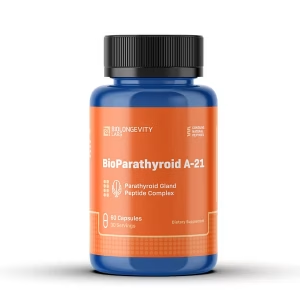
Bonothyrk is the parathyroid peptide bioregulator, a capsule built around the A-21 peptide complex extracted from parathyroid tissue and studied for supporting normal parathyroid function and calcium balance. It matters because the parathyroid glands, not your diet, make the final call on how much calcium stays in your bones today.
Most bone health routines start and end with calcium and vitamin D. This one starts a level higher, with the signal that decides where those minerals actually go.
Key Takeaways

The Short Version
Bonothyrk is a parathyroid-derived peptide bioregulator studied for supporting normal parathyroid function, calcium balance, and bone health.
Four glands the size of rice grains produce parathyroid hormone, which governs calcium release from bone, reabsorption in the kidney, and vitamin D activation.
Elevated parathyroid hormone becomes more common with age, and in older adults it tracks with lower bone density and faster bone loss.
Bonothyrk works at the signaling layer rather than the mineral layer, which makes it a companion to calcium and vitamin D rather than a replacement.
Four Glands the Size of Rice Grains Set Your Calcium
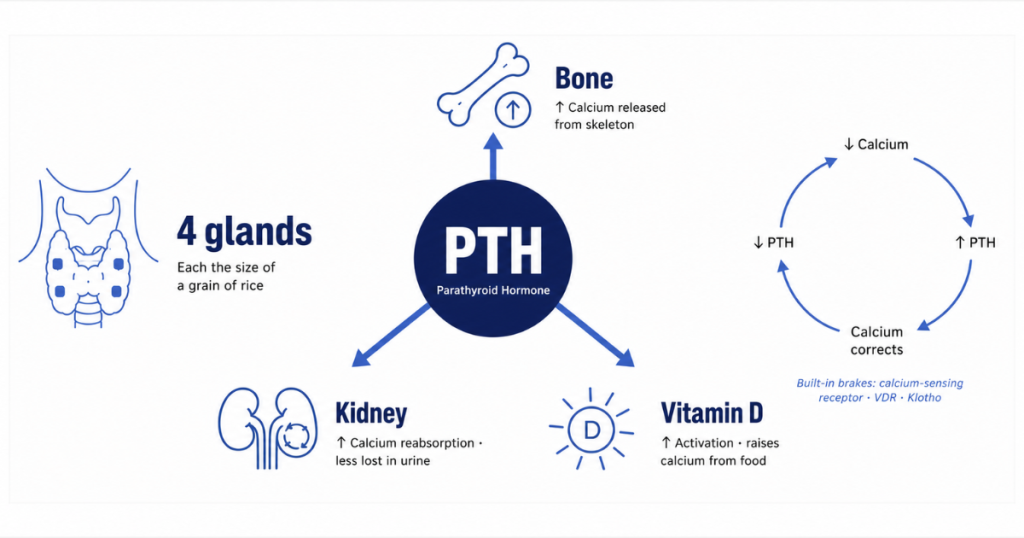
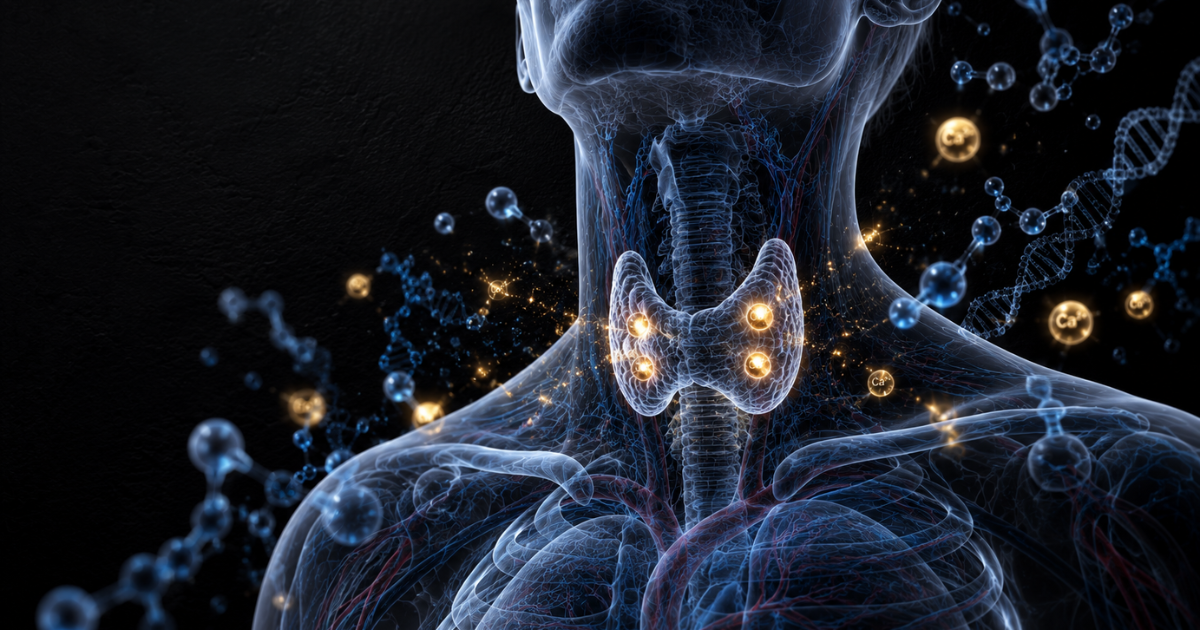
You have four parathyroid glands, each roughly the size of a grain of rice, tucked behind the thyroid in your neck. They are the smallest endocrine organs in the body and they run one of the most consequential systems in it.
Their job is calcium homeostasis. Serum calcium is regulated primarily by parathyroid hormone, or PTH, which the glands release in response to falling blood calcium [1].
PTH then pulls three levers at once:
- Bone. It signals the release of stored calcium from the skeleton into the bloodstream.
- Kidney. It increases calcium reabsorption so less is lost in urine.
- Vitamin D. It drives activation of vitamin D, which raises calcium absorption from food.
The system has built-in brakes. A 2023 review in Cell and Tissue Research describes how the calcium-sensing receptor, the vitamin D receptor, and Klotho work together to keep PTH secretion from running high [1].
That’s the thermostat. Calcium falls, PTH rises, bone releases mineral, the level corrects, PTH settles back down. It works beautifully for decades.
When the Signal Starts Drifting
After 60, the calcium thermostat tends to sit a little too high, and the bill for that gets paid out of the skeleton.
The pattern has a name in the literature, secondary hyperparathyroidism, and it’s common. In a study of more than 4,000 Irish adults aged 60 and over, up to one in six had elevated PTH, and those participants had measurably lower bone density at the femoral neck and total hip along with higher bone turnover markers [2]. A nationally representative study of adults aged 50 and over put the prevalence at 12.3 percent [3].
The drivers are mostly the ordinary parts of aging. Vitamin D deficiency raised the odds more than fourfold, and declining kidney function, low calcium intake, obesity, loop diuretics and proton pump inhibitors all pushed PTH up [2][3].
The consequences show up over time rather than overnight. In an 8-year prospective study of 826 men aged 60 to 87, those whose PTH sat above the median lost cortical thickness, bone mineral density and estimated bone strength faster than men in the lowest quartile [4].
Here’s what makes that finding useful rather than alarming. Bone loss in older adults isn’t only a mineral supply problem. It’s also a signaling problem, and the signal comes from four glands most people have never thought about.
What A-21 Is, and What a Parathyroid Peptide Targets

Bonothyrk is a short-chain peptide complex extracted from parathyroid tissue and classified as A-21 in the Khavinson bioregulator system. Each BioParathyroid capsule delivers 40 mg of the complex.
The premise of the category is tissue specificity. Short peptides isolated from one organ are studied for supporting that same organ, with the peptide’s structure determining which direction it steers a cell [6].
Two mechanistic findings anchor the science. Short peptides of two to seven amino acids can cross into the cell nucleus, interact with DNA and histone proteins, and influence which genes are transcribed [5]. And peptide-driven regulation has been shown to direct cell differentiation across a range of tissues, including osteogenic differentiation in stem cells [6].
Decades of work on the bioregulator family reported that long-term treatment slowed age-related changes in biomarkers of aging, with clinical use tracked across six to twelve years [7]. Those outcomes describe the family as a whole rather than Bonothyrk specifically, and independent human trials on this exact complex are still limited. That’s the accurate picture, and it’s why the strongest reason to take this peptide is the well-documented biology of the gland it targets.
For a fuller introduction to the category, our plain-language primer on peptide bioregulators covers the fundamentals, and the story of the research program these compounds came from explains how the organ-by-organ system was built.
Bonothyrk, Calcium, and Vitamin D Do Different Jobs
This is the practical question most readers arrive with, so here’s the direct answer: they operate at different layers of the same system, and none of them substitutes for the others.
| Layer | What it addresses | What the evidence looks like |
|---|---|---|
| Calcium | Raw mineral supply | Well established; low intake is an independent predictor of elevated PTH [3] |
| Vitamin D | Absorption and the main brake on PTH | Strong human data, including randomized trials showing lower PTH and bone resorption markers [8] |
| Bonothyrk (A-21) | Tissue-level support for the gland producing the signal | Peptide mechanism documented; gland-specific human trials still limited [5][6] |
The vitamin D layer is worth taking seriously on its own. In a randomized double-blind trial in women over 60, 84 days of vitamin D and calcium fortified yogurt lowered serum PTH and bone resorption markers compared with a matched control product [8].
So the sensible framing is stacking, not choosing. Get the mineral and the vitamin right first, then add gland-level peptide support on top of a foundation that’s already working.
The Parathyroid and Thymus Started in the Same Place
Here’s a detail almost nobody covering this peptide mentions: the parathyroid glands and the thymus grow from the same embryonic tissue.
Both arise from the pharyngeal pouches, and during development the parathyroid domain appears alongside the thymus domain and migrates attached to the top of the thymus before separating and settling against the thyroid [1].
That shared origin isn’t just trivia. A 2025 review in the International Journal of Molecular Sciences examined the developmental, anatomical and functional links between the two glands, noting evidence that PTH may influence thymic function and T-cell maturation, while thymic signaling molecules may in turn affect calcium handling and parathyroid activity [9].
For anyone building an organ-system stack, that makes BioThymus (Vladonix) a more logical companion than it first appears. Readers focused on the skeleton more broadly often add BioBoneMarrow (Bonomarlot) or the cartilage complex covered in our guide to Sigumir, and the full peptide bioregulator range is organized by organ system.
One safety point worth stating once and clearly: if you have reduced kidney function, a known parathyroid or calcium disorder, or you take loop diuretics, proton pump inhibitors, or prescribed vitamin D, talk with your clinician before adding Bonothyrk. Calcium regulation is one of the systems where coordination with existing care genuinely matters.
Courses, Capsules, and the Paperwork Behind Them
Peptide bioregulators are taken in courses rather than continuously. The standard approach for Bonothyrk is one to two capsules once or twice daily with food for a 30-day course, repeated a few times across the year. Follow the product label unless your clinician recommends otherwise.
Because A-21 is an animal-tissue derived complex, verification is the part of the buying decision that carries the most weight.
Three things to confirm before you order:
- A Certificate of Analysis from an independent laboratory, published where you can read it.
- Analytical confirmation of identity and purity, ideally HPLC coupled with mass spectrometry.
- A transparent label stating the exact peptide complex and the milligram amount per capsule.
BioLongevity publishes Certificates of Analysis for every batch, verified through an independent CLIA-certified facility. For an ingredient this specialized, the documentation is part of what you’re buying.
Frequently Asked Questions
What is Bonothyrk used for?
Bonothyrk is used to support normal parathyroid function, calcium balance, and bone health as part of a longevity routine. It’s an educational and wellness product, not a treatment for any condition.
Does Bonothyrk contain calcium or vitamin D?
No. Bonothyrk is a peptide complex extracted from parathyroid tissue. It contains no minerals and no vitamins, which is why it’s typically taken alongside calcium and vitamin D rather than instead of them.
Can Bonothyrk replace calcium and vitamin D supplements?
No. They work at different layers. Calcium supplies the mineral, vitamin D governs absorption and helps keep PTH in check, and Bonothyrk is aimed at the gland that produces the signal.
Is Bonothyrk the same as Thyreogen?
No. Thyreogen is the thyroid bioregulator, A-2. Bonothyrk is the parathyroid bioregulator, A-21. The glands sit next to each other but do entirely different jobs.
How long is a Bonothyrk course?
A typical course runs 30 days, with one to two capsules taken once or twice daily with food, repeated a few times per year. Follow the product label for the exact protocol.
Can Bonothyrk be stacked with other bioregulators?
Yes. Bioregulators are routinely combined across organ systems, and the parathyroid complex pairs naturally with bone marrow, cartilage, or thymus formulas.
Read More From the BioLongevity Blog
Ready to support the gland that decides where your calcium goes? BioParathyroid – A-21 Peptide Bioregulator (Bonothyrk) delivers a transparent 40 mg A-21 peptide complex, third-party tested in a CLIA-certified lab, with the Certificate of Analysis published before you buy rather than after.
Ask a qualified clinician before starting any supplement if you are pregnant, nursing, taking medication, or managing a medical condition.
These statements have not been evaluated by the Food and Drug Administration. This product is not intended to diagnose, treat, cure, or prevent any disease.
References
- Kameda Y. Cellular and molecular mechanisms of the organogenesis and development, and function of the mammalian parathyroid gland. Cell and Tissue Research. 2023;393(3):425-442. https://doi.org/10.1007/s00441-023-03785-3
- Fitzpatrick D, Laird E, Ward M, Hoey L, Hughes CF, Strain JJ, Cunningham C, Healy M, Molloy AM, McNulty H, Lannon R, McCarroll K. Secondary hyperparathyroidism: Predictors and relationship with vitamin D status, bone turnover markers and bone mineral density. Bone. 2024;184:117108. https://doi.org/10.1016/j.bone.2024.117108
- Koochaki H, Panahi N, Mashaknejadian Behbahani F, Sehatpour F, Khalagi K, Aghaei Meybodi HR, Panahi M, Sanjari M, Rezaei N, Razi F, Larijani B, Ostovar A, Fahimfar N. Prevalence and determinants of secondary hyperparathyroidism: IMOS-2021. Scientific Reports. 2026. https://doi.org/10.1038/s41598-026-54960-9
- Bobillier A, Wagner P, Whittier DE, Ecochard R, Boyd SK, Chapurlat R, Szulc P. Association of Vitamin D and Parathyroid Hormone Status With the Aging-Related Decline of Bone Microarchitecture in Older Men: The Prospective Structure of Aging Men’s Bones (STRAMBO) Study. Journal of Bone and Mineral Research. 2022;37(10):1903-1914. https://doi.org/10.1002/jbmr.4657
- Khavinson VK, Popovich IG, Linkova NS, Mironova ES, Ilina AR. Peptide Regulation of Gene Expression: A Systematic Review. Molecules. 2021;26(22):7053. https://doi.org/10.3390/molecules26227053
- Khavinson V, Linkova N, Diatlova A, Trofimova S. Peptide Regulation of Cell Differentiation. Stem Cell Reviews and Reports. 2020;16(1):118-125. https://doi.org/10.1007/s12015-019-09938-8
- Anisimov VN, Khavinson VKh. Peptide bioregulation of aging: results and prospects. Biogerontology. 2010;11(2):139-149. https://doi.org/10.1007/s10522-009-9249-8
- Bonjour JP, Benoit V, Atkin S, Walrand S. Fortification of Yogurts with Vitamin D and Calcium Enhances the Inhibition of Serum Parathyroid Hormone and Bone Resorption Markers: A Double Blind Randomized Controlled Trial in Women over 60 Living in a Community Dwelling Home. The Journal of Nutrition, Health and Aging. 2015;19(5):563-569. https://doi.org/10.1007/s12603-015-0498-8
- Comănescu MP, Boișteanu O, Hînganu D, Hînganu MV, Grigorovici R, Grigorovici A. Perspectives on the Parathyroid-Thymus Interconnection: A Literature Review. International Journal of Molecular Sciences. 2025;26(13):6000. https://doi.org/10.3390/ijms26136000