

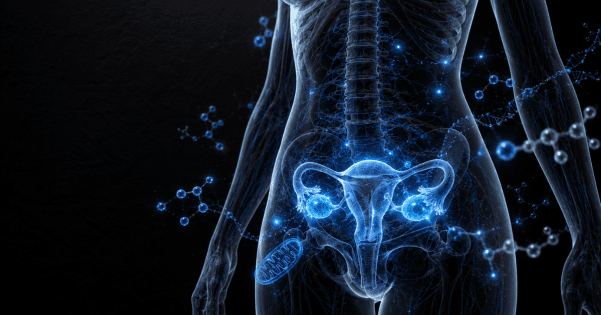
Zhenoluten is the ovary peptide bioregulator, a capsule built around the A-15 peptide complex extracted from ovarian tissue and studied for supporting normal ovarian function through midlife. Women reach for it because the ovary is on a different aging schedule than the rest of the body, and that schedule starts running down far earlier than most people expect.
That timing is the whole reason a tissue-specific ovarian peptide exists as a category. It’s also the part most articles about Zhenoluten skip.
Key Takeaways

The Short Version
Zhenoluten is an ovary-derived peptide bioregulator studied for supporting normal ovarian function and healthy hormonal aging in women.
The ovary loses function decades ahead of most other organs, with follicle depletion picking up speed around age 38.
Its proposed benefit comes from tissue specificity, where short peptides taken from one organ are studied for supporting that same organ.
Because this is an advanced ingredient, third-party testing and a transparent single-complex label matter more than marketing claims.

Your Ovaries Are Decades Ahead of the Rest of You
The ovary is the first organ in the human body to retire. Follicle loss begins before birth and continues quietly for decades. According to a 2025 review in the Journal of Clinical Medicine, the rate of depletion accelerates around age 38, and ovarian activity typically ceases around age 50 [1].
Compare that to almost any other organ. Your heart, liver, kidneys and lungs are still doing their jobs at 50, 60, 70. The ovary is finished at an age when most women consider themselves early into midlife.
What happens inside the tissue during that stretch is fairly well mapped. Researchers point to a few overlapping drivers:
- Follicle depletion. The resting pool of primordial follicles shrinks, and the growing cohorts get smaller [1].
- Oxidative stress and mitochondrial strain. Both are considered central to the age-related decline in oocyte quality [3].
- Changes in the surrounding tissue. Fibrosis and low-grade inflammation in the ovarian stroma add to the decline [1].
- Shifting hormone signals. Estrogen and inhibin B fall, FSH rises to compensate, and cycles become irregular before they stop [1].

There’s a signaling detail here that makes the ovary especially interesting. Research on human ovarian tissue across the lifespan found that kisspeptin expression holds steady through the reproductive years, spikes to its highest point during menopause, then drops to minimum levels afterward [7]. Researchers read that spike as a compensatory response to falling estrogen output.
So the tissue keeps signaling hard while it ages, and that ongoing signaling is precisely what a tissue-specific peptide is aimed at.

What Zhenoluten Is and Where A-15 Comes From
Zhenoluten is a short-chain peptide complex extracted from ovarian tissue and labeled A-15 in the Khavinson bioregulator system. In supplement form it’s sold as a capsule, and each BioOvary capsule delivers 40 mg of the A-15 complex.
The idea behind the whole category is tissue specificity. Short peptides isolated from one organ are studied for supporting that same organ, with different sequences steering cells in different directions [6].
If this category is new to you, our primer on what peptide bioregulators are covers the fundamentals, and the story behind Khavinson’s peptide research explains where these compounds came from and why they’re grouped by organ. This article stays with the ovary.
Two mechanistic findings give the category its scientific footing. Short peptides of two to seven amino acids can enter the cell nucleus, interact with DNA and histone proteins, and influence which genes are switched on or off [4]. Molecular modeling work also shows these ultrashort peptides bind efficiently to the LAT and PEPT transporter families, which is a plausible route into the cell in the first place [5].
That’s the mechanism Zhenoluten is built on: peptides small enough to get in, and specific enough to speak to ovarian cells rather than every cell they touch.
Reading the Evidence Honestly, and Where It’s Strongest
The evidence behind ovary peptide support sits in three tiers, and separating them is the most useful thing an article like this can do for you.
Tier one is the biology itself. Ovarian aging is one of the better-characterized processes in reproductive medicine. Follicle depletion, oxidative stress, mitochondrial dysfunction and stromal change are all documented [3], and a 2025 review in Frontiers in Endocrinology tracks a growing field of interventions aimed at maintaining ovarian function for longer [2]. The target is real and well described.
Tier two is the peptide mechanism. A systematic review published in Molecules found that short peptides regulate gene expression and protein synthesis across a wide range of species, including humans [4]. This is the strongest part of the bioregulator case, and it sits in mainstream peer-reviewed journals.
Tier three is the long-term human record for the category. Decades of work on peptide bioregulators reported that long-term treatment with certain peptide preparations slowed age-related changes in biomarkers of aging, alongside clinical applications tracked over six to twelve years [6].
One honest note, stated once: those long-run outcomes come from the peptide bioregulator family as a whole, not from trials of Zhenoluten specifically. Independent human trials on this exact complex are still limited, which is true of nearly every organ-specific bioregulator sold today. This family’s advantage is that it has a documented, decades-long research program behind it at all.
Perimenopause, Postmenopause, and Where a Peptide Sits
Zhenoluten is designed to support normal ovarian function as part of a long-term routine, and the life stage a woman is in changes what that support is actually doing.
| Life stage | What’s happening in the ovary | What tissue-specific support is aimed at |
|---|---|---|
| Mid-30s to early 40s | Follicle depletion accelerates; cycles are still regular [1] | Supporting normal ovarian function while it’s still active |
| Perimenopause | Estrogen and inhibin B fall, FSH rises, cycles turn erratic [1] | Supporting healthy hormonal transition already within the normal range |
| Postmenopause | Follicular reserve is exhausted; ovarian signaling drops to minimum [1][7] | Supporting healthy aging of ovarian and hormone-responsive tissue |
This is where the honest framing matters. Zhenoluten is not a fertility product, not a hormone, and not a substitute for hormone therapy. It contains no estrogen and no progesterone. What it offers is tissue-level support for an organ that most longevity routines ignore entirely.
One safety point worth stating plainly: if you take hormone therapy, an oral contraceptive, tamoxifen, or you’re managing a hormone-sensitive condition, talk to your clinician before adding Zhenoluten. This is about coordinating with the care you already have.
The Ovary and the Pineal Gland Are on the Same Circuit
Ovarian function and melatonin are more connected than most supplement content lets on, which is why women building a bioregulator routine often look at two peptides rather than one.
Melatonin is synthesized in the pineal gland, but it’s also produced locally in the ovary, where a 2025 review in Archives of Gynecology and Obstetrics describes it acting as an antioxidant and supporting ovarian cells against oxidative damage [8]. Pineal melatonin output also declines with age, and in animal research a pineal peptide preparation was studied for its effect on melatonin levels and lifespan in old rats [9].
That gives the pairing a real rationale rather than a marketing one. Women focused on hormonal aging often run the ovary complex alongside Endoluten, the pineal bioregulator, available as BioPineal (A-8). One targets the tissue, the other targets the rhythm that tissue runs on.
If you’re building a broader multi-organ routine, the full range of peptide bioregulators is organized by organ system, and the male counterpart to Zhenoluten is covered in our guide to Testoluten and testicular aging.
How to Take It, and What to Demand From the Label
Peptide bioregulators are taken in courses rather than continuously, and Zhenoluten follows that pattern. The typical approach is one to two capsules daily with food for 30 days, with courses repeated across the year. Follow the product label unless your clinician advises otherwise.
Quality is where products in this category genuinely separate. Ovary peptide complexes are animal-tissue derived, which makes sourcing and verification non-negotiable rather than nice to have.
Three things are worth checking before you buy:
- A Certificate of Analysis you can actually open and read, from an independent lab.
- A transparent label listing the exact peptide complex and the milligram amount per capsule.
- GMP manufacturing rather than vague premium language.
Every BioLongevity batch is third-party tested and documented, and you can browse our published Certificates of Analysis before you order rather than after. A brand that publishes its testing has already answered the question most peptide labels leave open.
Frequently Asked Questions
What is Zhenoluten used for?
Zhenoluten is used to support normal ovarian function and healthy hormonal aging in women, most often from the late 30s onward. It’s taken as part of a longevity routine rather than as a treatment for any condition.
Does Zhenoluten contain hormones?
No. Zhenoluten is a peptide complex extracted from ovarian tissue. It contains no estrogen, no progesterone, and no synthetic hormones.
Can Zhenoluten help with menopause symptoms?
Zhenoluten is designed to support normal ovarian function and healthy aging, not to treat menopause or its symptoms. Women who are managing significant symptoms should work with a clinician on an appropriate plan.
How long is a Zhenoluten course?
A typical course runs 30 days, with courses repeated a few times per year. Follow the product label for the exact protocol.
Can Zhenoluten be combined with other bioregulators?
Yes. Bioregulators are routinely combined to cover several organ systems, and the ovary complex is commonly paired with the pineal complex for hormonal aging support.
Is Zhenoluten the same as Epitalon?
No. Epitalon is a synthesized pineal tetrapeptide. Zhenoluten is a natural peptide complex extracted from ovarian tissue and classified as A-15 in the bioregulator system.
Read More From the BioLongevity Blog
Ready to give the fastest-aging organ in your body its own line of support? BioOvary – A-15 Ovary Peptide Bioregulator (Zhenoluten) delivers a transparent 40 mg A-15 peptide complex, third-party tested and single-ingredient, so you can verify exactly what you’re taking before you take it.
Ask a qualified clinician before starting any supplement if you are pregnant, nursing, taking medication, or managing a medical condition.
These statements have not been evaluated by the Food and Drug Administration. This product is not intended to diagnose, treat, cure, or prevent any disease.
References
- Bochynska S, García-Pérez MÁ, Tarín JJ, Szeliga A, Meczekalski B, Cano A. The Final Phases of Ovarian Aging: A Tale of Diverging Functional Trajectories. Journal of Clinical Medicine. 2025;14(16):5834. https://doi.org/10.3390/jcm14165834
- Hirano M, Onodera T, Takasaki K, Takahashi Y, Ichinose T, Nishida H, Hiraike H, Nagasaka K. Ovarian aging: pathophysiology and recent developments in maintaining ovarian reserve. Frontiers in Endocrinology. 2025;16:1619516. https://doi.org/10.3389/fendo.2025.1619516
- Tesarik J, Galán-Lázaro M, Mendoza-Tesarik R. Ovarian Aging: Molecular Mechanisms and Medical Management. International Journal of Molecular Sciences. 2021;22(3):1371. https://doi.org/10.3390/ijms22031371
- Khavinson VK, Popovich IG, Linkova NS, Mironova ES, Ilina AR. Peptide Regulation of Gene Expression: A Systematic Review. Molecules. 2021;26(22):7053. https://doi.org/10.3390/molecules26227053
- Khavinson VK, Linkova NS, Rudskoy AI, Petukhov MG. Feasibility of Transport of 26 Biologically Active Ultrashort Peptides via LAT and PEPT Family Transporters. Biomolecules. 2023;13(3):552. https://doi.org/10.3390/biom13030552
- Anisimov VN, Khavinson VKh. Peptide bioregulation of aging: results and prospects. Biogerontology. 2010;11(2):139-149. https://doi.org/10.1007/s10522-009-9249-8
- Drobintseva AO, Polyakova VO, Rodichkina VR, Kvetnoy IM. Kisspeptins in human ovarian tissue during ontogenesis. Advances in Gerontology. 2019;32(4):524-529. https://pubmed.ncbi.nlm.nih.gov/31800179/
- He J, Ye T, Xu K, Liu Y, Ren L. Melatonin: a potential target for regulating ovarian function. Archives of Gynecology and Obstetrics. 2025;312(3):721-731. https://doi.org/10.1007/s00404-025-08079-3
- Anisimov VN, Bondarenko LA, Khavinson VKh. Effect of pineal peptide preparation (epithalamin) on life span and pineal and serum melatonin level in old rats. Annals of the New York Academy of Sciences. 1992;673:53-57. https://pubmed.ncbi.nlm.nih.gov/1485734/