


Bonomarlot is a natural bone marrow peptide bioregulator, sold as a capsule that carries the A-20 peptide complex derived from the bone marrow of young animals. It sits in the Khavinson family of tissue-specific peptides, and it’s studied for its potential to support the hematopoietic system, the blood-and-immune-cell machinery that runs out of your bone marrow.
Bone marrow rarely gets attention in a longevity routine, which is odd, because it’s the source of every red cell, white cell, and platelet in your body. This guide covers what your marrow actually does, why its output changes with age, what Bonomarlot is, and what the research does and doesn’t yet show.
Key Takeaways

The Short Version
Bonomarlot is a natural bone marrow peptide complex (A-20) from the Khavinson bioregulator family, studied for hematopoietic and immune support.
Bone marrow produces the body’s red cells, white cells, and platelets, and its stem-cell output measurably shifts with age.
The strongest science here is the biology of bone marrow aging in humans; the direct evidence for Bonomarlot itself is early-stage and mostly preclinical.
It’s a natural peptide complex rather than a synthetic research compound, so quality proof like third-party testing and a Certificate of Analysis is what to look for.
Your Bone Marrow Is the Body’s Blood and Immune Cell Factory
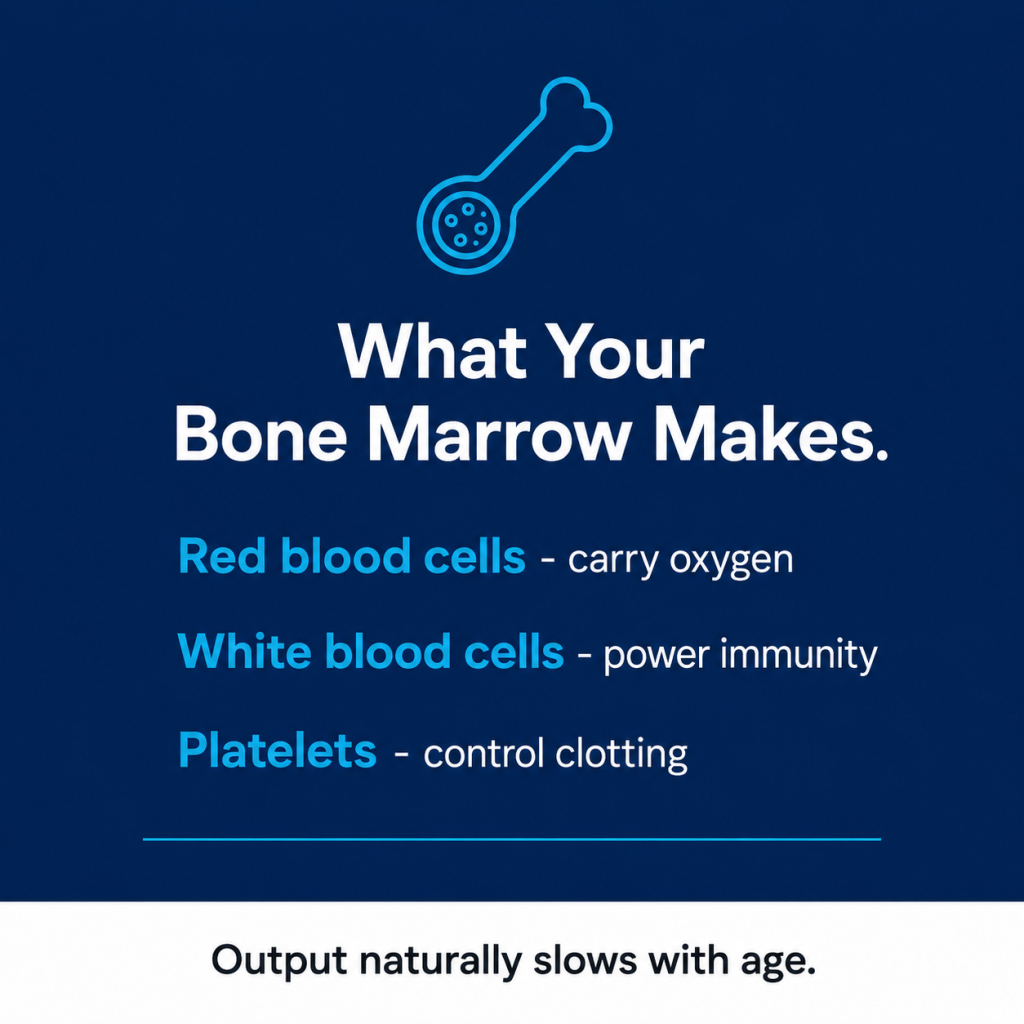
Bone marrow is the soft tissue inside your bones where blood cells are made. Every day it turns out billions of new cells from a small pool of hematopoietic stem cells, and those cells fall into three jobs your body can’t run without.
- Red blood cells carry oxygen from your lungs to every tissue.
- White blood cells are your immune system’s front line against infection.
- Platelets let your blood clot so a small injury doesn’t keep bleeding.
Those stem cells sit at the top of the whole blood-and-immune supply chain. When people talk about immune resilience or recovery capacity, they’re describing downstream effects of cells that were born in the marrow. That’s the reason bone marrow belongs in a conversation about healthy aging, not just in a conversation about blood disorders.
Why Bone Marrow Function Shifts With Age
Bone marrow ages, and unlike a lot of aging biology, this one is well documented in humans. As people get older, their hematopoietic stem cells accumulate somatic mutations, and occasionally one mutated stem cell gains a growth edge and produces a large share of the blood supply, a pattern a 2019 review in Science calls clonal hematopoiesis.
Clonal hematopoiesis is common in older adults, and it’s more than a lab curiosity. It’s been linked to a higher risk of blood cancers and, independently, to cardiovascular disease, which suggests the aging marrow influences health well beyond blood counts (Jaiswal & Ebert 2019).
Aging marrow also feeds the low-grade, chronic inflammation researchers call inflammaging. The bone marrow is one of the organs where persistent inflammatory signaling builds up over time, and that background inflammation is now treated as a driver of age-related decline rather than a side effect of it.
Put together, the picture is straightforward: the tissue that makes your blood and immune cells doesn’t stay static, and its drift is one of the more measurable features of biological aging. That’s the backdrop any bone marrow peptide is stepping into.
What Bonomarlot Is and Where It Comes From
Bonomarlot is the bone marrow member of a peptide family developed over several decades by Russian gerontologist Vladimir Khavinson and the St. Petersburg Institute of Bioregulation and Gerontology. Khavinson’s group built preparations from animal tissue extracts, each one proposed to act on the organ it came from, and reported gene-expression and tissue-supportive effects across the set.
In BioLongevity’s catalog, Bonomarlot is the A-20 complex inside BioBoneMarrow, a natural peptide complex rather than a single lab-made sequence. That’s a real distinction. Some peptides in this broader world are synthetic short chains built to a defined formula, while the natural complexes are extracted mixtures of short peptides from the matching tissue.
If the general idea of tissue-specific peptides is new to you, our explainer on what peptide bioregulators are covers the category before you go deeper on any one tissue.
How Bone Marrow Peptides Are Thought to Work
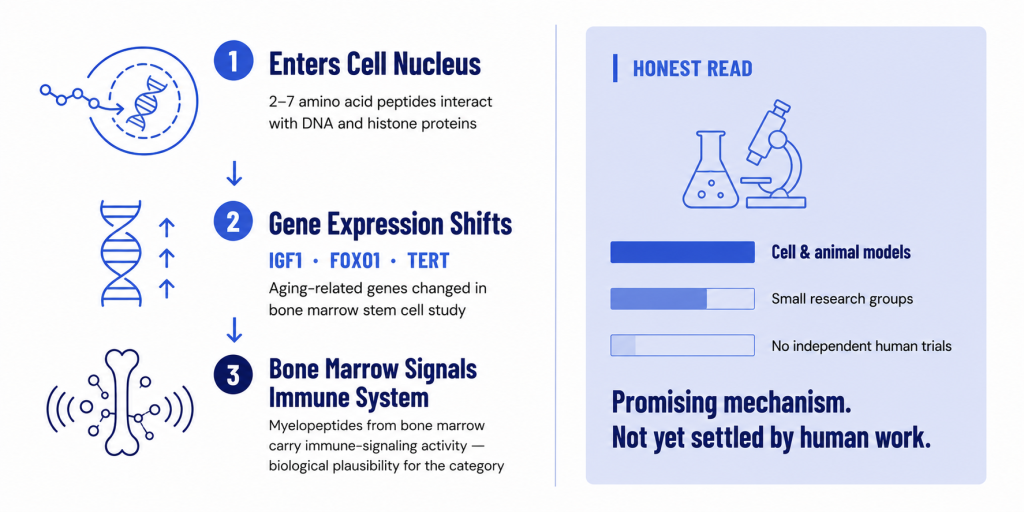
The proposed mechanism for short peptides like these is epigenetic, meaning they’re thought to influence which genes a cell switches on rather than acting like a hormone at a surface receptor. In a systematic review of the mechanism, short peptides of two to seven amino acids were described as able to enter the cell nucleus and interact with DNA and histone proteins in ways that can shift gene expression.
That model has been tested most directly in cell cultures. In one study, short peptides applied to aging human bone marrow-derived mesenchymal stem cells changed the expression of genes tied to cell aging, including IGF1, FOXO1, and TERT. This is cell-based research, an earlier tier of evidence than a human trial, and it’s worth reading as a mechanism signal rather than a proven outcome in people.
There’s also a longer history of the bone marrow producing its own regulatory peptides. Researchers isolated a group of bone marrow molecules called myelopeptides and found they carried immune-signaling activity, which supports the general premise that peptides from this tissue can influence immune function. That’s biological plausibility for the category, not confirmation of a specific Bonomarlot benefit.
The honest read on the mechanism
The gene-expression idea is coherent and has real laboratory support, and it’s also mostly built from cell and animal models produced by a small number of research groups. The mechanism is promising and worth watching, and it hasn’t been settled by independent human work.
What the Research Does and Doesn’t Show
Here’s the part most Bonomarlot pages skip. The direct human evidence for this specific peptide is thin, and being clear about that is the honest way to sell it.
The peptide bioregulator family as a whole has a body of published clinical reports, many from its originating group and published largely in Russian gerontology journals, describing benefits for immune and age-related endpoints with related peptides such as Vilon and Thymalin. Those reports are real, and they mostly predate the design standards used to evaluate modern supplements and drugs, so they read best as an early, in-house evidence base rather than independent confirmation.
For Bonomarlot specifically, there’s no published randomized controlled trial. The closest mechanistic human-tissue data comes from the bone marrow cell-culture work on gene expression (Ashapkin 2020), and the strongest, most rigorous science in this whole area is the human biology of how bone marrow ages (Jaiswal & Ebert 2019; Li 2023), not a trial of the peptide itself.
None of that makes the compound uninteresting. It means the accurate claim is a supportive one: Bonomarlot is studied for hematopoietic and immune support, and it fits a well-mapped aging system, while the proof specific to the peptide is still emerging.
| What’s claimed | Strongest evidence today | How to read it |
|---|---|---|
| Bone marrow aging matters for health | Human studies and reviews | Well supported, independent of any peptide (Jaiswal & Ebert 2019; Marnell 2021) |
| Short peptides can shift gene expression | Systematic review plus human-cell studies | Real mechanism signal, mostly preclinical (Khavinson 2021; Ashapkin 2020) |
| Bone marrow peptides affect immune function | Isolation and lab studies of myelopeptides | Plausible for the category, not product-specific (Petrov 1997) |
| Bonomarlot delivers a specific clinical benefit | No randomized controlled trial | Emerging, not yet proven in people |
Where Bonomarlot Fits Alongside Other Bioregulators
Bonomarlot makes the most sense as one piece of an immune-and-longevity approach rather than a standalone fix. Its natural companion is the thymus, because the two organs run the immune system together: the marrow builds immune cells, and the thymus trains the T-cells that come from them.
That’s why people exploring immune resilience often look at the bone marrow and thymus bioregulators as a pair, BioBoneMarrow for the production side and BioThymus for the training side. Both are natural peptide complexes from the same family.
If you’re building a broader routine, it’s worth seeing how these tissue-specific options sit next to more general longevity ingredients. Our guides to Vesugen and vascular peptides and to the best longevity supplements give useful context for where a single-tissue bioregulator does and doesn’t earn a place.
What to Look For in a Bone Marrow Peptide Bioregulator
Because Bonomarlot is a natural peptide complex sold direct to consumers, the buying decision comes down to sourcing and verification more than to a spec sheet. A few things separate a serious product from a research-grade unknown.
- Third-party testing and a Certificate of Analysis, so the identity and purity of the batch are documented rather than assumed.
- U.S. GMP manufacturing, which sets a consistent quality floor.
- A clearly natural complex with transparent labeling, rather than vague “peptide” marketing.
- Honest positioning, meaning a brand that describes the evidence accurately instead of promising it treats a disease.
Frequently Asked Questions
What is Bonomarlot used for?
Bonomarlot is studied as a bone marrow peptide bioregulator for hematopoietic and immune support, meaning support for the system that produces blood and immune cells. It’s positioned for healthy aging routines, not as a treatment for any medical condition.
Is Bonomarlot the same as BioBoneMarrow?
Yes. Bonomarlot is the name of the bone marrow peptide complex, and BioBoneMarrow is BioLongevity’s A-20 product built around it. They refer to the same natural peptide bioregulator.
Is Bonomarlot backed by human trials?
No published randomized controlled trial exists for Bonomarlot specifically. The available support comes from the broader peptide bioregulator research program, human bone marrow cell studies on gene expression, and the well-established human science of bone marrow aging.
Is Bonomarlot a natural or synthetic peptide?
BioLongevity’s Bonomarlot is a natural peptide complex extracted from bone marrow tissue, not a single synthetic sequence. That’s a meaningful difference from the lab-made short peptides sometimes sold in the same category.
Can Bonomarlot be combined with other bioregulators?
It’s commonly considered alongside the thymus bioregulator as an immune-aging pair, and within broader longevity routines. Ask a qualified clinician before combining supplements, especially if you take medication or manage a health condition.
Does Bonomarlot cause side effects?
Peptide bioregulators in this family have a long commercial history without widely reported adverse effects, but there’s no formal post-market surveillance system tracking them the way there is for approved drugs. Absence of reports isn’t the same as proof of safety, so a cautious start and clinician input are sensible.
Read More From the BioLongevity Blog
Bone marrow is the origin point for your blood and immune cells, and it’s one of the few aging systems you can actually read in the research. If you want to support it as part of a longevity routine, explore BioLongevity’s bioregulator collection, where every batch is third-party tested and backed by a Certificate of Analysis. For the mechanism behind how these short peptides are thought to act, the science of peptides is a good next read.
Ask a qualified clinician before starting any supplement if you are pregnant, nursing, taking medication, or managing a medical condition. This article is educational and does not replace medical advice.
These statements have not been evaluated by the Food and Drug Administration. This product is not intended to diagnose, treat, cure, or prevent any disease.
References
- Jaiswal S, Ebert BL. Clonal hematopoiesis in human aging and disease. Science. 2019;366(6465):eaan4673. DOI
- Li X, Li C, Zhang W, Wang Y, Qian P, Huang H. Inflammation and aging: signaling pathways and intervention therapies. Signal Transduction and Targeted Therapy. 2023;8(1):239. DOI
- Marnell CS, Bick A, Natarajan P. Clonal hematopoiesis of indeterminate potential (CHIP): Linking somatic mutations, hematopoiesis, chronic inflammation and cardiovascular disease. Journal of Molecular and Cellular Cardiology. 2021;161:98-105. DOI
- Khavinson VKh. Peptides and Ageing. Neuro Endocrinology Letters. 2002;23 Suppl 3:11-144. PubMed
- Khavinson VK, Popovich IG, Linkova NS, Mironova ES, Ilina AR. Peptide Regulation of Gene Expression: A Systematic Review. Molecules. 2021;26(22):7053. DOI
- Ashapkin V, Khavinson V, Shilovsky G, Linkova N, Vanuyshin B. Gene expression in human mesenchymal stem cell aging cultures: modulation by short peptides. Molecular Biology Reports. 2020;47(6):4323-4329. DOI
- Petrov RV, Mikhailova AA, Fonina LA. Bone marrow immunoregulatory peptides (myelopeptides): isolation, structure, and functional activity. Biopolymers. 1997;43(2):139-146. DOI
- Khavinson VKh, Kuznik BI, Ryzhak GA. Peptide bioregulators: the new class of geroprotectors. Message 2. Clinical studies results. Advances in Gerontology. 2013;26(1):20-37. PubMed