

Ventfort is a peptide bioregulator made from blood vessel tissue, and it’s studied for its support of endothelial function, healthy blood flow, and vascular aging. The endothelium is the single-cell lining inside every blood vessel you have, and it’s where vascular aging starts.
Ventfort has something most bioregulators don’t: small human studies with objective measurements attached. Not just symptom questionnaires. Doppler ultrasound.
Key Takeaways

The Short Version
Ventfort is a vascular peptide bioregulator studied for its support of endothelial function, blood flow, and healthy vascular aging.
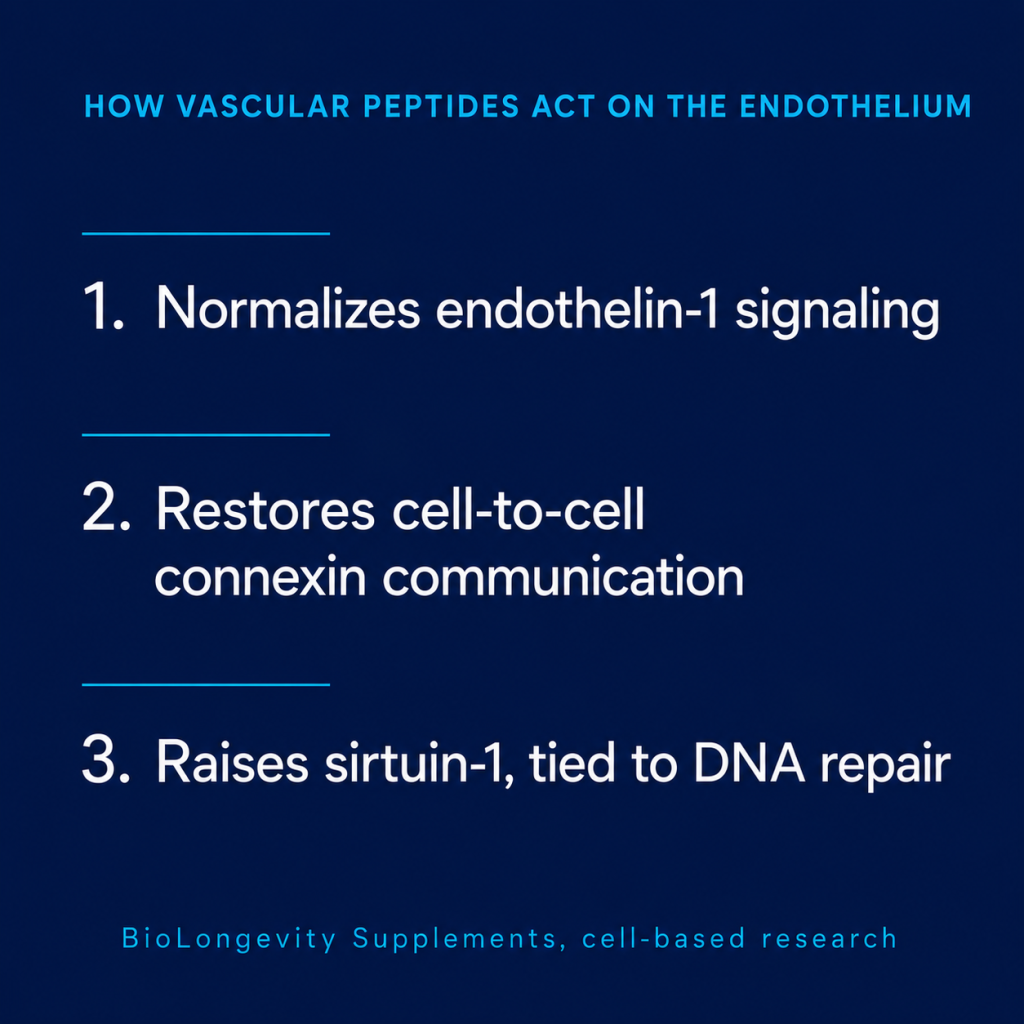
In cell-based research, the related KED peptide normalized endothelin-1 signaling, restored cell-to-cell communication, and increased sirtuin-1.
In a clinical study of 41 patients, the vascular tripeptide improved arterial blood flow measured by Doppler ultrasound.
Look for third-party testing, a published Certificate of Analysis, and a clearly named tissue source before you buy.
What Ventfort Is
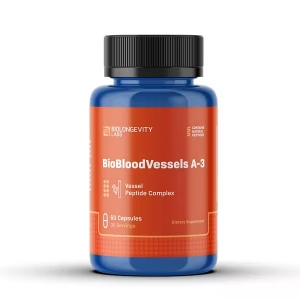
Ventfort is a short-chain peptide complex extracted from the vascular tissue of young animals, specifically the aorta. It’s designated A-3 in the Khavinson bioregulator catalogue, the family of tissue-specific peptide complexes developed at the St. Petersburg Institute of Bioregulation and Gerontology.
BioLongevity sells it as BioBloodVessels (A-3).
The premise is the same one that runs through the whole category. Every tissue makes its own regulatory peptides. Those signals decline with age. A bioregulator reintroduces peptides taken from the tissue you want to support.
Ventfort’s synthetic counterpart in the research literature is KED (Lys-Glu-Asp), also called Vesugen. It’s the short peptide developed from the same vascular research line. Most of the mechanistic and clinical work below was done on KED.
New to bioregulators? Start with what peptide bioregulators are.
Why the Endothelium Matters
The endothelium is a one-cell-thick lining that runs through every artery, vein, and capillary in your body. Laid flat, it would cover a tennis court.
It does three jobs that matter for aging:
- It controls how vessels dilate and constrict, which sets blood pressure moment to moment
- It regulates what crosses from blood into tissue
- It manages whether cells stick to the vessel wall or pass by
When the endothelium stops doing those jobs well, vessels stiffen, plaque builds, and circulation drops. That’s the process vascular peptides are aimed at.
How Vascular Peptides Work
Short peptides don’t act on surface receptors. They go into the cell.
They’re carried across the membrane by ordinary peptide transporters. The POT family (PEPT1, PEPT2) and LAT carriers are described in a 2022 review as the probable route for ultrashort peptides. Once inside, they reach DNA and shift which genes get read.
In cell-based research on human endothelium, the KED peptide produced three distinct effects in normal, atherosclerotic, and restenotic tissue:
| What KED did | Why it matters |
|---|---|
| Normalized endothelin-1 expression | Endothelin-1 is a potent vessel-constricting signal that rises in vascular disease |
| Restored connexin expression | Connexins are the channels endothelial cells use to talk to each other |
| Increased sirtuin-1 | Sirtuin-1 is a repair enzyme involved in DNA maintenance |
A separate study on vascular cell cultures found that short peptides reduced synthesis of E-selectin, the adhesion molecule that lets immune cells stick to the vessel wall and start forming plaque, while raising the cell renewal marker Ki-67 and lowering p53.
Tissue specificity holds here as it does across the category. When polypeptides from seven different tissues were tested on matching organotypic cultures from young and old rats, each stimulated only its own tissue.
What the Research Says About Ventfort Peptide Benefits
Human blood flow data
This is where the vascular peptides pull ahead of most of the bioregulator catalogue.
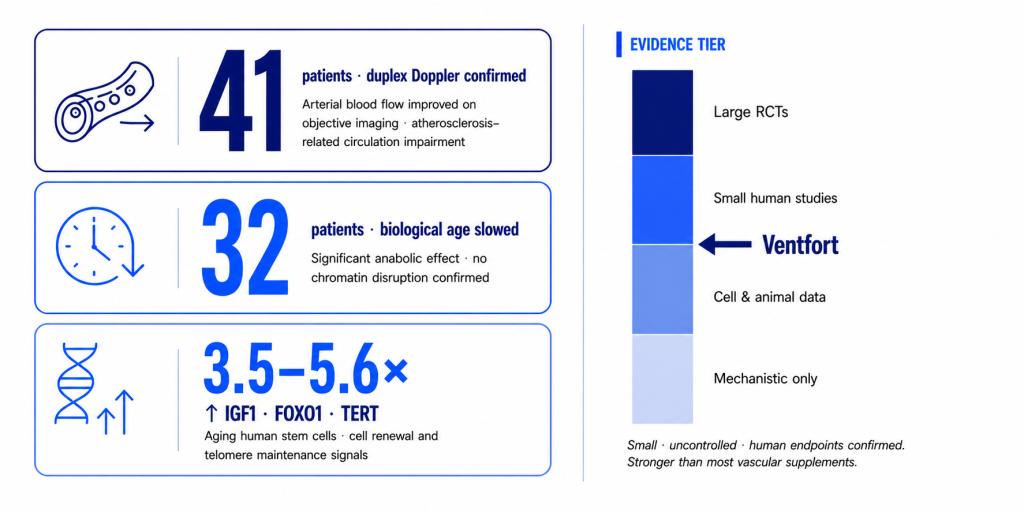
In a clinical study, researchers treated 41 patients with vascular circulation impairment linked to atherosclerosis using the vasoactive tripeptide Vesugen as a single-agent therapy. They measured arterial blood flow before and after with duplex Doppler ultrasound.
Blood flow through the main artery improved significantly, on both clinical assessment and objective imaging.
Small study, no placebo arm, published in a Russian gerontology journal. All true. It’s also an objective, instrument-measured circulatory endpoint in human beings, which is not something you can say about most supplement ingredients on the shelf.
Biological age markers
A second human study followed 32 patients aged 41 to 83 taking the vascular tripeptide alongside a brain peptide. The researchers reported a significant anabolic effect and a slowed rate of aging by biological age indicators, with the vascular peptide showing the more pronounced effect of the two.
They also confirmed no effect on chromatin condensation, meaning no evidence of genetic-level disruption. Worth noting on safety.
Gene expression and cell renewal
Related short peptides in this family enhanced IGF1 gene expression by 3.5 to 5.6 times in aging human stem cells, alongside changes in FOXO1 and TERT. Those genes are tied to cell renewal, stress resistance, and telomere maintenance.
The honest evidence tier
The two human studies here are small, uncontrolled, and published in Russian-language journals. The mechanistic work is cell-based. There is no large modern randomized trial on Ventfort.
That’s the accurate picture, and it’s still a stronger evidence base than most vascular supplements can point to. Emerging, promising, and worth watching.
Who Ventfort Is For
- Adults over 40 who want to support vascular function proactively, before stiffness and reduced circulation show up.
- Longevity optimizers tracking blood pressure, lipids, or arterial stiffness who want to support the trend.
- Anyone building a systems-based routine who understands that circulation is upstream of nearly everything else: brain, muscle, skin, kidney.
One safety point worth stating once and clearly. If you take blood thinners, blood pressure medication, or any cardiovascular drug, talk to your clinician before adding a vascular supplement. That’s not hedging. That’s the right sequence.
Ask a qualified clinician before starting any supplement if you are pregnant, nursing, taking medication, or managing a medical condition.
What to Look for in a Vascular Peptide Bioregulator
| What to check | Why it matters |
|---|---|
| Third-party testing | Confirms peptide content matches the label |
| Certificate of Analysis | Batch-level proof of identity, purity, and contaminant screening |
| Named tissue source | Vascular specificity is the mechanism, so the source belongs on the label |
| U.S. GMP manufacturing | Manufacturing standards you can trace |
| Transparent dose | No proprietary blend obscuring the amount |
BioLongevity publishes a Certificate of Analysis for every batch. If a brand won’t show you one, you’re trusting a label instead of a lab.
Frequently Asked Questions
Is Ventfort the same as Vesugen?
They’re related but not identical. Ventfort is the natural peptide complex from vascular tissue. Vesugen is the synthetic tripeptide KED developed from the same research line. Most of the published studies used KED.
Does Ventfort lower blood pressure?
Ventfort is studied for its support of endothelial function and healthy circulation. It isn’t a blood pressure medication and shouldn’t be used as one or combined with one without a clinician’s input.
Can Ventfort be taken with heart or circulation medication?
Ask your clinician first. Vascular medications and vascular supplements is exactly the overlap where a professional opinion pays for itself.
How is Ventfort taken?
Bioregulators are traditionally taken in cycles rather than continuously. Follow the product label unless your clinician recommends otherwise.
Can Ventfort be stacked with other bioregulators?
Yes, and circulation is a common foundation for a stack, since every other tissue depends on it. See the full bioregulator collection.
Where to Start
Every organ you’re trying to support downstream, from brain to kidney to muscle to skin, is only as good as the blood getting to it. Vascular health is the foundation layer of a longevity routine, not an afterthought.
BioBloodVessels (A-3) is BioLongevity’s vascular peptide bioregulator, formulated with the natural aorta peptide complex, third-party tested, and manufactured in the U.S. under GMP standards. Every batch has a published Certificate of Analysis, so the quality claim is one you can verify yourself.
Ask a qualified clinician before starting any supplement if you are pregnant, nursing, taking medication, or managing a medical condition.
These statements have not been evaluated by the Food and Drug Administration. This product is not intended to diagnose, treat, cure, or prevent any disease.
References
- Khavinson VK, Ryzhak GA, Mikhailova ON. Saint Petersburg Institute of Bioregulation and Gerontology: achievements and prospects. Advances in Gerontology. 2013;26(1):11-19. PubMed
- Khavinson V, Linkova N, Kozhevnikova E, Dyatlova A, Petukhov M. Transport of Biologically Active Ultrashort Peptides Using POT and LAT Carriers. International Journal of Molecular Sciences. 2022;23(14):7733. DOI
- Kozlov KL, Bolotov II, Linkova NS, Drobintseva AO, Khavinson VK, Dyakonov MM, Kozina LS. Molecular aspects of vasoprotective peptide KED activity during atherosclerosis and restenosis. Advances in Gerontology. 2016;29(4):646-650. PubMed
- Khavinson VK, Lin’kova NS, Evlashkina EV, Durnova AO, Kozlov KL, Gutop OE. Molecular aspects of anti-atherosclerotic effects of short peptides. Bulletin of Experimental Biology and Medicine. 2014;158(1):159-163. DOI
- Ryzhak AP, Chalisova NI, Lin’kova NS, Khalimov RI, Ryzhak GA, Zhekalov AN. Polypeptides influence on tissue cell cultures regeneration of various age rats. Advances in Gerontology. 2015;28(1):97-103. PubMed
- Kitachev KV, Sazonov AB, Kozlov KL, Petrov KIu, Sliusarev AS, Khavinson VK. The efficacy of peptide bioregulators of vessels in lower limbs chronic arterial insufficiency treatment in old and elderly people. Advances in Gerontology. 2014;27(1):156-159. PubMed
- Meshchaninov VN, Tkachenko EL, Zharkov SV, Gavrilov IV, Katyreva IuE. Effect of synthetic peptides on aging of patients with chronic polymorbidity and organic brain syndrome of the central nervous system in remission. Advances in Gerontology. 2015;28(1):62-67. PubMed
- Ashapkin V, Khavinson V, Shilovsky G, Linkova N, Vanyushin B. Gene expression in human mesenchymal stem cell aging cultures: modulation by short peptides. Molecular Biology Reports. 2020;47(6):4323-4329. DOI