

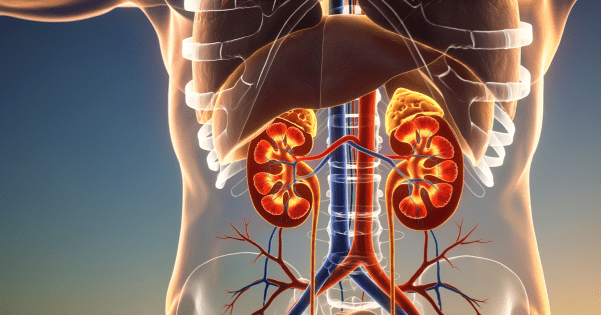
Pielotax is a peptide bioregulator made from kidney tissue, and it’s studied for its support of normal kidney filtration, protein handling, and antioxidant defense in aging kidneys. Your kidneys filter roughly 180 liters of blood a day, and that capacity quietly declines from about age 40 onward.
The kidney is one of the more thoroughly studied targets in the peptide bioregulator literature. Not because of human trials, but because one research group ran kidney peptides through three different injury models and got a consistent answer each time.
Key Takeaways

The Short Version
Pielotax is a kidney peptide bioregulator studied for its support of normal filtration, protein retention, and antioxidant capacity in aging kidneys.
In aging rats, kidney peptides increased urine output, reduced protein loss in urine by up to 2.8 times, and raised antioxidant enzyme activity in kidney tissue.
Kidney peptides showed protective effects across three independent injury models, and researchers found no evidence of kidney toxicity.
The evidence is animal and cell-based, so treat Pielotax as long-game support and see a clinician for any actual kidney concern.

What Pielotax Is
Pielotax is a short-chain peptide complex extracted from the kidney tissue of young animals. It’s designated A-9 in the Khavinson bioregulator catalogue, the family of tissue-specific peptide complexes developed at the St. Petersburg Institute of Bioregulation and Gerontology (institutional overview).
BioLongevity sells it as BioKidney (A-9).
The premise behind every bioregulator is the same. Each tissue makes its own regulatory peptides. Those signals fade with age. A bioregulator reintroduces peptides sourced from the tissue you want to support.
If the category is new to you, read what peptide bioregulators are first.

How Kidney Peptides Work in the Body
Short peptides don’t act on a cell’s surface. They go inside it.
They’re small enough to be carried across the membrane by ordinary peptide transporters. The POT family (PEPT1, PEPT2) and LAT carriers are what a 2022 review describes as the probable route for ultrashort peptides into the cell. From there they can reach DNA and change which genes are read.
Related short peptides have been shown to modulate the expression of genes involved in cell renewal and aging, including IGF1, FOXO1, and TERT in human stem cell cultures.
What makes bioregulators different from a generic antioxidant is tissue specificity. In a side-by-side study, polypeptides from seven tissues were applied to matching tissue cultures from young and old rats. Each one selectively stimulated its own tissue, increasing the proliferation marker PCNA and lowering p53. The signal goes where it came from.
What the Research Says About Pielotax Peptide Benefits
Here’s where kidney peptides earn their place in a longevity routine.
Aging kidneys
The most relevant study looked directly at old rats, not injured ones. Just aged.
Researchers gave a polypeptide kidney complex and the short peptides AED, EDL, and AEDG to aging rats and tracked kidney function. The results were consistent:
- Urine output increased by 1.2 to 1.4 times
- Protein in urine and protein excretion dropped by 1.5 to 2.8 times
- Distal sodium transport rose by 1.2 to 1.3 times
- Antioxidant enzyme activity in kidney tissue increased while lipid peroxidation fell
Protein leaking into urine is one of the earliest signals that filtration is slipping. Cutting it by a factor of two or more, in aged animals, is a meaningful finding.
The researchers also examined kidney tissue directly and found no evidence of toxicity. They concluded that the kidney polypeptide complex and its peptides “may be considered as nephroprotective agents in kidney aging.”
Two independent injury models
The same group then stress-tested kidney peptides.
In rats given cisplatin, a chemotherapy drug known to damage kidneys, the kidney polypeptide complex and short peptides normalized urine output, creatinine handling, glomerular filtration rate, and sodium reabsorption, and reduced protein loss in urine.
In a separate study using two different injury models, gentamicin-induced kidney damage and ischemia/reperfusion injury, the EDL peptide prevented reduced urine output and retained nitrogen waste, lowered protein in urine, preserved antioxidant enzyme activity, suppressed lipid peroxidation, and normalized the energy supply to kidney cells.
Three separate models. Three protective results. That’s a rare degree of replication for a supplement ingredient, and it’s the strongest argument in Pielotax’s favor.
The honest evidence tier
All of the above is animal research. There is no published human clinical trial on Pielotax, and we’re not going to pretend otherwise.
What that means practically: the mechanism is well characterized, the preclinical signal is strong and repeated, and human confirmation is still ahead. That’s the right reason to treat Pielotax as long-horizon support rather than a fix for anything acute.
Who Pielotax Is For
- Adults over 40 building a proactive, system-by-system longevity routine.
- High performers who put real load through their kidneys: high protein intake, heavy training, hot climates, high supplement volume.
- Longevity optimizers who track markers like eGFR and creatinine and want to support the trend, not react to it.
One safety point that carries real weight: if you have reduced kidney function, are on medication cleared through the kidneys, or have been told your creatinine or eGFR is off, that belongs in a clinician’s hands. Kidney function is not a place to self-experiment.
Ask a qualified clinician before starting any supplement if you are pregnant, nursing, taking medication, or managing a medical condition.
What to Look for in a Kidney Peptide Bioregulator
| What to check | Why it matters |
|---|---|
| Third-party testing | Confirms peptide content matches the label |
| Certificate of Analysis | Batch-level proof of identity, purity, and contaminant screening |
| Named tissue source | Tissue specificity is the mechanism, so the source belongs on the label |
| U.S. GMP manufacturing | Traceable manufacturing standards |
| Transparent dose | No proprietary blend hiding the amount |
Heavy metal and contaminant screening matters more here than almost anywhere else, because the kidneys are what clear them. BioLongevity publishes a Certificate of Analysis for every batch.
Frequently Asked Questions
What does Pielotax do?
Pielotax is a kidney peptide bioregulator studied for its support of normal filtration, protein retention, and antioxidant activity in kidney tissue. In animal research, kidney peptides improved several markers of filtration in aged and injured kidneys.
Is Pielotax the same as Epitalon?
No. Epitalon is the AEDG tetrapeptide from pineal tissue. Pielotax is the kidney peptide complex. Interestingly, AEDG was one of the peptides tested in the kidney aging studies alongside kidney-derived peptides.
Is there human clinical data on Pielotax?
No published human trials on Pielotax specifically. The evidence is animal and cell-based. We’d rather tell you that than dress it up.
Can Pielotax be taken with other supplements?
Generally yes, but kidney-cleared medications are the exception worth raising with a clinician first. Follow the product label unless your clinician recommends otherwise.
How is Pielotax taken?
Bioregulators are traditionally taken in cycles rather than continuously. The product label gives the specific protocol. To see how it fits alongside other tissue peptides, browse the full bioregulator collection.
Where to Start
Kidney function is one of the least glamorous markers in longevity and one of the most predictive. It declines slowly, silently, and mostly without symptoms until it’s well along.
BioKidney (A-9) is BioLongevity’s kidney peptide bioregulator, formulated with the natural kidney peptide complex, third-party tested, and manufactured in the U.S. under GMP standards. Every batch carries a published Certificate of Analysis, including contaminant screening. That’s exactly what you’d want to verify before asking your kidneys to process anything.
Ask a qualified clinician before starting any supplement if you are pregnant, nursing, taking medication, or managing a medical condition.
These statements have not been evaluated by the Food and Drug Administration. This product is not intended to diagnose, treat, cure, or prevent any disease.
References
- Khavinson VK, Ryzhak GA, Mikhailova ON. Saint Petersburg Institute of Bioregulation and Gerontology: achievements and prospects. Advances in Gerontology. 2013;26(1):11-19. PubMed
- Khavinson V, Linkova N, Kozhevnikova E, Dyatlova A, Petukhov M. Transport of Biologically Active Ultrashort Peptides Using POT and LAT Carriers. International Journal of Molecular Sciences. 2022;23(14):7733. DOI
- Ashapkin V, Khavinson V, Shilovsky G, Linkova N, Vanyushin B. Gene expression in human mesenchymal stem cell aging cultures: modulation by short peptides. Molecular Biology Reports. 2020;47(6):4323-4329. DOI
- Ryzhak AP, Chalisova NI, Lin’kova NS, Khalimov RI, Ryzhak GA, Zhekalov AN. Polypeptides influence on tissue cell cultures regeneration of various age rats. Advances in Gerontology. 2015;28(1):97-103. PubMed
- Zamorskii II, Shchudrova TS, Zeleniuk VG, Linkova NS, Nichik TE, Khavinson VK. The influence of peptides on the morphofunctional state of old rats’ kidneys. Advances in Gerontology. 2018;31(4):498-504. PubMed
- Zamorskii II, Shchudrova TS, Lin’kova NS, Nichik TE, Khavinson VK. Peptides Restore Functional State of the Kidneys During Cisplatin-Induced Acute Renal Failure. Bulletin of Experimental Biology and Medicine. 2015;159(6):736-739. DOI
- Zamorskii II, Shchudrova TS, Lin’kova NS, Nichik TE, Khavinson VK. Nephroprotective Effect of EDL Peptide at Acute Injury of Kidneys of Different Genesis. Bulletin of Experimental Biology and Medicine. 2017;163(3):389-393. DOI