


Dihydroberberine and berberine work through the same metabolic pathways, but they aren’t interchangeable. Dihydroberberine absorbs far better gram for gram, while berberine carries the deeper bank of human clinical evidence.
That gap is the whole story. Most articles online call dihydroberberine a flat upgrade and leave it there. The honest version is more useful.
Here’s how the two compare, what the research actually supports for each, and how to decide which one belongs in your routine.
Key Takeaways

The Short Version
Dihydroberberine is a more absorbable form of berberine that converts back into active berberine once it’s inside your body.
Berberine has the stronger human evidence base, with meta-analyses showing meaningful drops in blood sugar and cholesterol markers.
Dihydroberberine reaches higher blood levels per milligram, so a smaller dose may do the work of a larger berberine dose with less digestive upset.
If you take glucose-lowering medication, talk to your clinician before starting either one, since both can lower blood sugar.
What’s the Difference Between Dihydroberberine and Berberine?
Dihydroberberine is the reduced, more absorbable form of berberine. Your gut bacteria already make a small amount of it when you swallow berberine, and your body then oxidizes it back into active berberine.
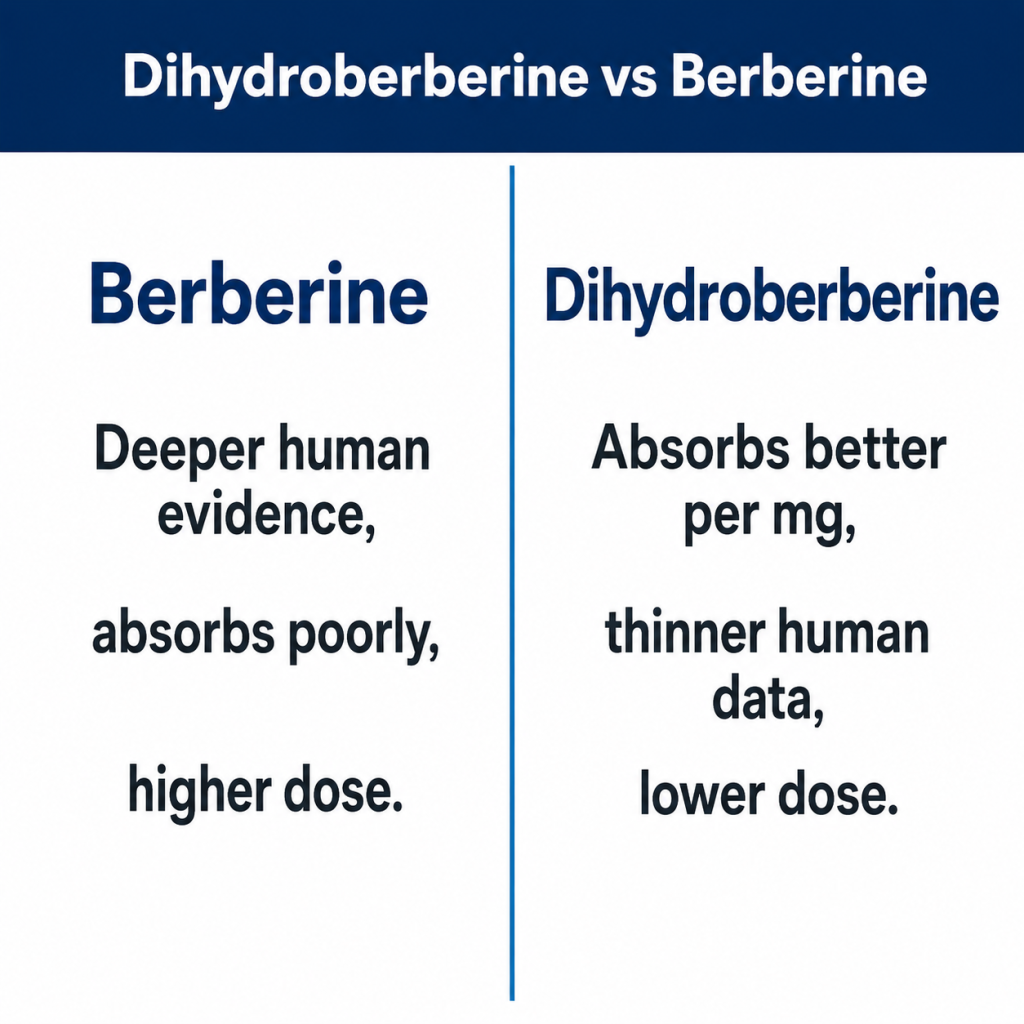
Both are plant alkaloids. Berberine comes from plants like goldenseal, barberry, and Chinese goldthread, and it’s been used in traditional medicine for centuries. Dihydroberberine delivers that same active compound in a form that crosses the gut wall more easily. The effects come from berberine itself.
Researchers first showed this absorption edge in animal models, where dihydroberberine and its analogs reached the bloodstream more efficiently than standard berberine in diabetic and obese mouse studies.
| Factor | Berberine | Dihydroberberine |
|---|---|---|
| What it is | Original plant alkaloid | Reduced, more absorbable form |
| Absorption | Poor | Higher per milligram |
| Typical dose | 500 mg, 2 to 3x daily | 100 to 200 mg daily |
| Human outcome data | Strong (many trials) | Early (small trials) |
| In the body | Active as-is | Converts to berberine |
Why Berberine Is So Hard to Absorb
Berberine barely makes it into your bloodstream. Only a small fraction of an oral dose reaches circulation, which is why it needs such a large daily amount to work.
Part of the problem is a transporter called P-glycoprotein. It pumps berberine back out of your intestinal cells almost as fast as it gets absorbed, a process confirmed in cell-based research on intestinal permeability.
To get around this, most berberine products push the dose up to 1,000 to 1,500 mg per day. That unabsorbed berberine sits in the gut, and for many people it causes cramping, loose stools, or bloating. Some users call it “berberine bloat.”
It’s a comfort problem rather than a safety one. And it’s the main reason people start looking for a better-absorbed form in the first place.
How Dihydroberberine Improves Absorption
Dihydroberberine sidesteps the absorption problem by entering the bloodstream more readily, then converting to berberine inside the body. Less compound is wasted, and less is left behind to irritate your gut.
The clearest human evidence comes from a randomized crossover trial. In that study, a 100 mg dose of dihydroberberine produced significantly higher plasma berberine over a two-hour window than a 500 mg dose of standard berberine.
That’s a real result, and it’s worth keeping in perspective. The trial included only five healthy men and measured absorption over a short window, not long-term blood sugar change (Moon 2021). Animal research supports the same absorption advantage (Cheng 2010), but the human data on dihydroberberine is still early.
The takeaway: dihydroberberine’s absorption edge is well supported. Its long-term outcome data is promising and still catching up to berberine’s.
What the Evidence Says About Blood Sugar and Metabolism
Berberine is one of the better-studied natural compounds for blood sugar, and that’s where the evidence gap between the two forms shows up most clearly.
A meta-analysis of 46 randomized controlled trials found that berberine supplementation was associated with lower HbA1c, fasting glucose, and post-meal glucose in people with type 2 diabetes. The same review reported improvements in triglycerides, LDL cholesterol, and HDL cholesterol (Guo 2021). A separate umbrella meta-analysis linked berberine to better glycemic markers and lower inflammatory markers like C-reactive protein and IL-6.
Both compounds appear to work largely through AMPK, an enzyme often described as the body’s metabolic master switch. When AMPK is active, cells take up more glucose and use energy more efficiently. Cell-based research shows berberine activates this pathway and increases glucose uptake. Newer research on dihydroberberine points to an additional target, the enzyme glucokinase, which helps regulate insulin release, though that work is so far limited to cells and mice.
Here’s the honest evidence picture:
| Claim | Berberine | Dihydroberberine |
|---|---|---|
| Improves blood sugar markers | Human trials and meta-analyses (Guo 2021, Nazari 2023) | Mechanism plus animal data (Zhang 2025) |
| Better absorption | Poor by default (Li 2017) | Confirmed in a human pilot (Moon 2021) |
| Supports lipid markers | Human meta-analysis (Guo 2021) | Inferred via conversion to berberine |
| AMPK activation | Cell-based research (Kim 2007) | Animal research (Cheng 2010) |
Because dihydroberberine becomes berberine in the body, it’s reasonable to expect similar benefits. But “reasonable to expect” isn’t the same as “proven in humans,” and that distinction matters when you’re choosing a supplement.
Dihydroberberine vs Berberine: Dosing and Tolerability
Berberine is usually taken at 500 mg, two to three times daily with meals. Dihydroberberine is typically dosed much lower, around 100 to 200 mg, often once or twice a day.
The lower effective dose is dihydroberberine’s practical advantage. Less compound passing through your gut means less of the digestive discomfort that drives people away from high-dose berberine (Moon 2021).
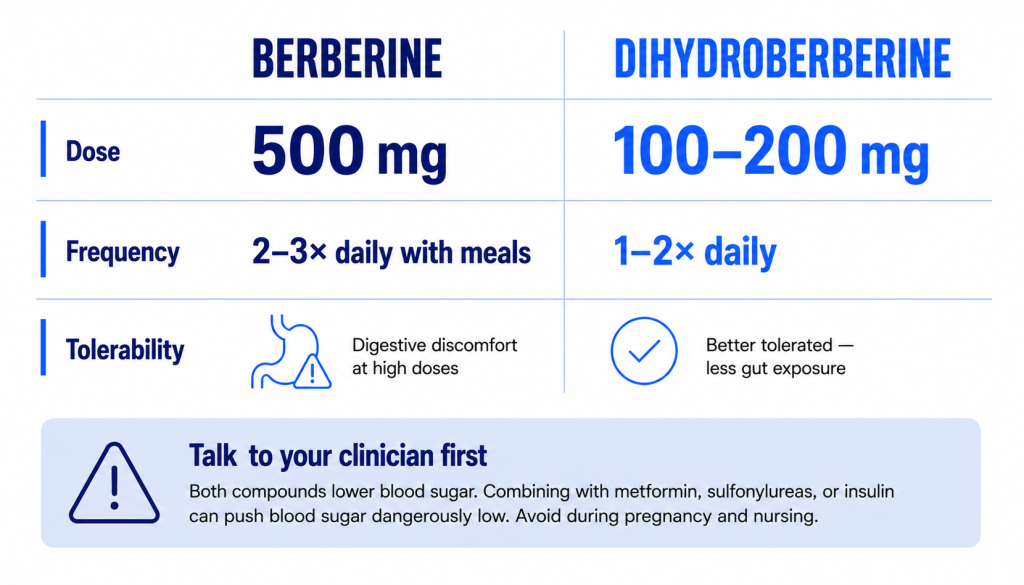
One safety point applies to both, and it’s important. Berberine and dihydroberberine can both lower blood sugar. If you take diabetes medication such as metformin, a sulfonylurea, or insulin, the effects can stack and push your blood sugar too low. Talk to your clinician before combining them. Both compounds should also be avoided during pregnancy and nursing.
Which One Should You Choose?
Choose based on what you value most: proven track record, or absorption and comfort. Neither choice is wrong, because both deliver the same active compound to your bloodstream.
| Choose berberine if you | Choose dihydroberberine if you |
|---|---|
| Want the most thoroughly studied option | Get digestive upset from berberine |
| Tolerate it without gut issues | Prefer a lower, simpler daily dose |
| Are comfortable with multiple daily doses | Want better absorption per milligram |
| Prioritize the deepest human evidence | Want metabolic support that’s easier on the gut |
For many people, dihydroberberine is the more practical pick: similar benefits, a smaller dose, and fewer trips to the bathroom. If you’ve used berberine for years without complaint, there’s no urgent reason to switch.
Frequently Asked Questions
Is dihydroberberine the same as berberine?
Not exactly, but they’re closely related. Dihydroberberine is a more absorbable form of berberine that converts back into active berberine once it’s in your body, so the active compound ends up being the same.
Is dihydroberberine stronger than berberine?
It’s more absorbable, not inherently more powerful. A small human trial found that 100 mg of dihydroberberine raised blood berberine levels more than 500 mg of berberine, which is why lower doses can be effective (Moon 2021).
Can you take dihydroberberine and berberine together?
There’s no strong reason to. Since dihydroberberine converts to berberine in the body, stacking them mostly raises your total berberine load. If you do combine them, keep the total dose modest and check with a clinician, especially if you take glucose-lowering medication.
Does dihydroberberine cause less bloating than berberine?
Often, yes. Because dihydroberberine works at a lower dose, less unabsorbed compound reaches your gut, which tends to reduce the cramping and bloating linked to high-dose berberine (Moon 2021).
How much dihydroberberine equals 500 mg of berberine?
Research suggests a much smaller dose is needed. In one human study, 100 mg of dihydroberberine produced higher blood berberine levels than 500 mg of standard berberine over two hours (Moon 2021). Most products land in the 100 to 200 mg range.
Build Your Metabolic Routine With BioLongevity
If you want dihydroberberine without the trial and error, BioLongevity’s BioAbsorb pairs it with activated B vitamins to support metabolic health and daily energy. Every batch is third-party tested with a Certificate of Analysis, so you know the form and dose you’re getting. Explore BioAbsorb and the full capsule lineup to match a formula to your goal.
Ask a qualified clinician before starting any supplement if you are pregnant, nursing, taking medication, or managing a medical condition.
These statements have not been evaluated by the Food and Drug Administration. This product is not intended to diagnose, treat, cure, or prevent any disease.
References
[1] Moon JM, Ratliff KM, Hagele AM, Stecker RA, Mumford PW, Kerksick CM. Absorption Kinetics of Berberine and Dihydroberberine and Their Impact on Glycemia: A Randomized, Controlled, Crossover Pilot Trial. Nutrients. 2021;14(1):124. doi:10.3390/nu14010124
[2] Guo J, Chen H, Zhang X, et al. The Effect of Berberine on Metabolic Profiles in Type 2 Diabetic Patients: A Systematic Review and Meta-Analysis of Randomized Controlled Trials. Oxid Med Cell Longev. 2021;2021:2074610. doi:10.1155/2021/2074610
[3] Nazari A, Ghotbabadi ZR, Kazemi KS, et al. The Effect of Berberine Supplementation on Glycemic Control and Inflammatory Biomarkers in Metabolic Disorders: An Umbrella Meta-analysis of Randomized Controlled Trials. Clin Ther. 2024;46(2):e64-e72. doi:10.1016/j.clinthera.2023.10.019
[4] Cheng Z, Chen AF, Wu F, et al. 8,8-Dimethyldihydroberberine with improved bioavailability and oral efficacy on obese and diabetic mouse models. Bioorg Med Chem. 2010;18(16):5915-24. doi:10.1016/j.bmc.2010.06.085
[5] Kim SH, Shin EJ, Kim ED, Bayaraa T, Frost SC, Hyun CK. Berberine activates GLUT1-mediated glucose uptake in 3T3-L1 adipocytes. Biol Pharm Bull. 2007;30(11):2120-5. doi:10.1248/bpb.30.2120
[6] Li YJ, Hu XB, Lu XL, et al. Nanoemulsion-based delivery system for enhanced oral bioavailability and Caco-2 cell monolayers permeability of berberine hydrochloride. Drug Deliv. 2017;24(1):1868-1873. doi:10.1080/10717544.2017.1410257
[7] Zhang C, Zhang X, Zhang Q, et al. Dihydroberberine normalizes insulin secretion by regulating glucokinase. Diabetes Obes Metab. 2025;28(1):151-165. doi:10.1111/dom.70171