



No supplement rewires your brain on its own. Neuroplasticity supplements supply the raw materials and signaling molecules your neurons use to build new connections, but the rewiring itself depends on what you do with your brain, including learning, movement, and sleep.
That distinction matters, because most products in this category are sold as if the capsule does the work. The research tells a more useful story. A few ingredients have real human evidence, several have promising but thinner data, and all of them work best alongside the behaviors that actually drive brain change. This guide sorts them by how strong the evidence really is.
Key Takeaways

The Short Version
No supplement directly rewires the brain; neuroplasticity supplements support the biology that makes rewiring possible.
Bacopa monnieri, omega-3 DHA, and bioavailable curcumin have the most consistent human cognitive trial data in this category.
Most studies measure memory or attention, not neuroplasticity itself, so treat “boosts plasticity” claims with healthy skepticism.
Aerobic exercise, novel learning, and sleep drive more measurable brain change than any capsule, which works best as an add-on.
What Neuroplasticity Actually Is
Neuroplasticity is your brain’s ability to reorganize itself by forming, strengthening, and pruning the connections between neurons. It’s the biology behind learning a language, recovering after an injury, or breaking a habit.
Brain change runs on a few specific processes:
- Synaptogenesis: building new synapses, the junctions where neurons pass signals.
- Long-term potentiation: strengthening existing connections so signals travel faster and more reliably.
- Dendritic branching: growing more receiving branches on a neuron so it can take in more input.
- BDNF and NGF signaling: growth proteins that act like fertilizer for neurons and their connections.
- Myelination: insulating active pathways so signals move quicker.
Every one of these depends on raw materials and signals, like fatty acids, choline, and growth-factor activity, that nutrition and supplements can influence. That’s the real basis for the category. The open question is how much a capsule moves any of it.
Can a Supplement Actually Increase Neuroplasticity?
Honestly, we rarely measure that directly. Almost every human supplement trial tracks cognitive outcomes like memory and attention, not synapse counts or growth-factor levels inside the brain.
A few exceptions exist. A 2023 systematic review and meta-analysis of 12 randomized trials found that omega-3 fatty acid supplementation raised blood levels of BDNF, the growth factor most closely tied to plasticity. Blood BDNF isn’t the same as brain rewiring, but it’s one of the few plasticity-linked markers that supplements have actually moved in people.
So when a product promises to “boost neuroplasticity,” read it as shorthand for “supports the biology associated with plasticity.” The useful question is which ingredients have human data, and how strong that data is.
The Ingredients With the Strongest Human Evidence
Three ingredients stand out because they’ve been tested in humans and showed measurable cognitive benefits, not just promising results in cells or animals. None of them is dramatic, and all of them are slow.
Bacopa monnieri
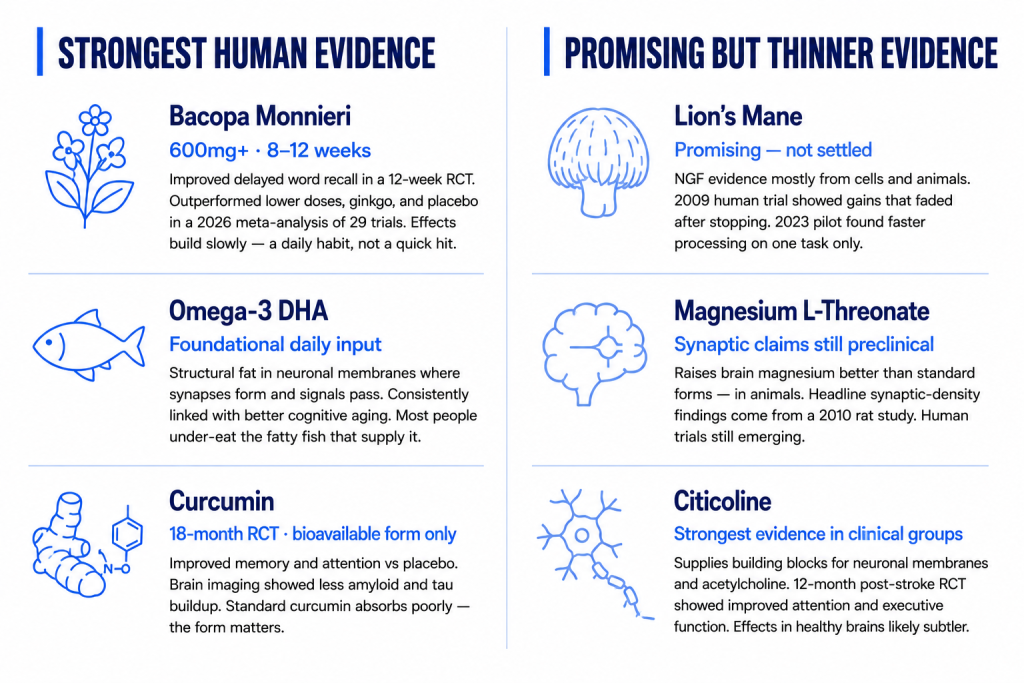
Bacopa is an Ayurvedic herb with some of the most consistent memory data in this category. In a 12-week randomized controlled trial in older adults, a standardized Bacopa extract improved delayed word recall compared with placebo.
A 2026 network meta-analysis of 29 trials found that higher-dose Bacopa, at 600 mg or more per day, improved working memory more than lower doses, ginkgo, or placebo. Effects build slowly, usually across 8 to 12 weeks, so this is a daily-habit ingredient rather than a quick hit.
Omega-3 DHA
DHA is a structural fat that makes up a large share of neuronal membranes, which is exactly where synapses form and signals pass. Beyond the BDNF finding above (Ziaei et al., 2023), higher omega-3 intake is consistently linked with better cognitive aging.
Think of DHA as a foundational input rather than a fast-acting nootropic. It’s one of the easier ingredients to justify because most people under-eat the fatty fish that supply it.
Curcumin
Curcumin, the active compound in turmeric, has anti-inflammatory activity that may help protect the circuits plasticity depends on. In an 18-month randomized trial in non-demented adults, a bioavailable curcumin formula improved memory and attention versus placebo, with brain imaging that suggested less amyloid and tau buildup.
The catch is absorption. Standard curcumin is poorly absorbed, so the form matters. The human trial used a bioavailable preparation, not raw turmeric powder.
Ingredients With Promising but Thinner Evidence
These get marketed hard, but their plasticity story leans more on animal or mechanistic data than on human outcomes. That doesn’t make them useless. It means the certainty is lower, and the marketing usually runs ahead of the proof.
Lion’s Mane (Hericium erinaceus)
Lion’s mane is the poster child for nerve growth factor, but most of that NGF evidence comes from cell and animal studies. The human picture is thinner and mixed.
A small 2009 trial in older adults with mild cognitive impairment found improvement over 16 weeks of supplementation that faded once people stopped taking it. A 2023 pilot trial in healthy young adults found faster processing on one task after a single dose, but few other clear effects. Promising, not settled.
Magnesium L-Threonate
Magnesium L-threonate raises brain magnesium more effectively than standard magnesium forms, at least in animals. The headline synaptic-density findings come from a 2010 rat study in which the compound increased synapse markers and improved memory.
Human trials are still emerging, so treat the synaptic-density claims as preclinical for now. The more reliable benefit is correcting an actual magnesium shortfall, since low intake is common and affects nerve signaling.
Citicoline and Choline Donors
Citicoline supplies building blocks for neuronal membranes and for acetylcholine, a neurotransmitter central to learning. Its strongest cognitive evidence comes from clinical groups rather than healthy adults.
In a 12-month randomized trial after ischemic stroke, citicoline improved attention and executive function compared with usual care. For an already-healthy brain, expect subtler effects than that result implies.
Here’s how the category sorts out once you separate what was studied from what was claimed:
| Ingredient | Evidence tier | Best studied for | What the data actually measured |
|---|---|---|---|
| Bacopa monnieri | Strong (human RCTs) | Memory, working memory | Cognitive test scores |
| Omega-3 DHA | Strong (human trials, meta-analysis) | Cognitive aging, BDNF | Blood BDNF and cognition |
| Curcumin (bioavailable) | Moderate (human RCT) | Memory, attention | Cognitive scores and brain imaging |
| Lion’s mane | Emerging (small human trials) | Mild cognitive support | Cognition; NGF mostly preclinical |
| Magnesium L-threonate | Emerging (mostly animal) | Synaptic density | Rodent synapse markers |
| Citicoline | Moderate in clinical groups | Attention, recovery | Cognition in patients |
Why the Stimulus Matters More Than the Pill
Plasticity is use-dependent, which means your brain only rewires in response to a demand. Without a stimulus, there’s nothing for any of these ingredients to amplify. That’s the part most supplement pages quietly skip.
Aerobic exercise is the most reliable lever you have. A 2022 meta-analysis found that structured exercise improved cognition in older adults mainly when aerobic training was part of the program. Movement raises BDNF, increases blood flow, and helps new connections stick.
Novel learning, deep sleep, and stress management do similar work. A supplement can supply raw materials, but the demand has to come from how you live. The capsule is the smaller lever. Your behavior is the larger one.
How to Build a Neuroplasticity Routine
Start with the inputs that change the most, then layer supplements as support rather than the main event.
- Lock in the foundations. Aerobic exercise most days, 7 to 9 hours of sleep, and a genuine learning challenge that pushes you.
- Add evidence-supported ingredients first. Omega-3 DHA daily, plus Bacopa or bioavailable curcumin if memory is your goal.
- Give it time. Most of these ingredients need 8 to 12 weeks of consistent use before any effect appears. Judging them after a week will mislead you.
- Prioritize quality. Look for third-party testing, a Certificate of Analysis, and transparent per-ingredient doses instead of proprietary blends that hide amounts.

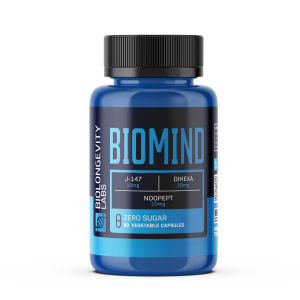
If you want a brain-focused formula to sit alongside those foundations, BioLongevity’s BioMind is built around compounds studied for neuroplasticity and synaptic signaling, and like everything in the catalog it’s third-party tested with transparent labeling. Those compounds sit at the earlier, more experimental end of the evidence spectrum, so pair it with the better-studied basics above rather than treating it as a replacement for them.
Frequently Asked Questions
Do neuroplasticity supplements really work?
Some do, in a limited sense. Bacopa, omega-3 DHA, and bioavailable curcumin have human trials showing modest cognitive benefits. None has been shown to rewire the brain on its own, and the effects are gradual rather than obvious.
How long do neuroplasticity supplements take to work?
Most need consistent daily use over 8 to 12 weeks. Bacopa and DHA in particular build slowly, so a one or two week trial won’t tell you much.
What is the best supplement for neuroplasticity?
There isn’t a single best one. For memory, Bacopa has the most consistent data. For a foundational input, omega-3 DHA is the easiest to justify. The right pick depends on your goal and on what’s already missing from your diet.
Can you increase neuroplasticity without supplements?
Yes, and it’s the more powerful route. Aerobic exercise, learning new skills, quality sleep, and managing stress drive measurable brain change with or without any supplement.
Are neuroplasticity supplements safe?
The well-studied ingredients here have good safety records at typical doses, though Bacopa can cause mild stomach upset in some people. Newer compounds have less long-term safety data. Check with a clinician if you take medication or manage a health condition.
Ask a qualified clinician before starting any supplement if you are pregnant, nursing, taking medication, or managing a medical condition.
These statements have not been evaluated by the Food and Drug Administration. This product is not intended to diagnose, treat, cure, or prevent any disease.
References
[1] Ziaei S, Mohammadi S, Hasani M, et al. A systematic review and meta-analysis of the omega-3 fatty acids effects on brain-derived neurotrophic factor (BDNF). Nutr Neurosci. 2023;27(7):715-725. doi:10.1080/1028415X.2023.2245996
[2] Calabrese C, Gregory WL, Leo M, et al. Effects of a standardized Bacopa monnieri extract on cognitive performance, anxiety, and depression in the elderly: a randomized, double-blind, placebo-controlled trial. J Altern Complement Med. 2008;14(6):707-713. doi:10.1089/acm.2008.0018
[3] Tiemtad P, Ingkaninan K, Temkitthawon P, et al. Comparative effects of Bacopa monnieri and Ginkgo biloba on cognitive functions: a systematic review and network meta-analysis. Phytomedicine. 2026;153:157915. doi:10.1016/j.phymed.2026.157915
[4] Small GW, Siddarth P, Li Z, et al. Memory and brain amyloid and tau effects of a bioavailable form of curcumin in non-demented adults: a double-blind, placebo-controlled 18-month trial. Am J Geriatr Psychiatry. 2018;26(3):266-277. doi:10.1016/j.jagp.2017.10.010
[5] Mori K, Inatomi S, Ouchi K, et al. Improving effects of the mushroom Yamabushitake (Hericium erinaceus) on mild cognitive impairment: a double-blind placebo-controlled clinical trial. Phytother Res. 2009;23(3):367-372. doi:10.1002/ptr.2634
[6] Docherty S, Doughty FL, Smith EF. The acute and chronic effects of lion’s mane mushroom supplementation on cognitive function, stress and mood in young adults: a double-blind, parallel groups, pilot study. Nutrients. 2023;15(22):4842. doi:10.3390/nu15224842
[7] Slutsky I, Abumaria N, Wu LJ, et al. Enhancement of learning and memory by elevating brain magnesium. Neuron. 2010;65(2):165-177. doi:10.1016/j.neuron.2009.12.026
[8] Alvarez-Sabín J, Ortega G, Jacas C, et al. Long-term treatment with citicoline may improve poststroke vascular cognitive impairment. Cerebrovasc Dis. 2013;35(2):146-154. doi:10.1159/000346602
[9] Venegas-Sanabria LC, Cavero-Redondo I, Martínez-Vizcaino V, et al. Effect of multicomponent exercise in cognitive impairment: a systematic review and meta-analysis. BMC Geriatr. 2022;22(1):617. doi:10.1186/s12877-022-03302-1